
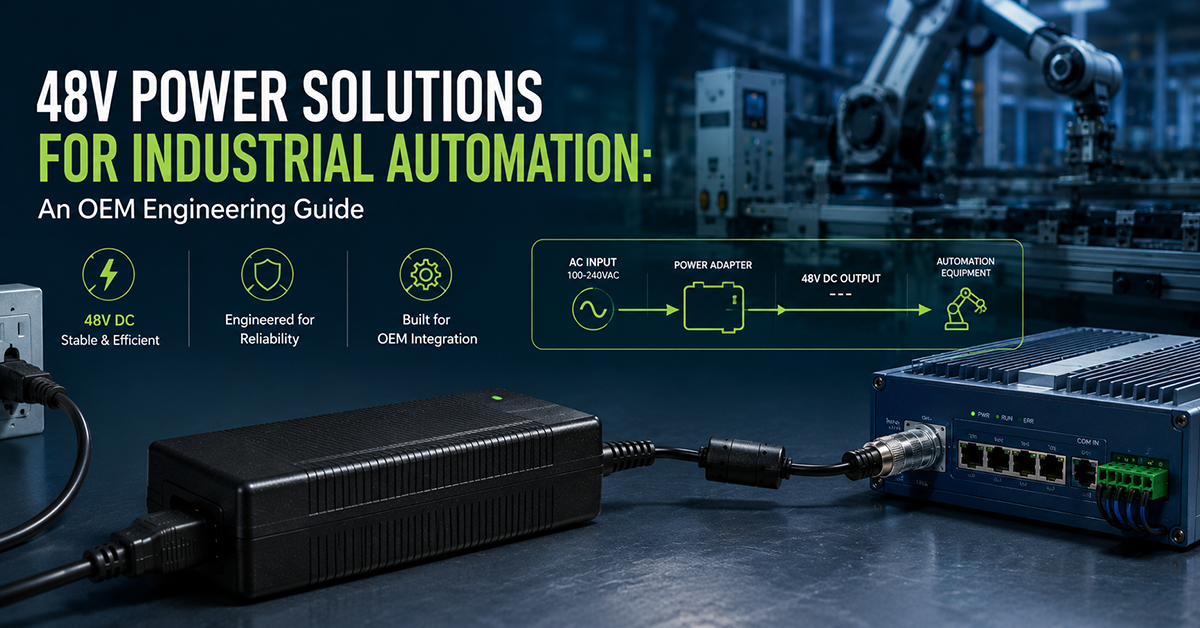
The shift from 24V to 48V power architecture is one of the most significant trends in industrial automation. Driven by increasing power demands from networked sensors, actuators, and edge computing hardware, 48V systems offer lower distribution losses, improved power density, and compatibility with Power over Ethernet (PoE/PoE++) standards.
This article covers the engineering rationale, system design considerations, compatibility with existing 24V infrastructure, and practical selection criteria for OEMs evaluating 48V power solutions for automation equipment.
Why Is 48V Power Architecture Gaining Traction in Industrial Automation?
Industrial automation has historically operated at 24VDC for control systems. The 24V standard originated from the need for safe low-voltage operation with sufficient headroom above standard semiconductor thresholds. However, two converging trends are challenging the 24V paradigm:
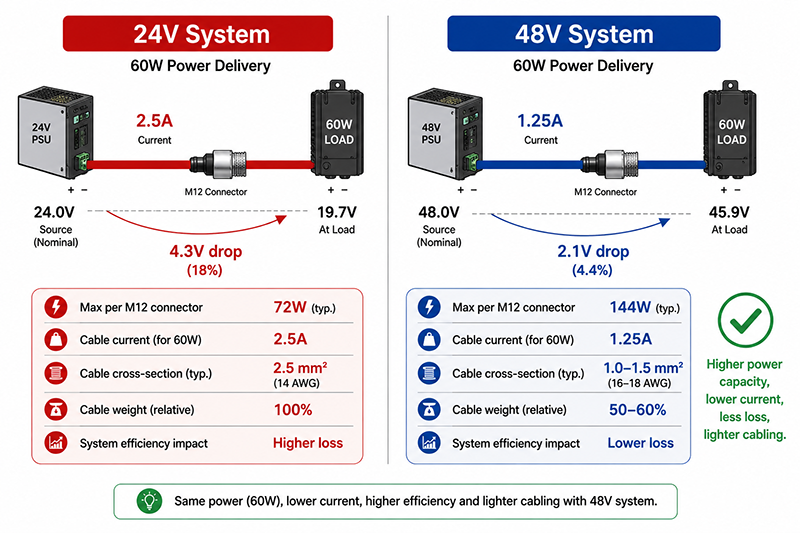
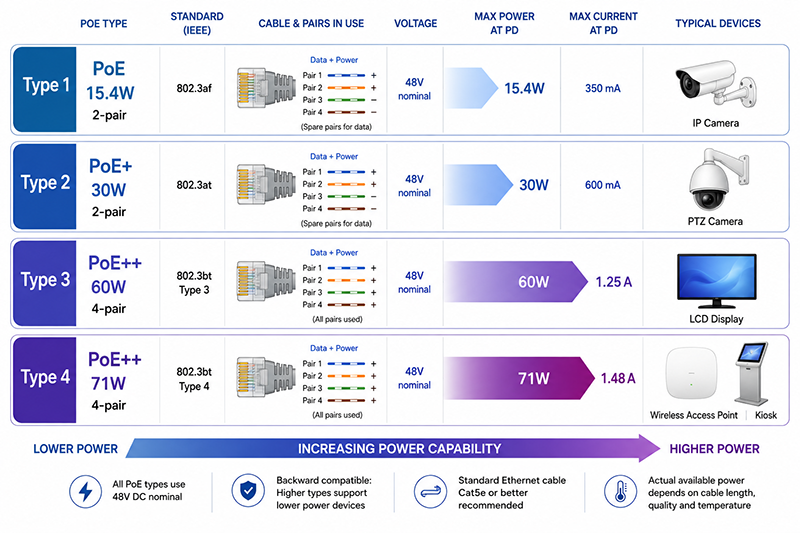
- Power demand per device is rising. A modern IO-Link master with eight connected smart sensors can draw 50W or more. A PoE++ powered device (IEEE 802.3bt) requires up to 71W per port. These loads would require 3A per port at 24V — impractical for standard M12 connectors and cable gauges.
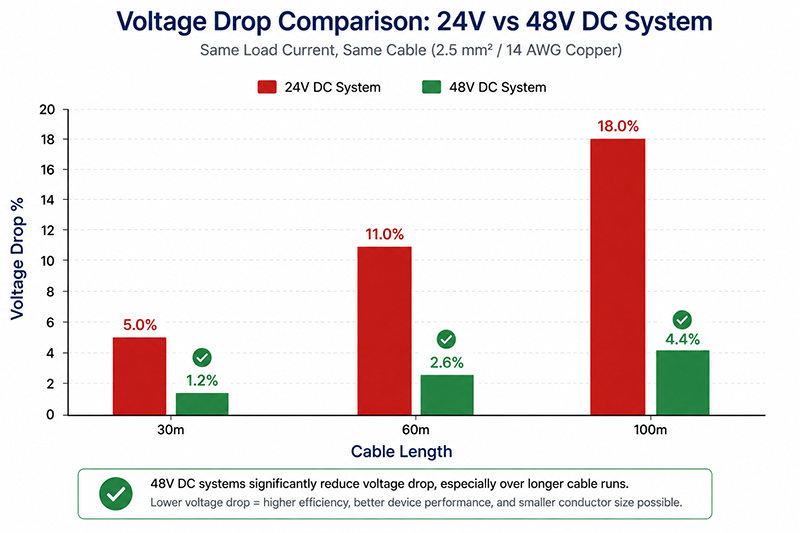
- Distribution losses at 24V become prohibitive at scale. A 100m cable run delivering 60W at 24V requires 2.5A, causing a voltage drop of 2.5–5V depending on cable gauge. At 48V, the same power requires 1.25A, reducing voltage drop by approximately 75%.
| Parameter | 24V System | 48V System | Benefit |
| Current for 60W load | 2.5A | 1.25A | 50% lower |
| Voltage drop (100m, 18AWG) | 4.3V (18%) | 2.1V (4.4%) | 4× improvement |
| Cable copper weight | 100% | 50–60% | Significant savings |
| Max power per M12 connector | 72W (3A limit) | 144W (3A limit) | 2× capacity |
| PoE++ compatibility | Not supported | Full (IEEE 802.3bt) | Yes |
| Component availability | Mature ecosystem | Growing ecosystem | Transitioning |
| Safety voltage classification | SELV (≤60VDC) | SELV (≤60VDC) | Same class |
Why This Matters
- 48V systems deliver 4× more power through the same cable gauge compared to 24V, enabling longer cable runs and higher device counts without distribution infrastructure upgrades.
- All four PoE standards — Type 1 (802.3af, 15.4W), Type 2 (802.3at/PoE+, 30W), Type 3 (802.3bt, 60W), Type 4 (802.3bt, 71W) — are 48V-based, making 48V the native voltage for powered Ethernet devices in industrial networks.
- SELV classification (≤60VDC) means 48V systems require the same safety precautions as 24V — no additional safety engineering is needed for operator access.
What OEMs Should Do Now
- Audit the total power demand per network segment in your next-generation equipment — if any segment exceeds 60W, evaluate a 48V segment as an alternative to multiple 24V power feeds.
- For equipment with PoE++ powered devices (cameras, displays, access points), specify a 48V power supply as the primary input rather than converting from 24V.
- Consider hybrid architectures: maintain 24V for control logic and low-power sensors, while distributing 48V for high-power actuators, heaters, and PoE++ ports.
How Does 48V Architecture Compare with Existing 24V Infrastructure?
Most industrial facilities have extensive 24V distribution — control cabinets with 24V DIN rail power supplies, terminal blocks rated for 24V, and field wiring designed for 24V sensors and actuators. Transitioning to 48V raises practical compatibility questions.
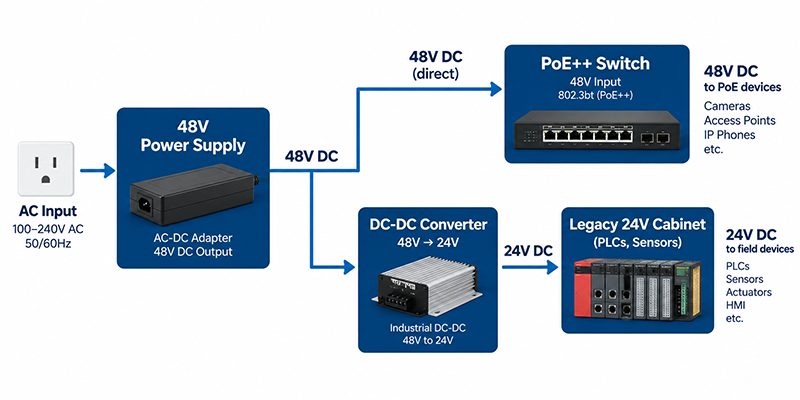
The most common approach is a hybrid architecture: a 48V primary distribution bus powers high-load branches (PoE++ switches, motor drives, heaters, lighting), while local DC-DC converters (48V-to-24V) power legacy 24V control components. This avoids rewiring existing 24V infrastructure while capturing the distribution benefits of 48V.
| Transition Approach | Pros | Cons | Best For |
| Full 48V | Maximum efficiency, lowest wiring cost | Requires 48V-rated components throughout | New greenfield installations |
| Hybrid 48V/24V | Backward compatible, phased transition | Higher complexity, conversion losses (~5–8%) | Brownfield upgrades |
| 24V-to-48V boost at load | Upgrades existing 24V supply | Boost stage adds cost per load, lower overall efficiency | Retrofitting existing equipment |
| Centralized 48V with local 48V-to-24V | Clean architecture, single power source | DC-DC converters at every control cabinet add cost | Mixed new-build facilities |
Why This Matters
- DC-DC conversion from 48V to 24V adds 5–8% efficiency loss but enables a unified power distribution architecture.
- Most industrial 24V components (PLCs, HMI panels, I/O modules) have a maximum input voltage range of 28.8–30V and cannot be powered directly from a 48V bus — DC-DC conversion is required.
- The total cost of a hybrid 48V/24V system is typically 10–20% lower than an all-24V system when distribution cabling savings are factored in for installations longer than 50m.
What OEMs Should Do Now
- For new equipment designs with mixed power loads (control + networked + actuation), specify a 48V primary input with onboard 48V-to-24V conversion for control logic.
- Include DC-DC converter efficiency in your system power budget — a 48V design requires 5–8% more input power to deliver the same 24V load as a direct 24V feed.
- When retrofitting existing 24V equipment to operate in a 48V distribution environment, verify the maximum input voltage of each 24V-rated component before connecting.
What Are the Power Budget Calculations for 48V Industrial Systems?
A systematic power budget calculation for a 48V industrial automation system follows three steps:
Step 1 — Catalog loads by voltage requirement
- 48V native loads: PoE++ switches (up to 71W per port), motor drives, fans, solenoids, heaters
- 24V legacy loads: PLCs, HMI panels, I/O modules, analog sensors, indicators
- Loads requiring DC-DC conversion: all 24V loads in a 48V system
Step 2 — Calculate 48V bus power (P_48)
- P_48 = Σ(native_48V_loads) + Σ(converted_24V_loads ÷ η_DCDC)
- η_DCDC = 0.92–0.95 (typical 48V-to-24V converter efficiency)
Step 3 — Add margin and capacity factors
- Continuous load margin: add 20% for startup transients and future expansion
- Peak load capacity: the 48V supply should handle 150% rated for 10ms to accommodate motor inrush
- Temperature derating: apply the supply’s derating curve at the cabinet ambient temperature
Example: An automation cabinet with:
- One PoE++ switch (4 ports × 60W = 240W at 48V)
- One 24V PLC rack with I/O (120W at 24V)
- Two 24V servo drives (250W each at 24V)
P_48 = 240W (native) + (120W + 500W) ÷ 0.93 ≈ 240W + 667W ≈ 907W
With 20% margin: 907W × 1.2 ≈ 1088W → specify a 1100W or 1200W 48V supply
Why This Matters
- DC-DC conversion losses are often overlooked in power budget calculations — a 600W 24V load requires approximately 650W from a 48V bus after conversion losses.
- PoE++ switches draw their full per-port power budget regardless of whether each port is connected to a powered device — always budget per-port based on the switch’s power budget, not the connected devices’ consumption.
- Motor drives and solenoids draw peak currents during starting that can exceed continuous ratings by 3–5× — the 48V supply’s peak current capability must be verified, not just its continuous rating.
What OEMs Should Do Now
- Create a load inventory for each automation cabinet, separating 48V-native and 24V-legacy loads.
- Use the DC-DC converter efficiency curve (not just the headline efficiency) in power budget calculations — converter efficiency typically drops at light load (below 20%).
- Verify the 48V power supply’s peak current specification matches the worst-case simultaneous startup load.
What Regulatory and Safety Standards Apply to 48V Industrial Power?
48V power supplies for industrial automation fall under the same safety framework as 24V supplies because both operate below the 60VDC SELV (Safety Extra-Low Voltage) threshold.
Key standards for 48V industrial power:
- IEC/EN 62368-1 or IEC/EN 60950-1: Safety for information technology and industrial equipment
- IEC/EN 61000-6-2: Industrial immunity (EMC)
- IEC/EN 61000-6-4: Industrial emissions (EMC)
- UL 508: Industrial control equipment (North America)
- IEEE 802.3bt: PoE++ power delivery specification (defines 48V–57V range)
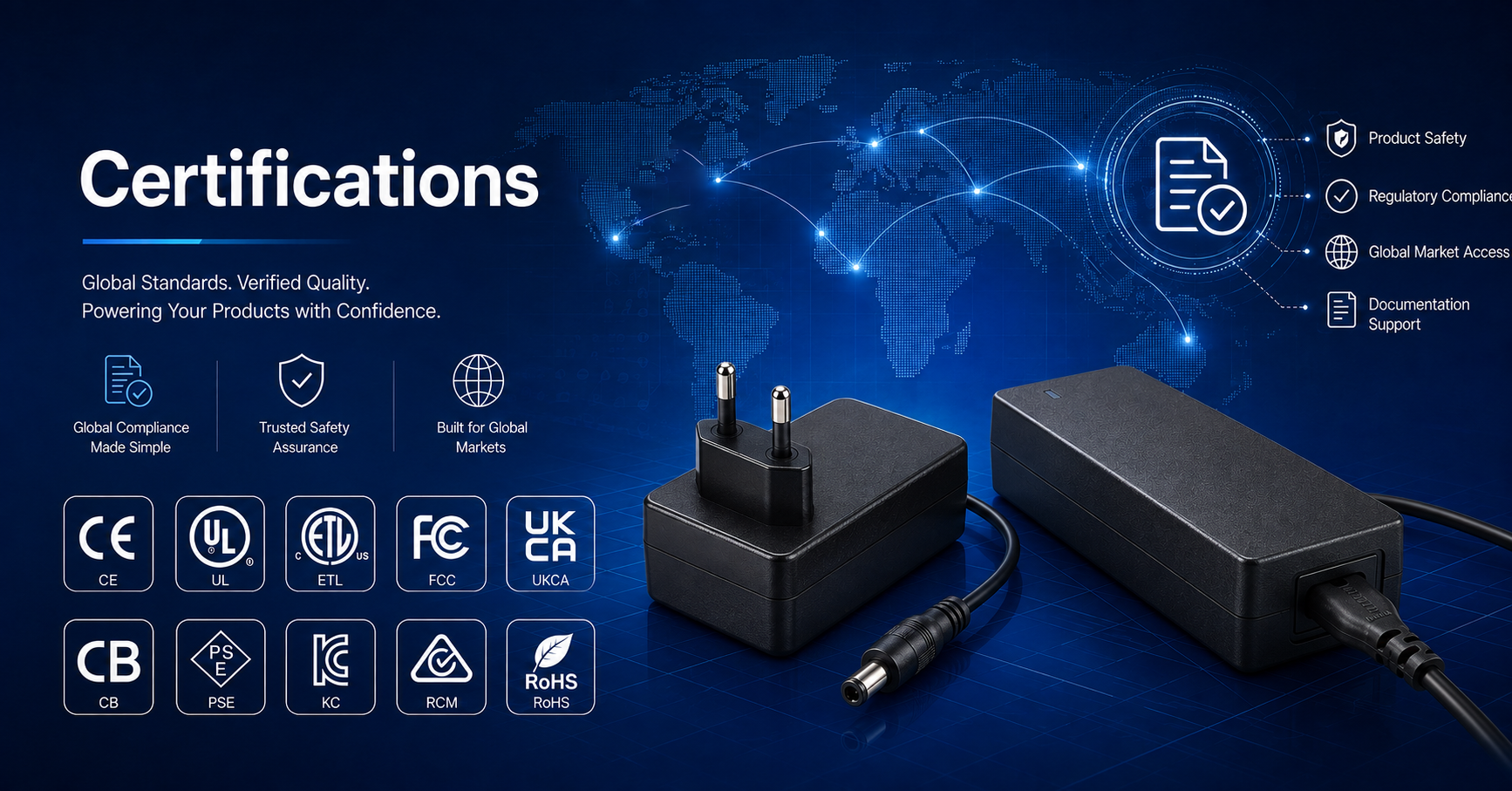
Certifications available depending on model, application and target market. A 48V power supply for industrial use should carry at minimum CE (EU), UL/ETL (US), or equivalent certification for the target market.
Why This Matters
- 48V remains within SELV limits (≤60VDC), meaning same safety engineering requirements as 24V — no high-voltage protection or special operator training required.
- PoE++ equipment operating at 48V–57V is classified as SELV but requires specific connector and cable ratings to handle the higher current safely.
- EMC compliance for 48V systems may differ from 24V because higher distribution voltage can couple more noise into adjacent control cables — shielded cabling or physical separation may be required.
What OEMs Should Do Now
- Verify that the 48V power supply carries the relevant safety and EMC certifications for your target markets.
- For PoE++ applications, specify a power supply with output voltage in the 52–56V range (within IEEE 802.3bt limits) to maximize power delivery per port after cable losses.
- Request the power supply manufacturer’s EMC test report for radiated and conducted emissions with the 48V output operating at full load.
CONCLUSION
48V power architecture offers significant advantages over 24V for modern industrial automation: lower distribution losses, higher power capacity per cable, native PoE++ compatibility, and reduced copper weight. Hybrid 48V/24V systems enable a practical transition path that preserves existing 24V control infrastructure while capturing the benefits of 48V distribution for high-power loads. Power budget calculations must account for DC-DC conversion losses and PoE++ budget allocation to avoid undersizing the supply.
Certifications available depending on model, application and target market.
Frequently Asked Questions
When should 48V be chosen over 24V for a new industrial system?
When distribution distance, cable cross-section or total load make the lower current worthwhile — typically where a segment exceeds what a single 24V feed can carry comfortably. 24V remains the working standard for PLC I/O and field sensors, so the decision is usually per segment rather than for the whole machine.
How should a PoE++ switch be budgeted?
Budget per port against the switch’s power budget, not against the sum of connected devices. A PoE++ switch reserves its per-port allowance whether or not every port is populated, so the supply sizing follows the switch specification.
How do I power legacy 24V devices from a 48V bus?
Through local DC-DC conversion. Most 24V control components have input ranges that do not accept a 48V bus directly, and conversion losses belong in the power budget as well as the wiring calculation.
What cable advantage does 48V actually provide?
For the same power, current is halved compared with 24V, so resistive drop and copper cross-section fall accordingly. The cable still has to be sized for the installation — ambient, bundling and routing all apply.
Is 48V still a safety-extra-low-voltage system?
48V nominal remains within the SELV range (≤60 V DC), so the safety approach is comparable to 24V. Connector, cable and protection ratings still have to be specified for the higher voltage.
Related Resources
🔌 Related Products
🏭 Related Applications
Industrial Control Power Solutions
Power solutions for PLC, CNC, servo and automation equipment
📖 Related Guides
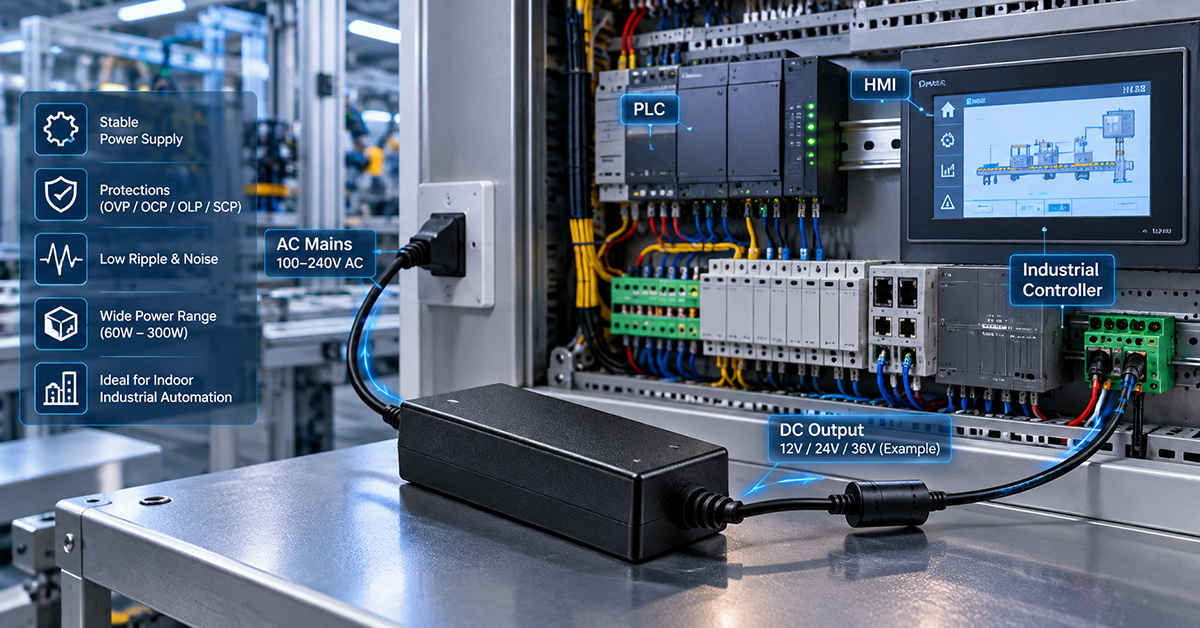
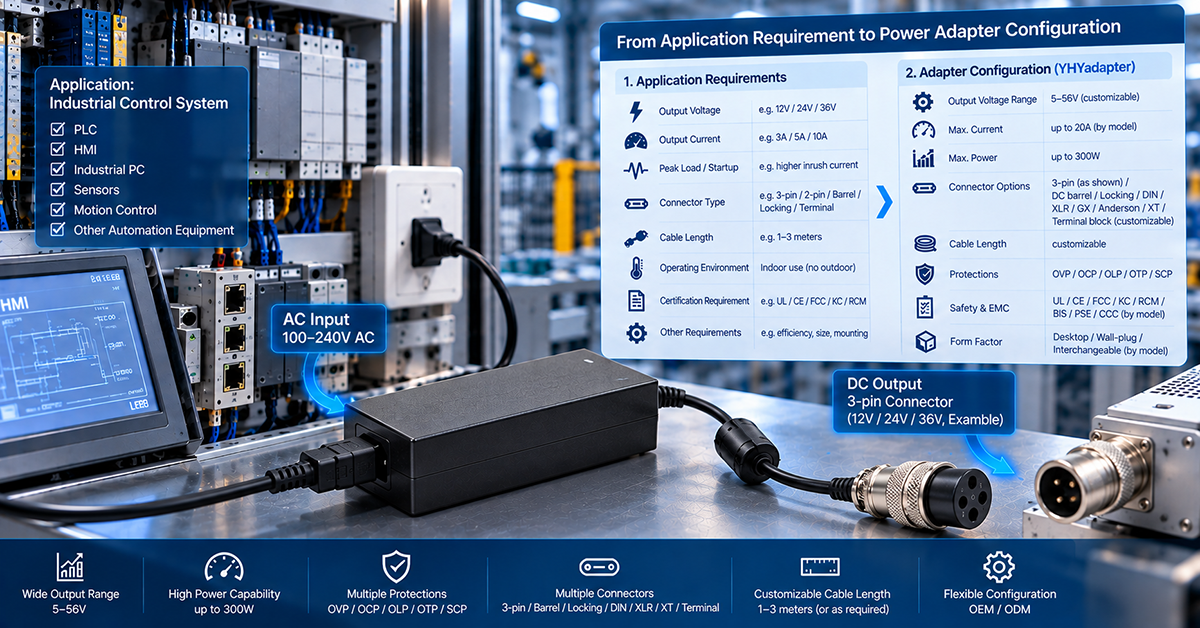
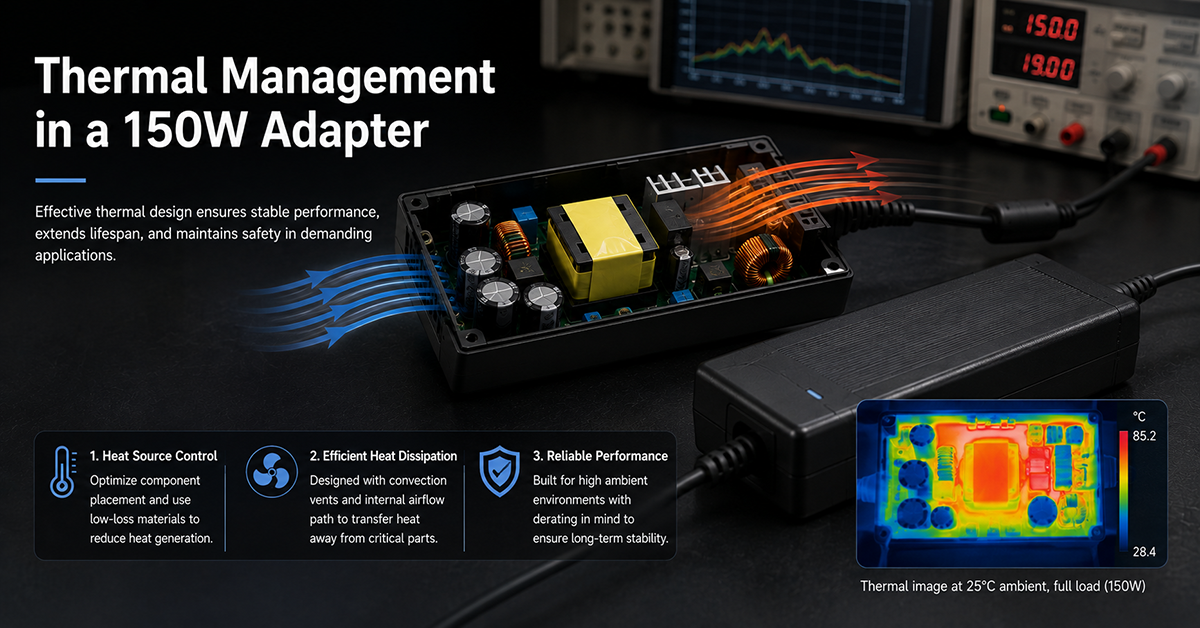
Thermal Management in a 150W Adapter
Fanless thermal management in a compact 150W adapter
✅ Related Certifications
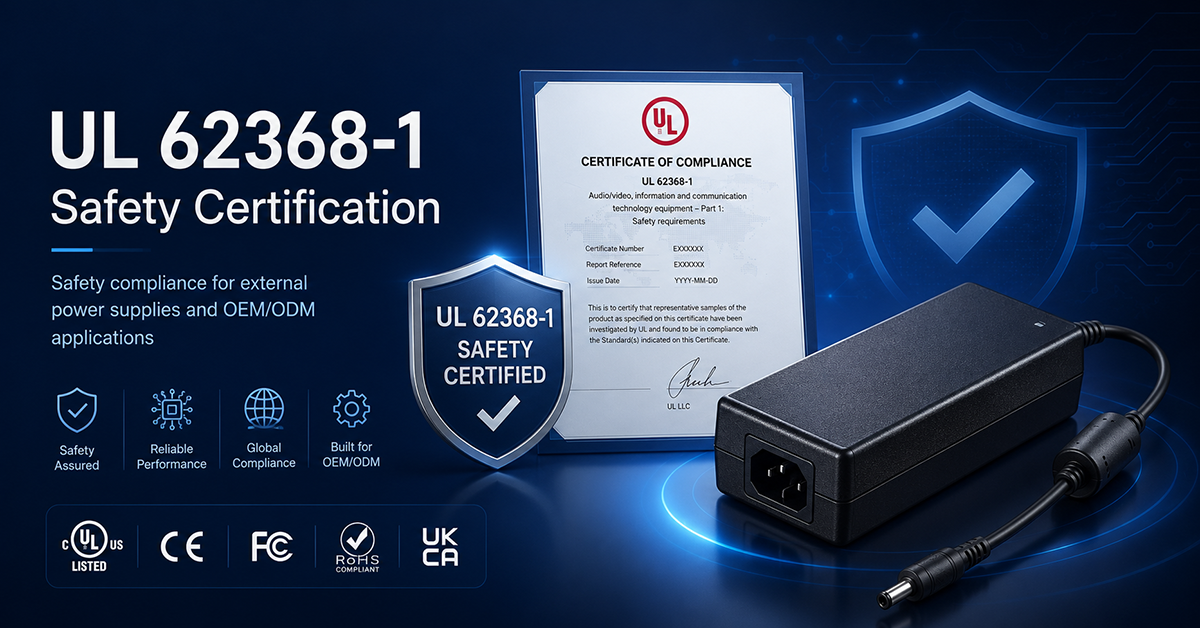
UL 62368-1 Safety Certification
Safety standard covering connector creepage/clearance, temperature rise, and strain relief requirements for IT/AV equipment power adapters.