
Introduction
When specifying an external power supply for your OEM product, efficiency rating is rarely the first specification engineers check—but it is often the one that creates the most downstream impact. A single percentage point of efficiency gain translates into measurable reductions in heat dissipation, enclosure cost, regulatory burden, and total cost of ownership over the product lifecycle.
Today’s regulatory landscape is shaped by multiple overlapping standards: the U.S. Department of Energy (DoE) Level VI, the European Union’s ErP Directive (Lot 6 and Lot 7), the California Energy Commission (CEC) requirements, and voluntary frameworks like the European CoC (Code of Conduct) Tier 2. Understanding which tier applies to your market, your power range, and your product category is critical to avoiding redesign cycles and market access delays.
This guide walks OEM procurement engineers through the technical thresholds, compliance strategies, and real-world trade-offs of modern efficiency standards for AC-DC external power supplies.
The Efficiency Standards Landscape
DoE Level VI — The Baseline
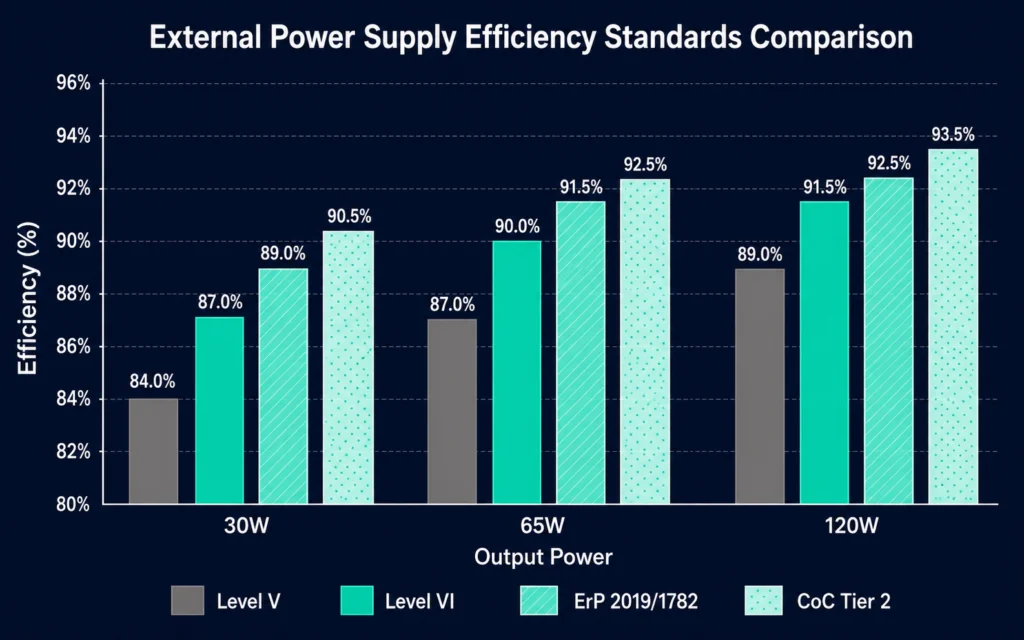
Since February 2016, the U.S. DoE has required Level VI efficiency for all external power supplies sold in the United States. This standard replaced Level V and imposed stricter limits on both average active-mode efficiency and no-load power consumption.
| Power Level | Average Efficiency (Level VI) | Max No-Load (Level VI) |
|---|---|---|
| ≤ 1 W | ≥ 0.480 × P + 0.140 | ≤ 0.100 W |
| 1 W – 49 W | ≥ 0.0626 × ln(P) + 0.622 | ≤ 0.100 W |
| 49 W – 250 W | ≥ 0.870 | ≤ 0.210 W |
| > 250 W | ≥ 0.875 | ≤ 0.500 W |
Where P = nameplate output power in watts.
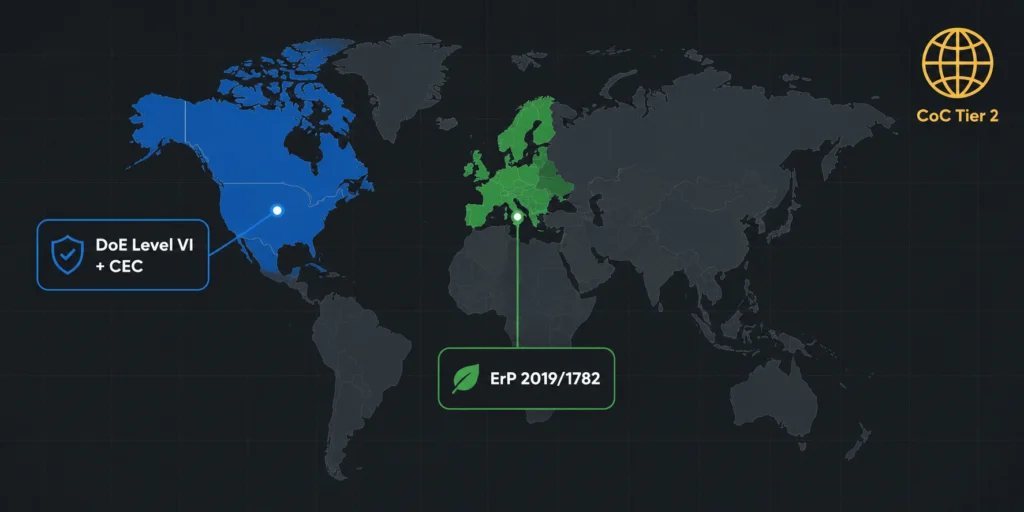
Level VI is now the legal minimum for U.S. market entry. Any power supply destined for North American OEM equipment must carry Level VI certification or be energy-efficiency exempt (e.g., some medical devices and low-voltage DC-DC converters).
ErP Directive (EU) Lot 6 & Lot 7
The European Union’s ErP (Energy-related Products) Directive 2009/125/EC covers external power supplies under Commission Regulation (EU) 2019/1782, commonly referred to as the Lot 6 and Lot 7 regulations:
- Lot 6 — External power supplies sold as standalone components (the most relevant category for OEMs).
- Lot 7 — External power supplies embedded in or shipped with end products (applies to complete OEM assemblies).
The current ErP tier, effective from April 2020, sets active-mode efficiency thresholds roughly equivalent to DoE Level VI, with no-load limits slightly tighter in some power bands:
| Power Band | ErP Average Efficiency (2019/1782) | No-Load Limit |
|---|---|---|
| ≤ 1 W | ≥ 0.480 × P + 0.140 | ≤ 0.100 W |
| 1 W – 49 W | ≥ 0.0626 × ln(P) + 0.622 | ≤ 0.100 W |
| 49 W – 250 W | ≥ 0.870 | ≤ 0.210 W |
| > 250 W | ≥ 0.875 | ≤ 0.500 W |
Key difference: EU ErP no-load limits are more aggressive than DoE Level VI in the mid-to-high power range. An adapter that passes Level VI may fail ErP on standby consumption alone.
CoC Tier 2 — The Voluntary Premium Tier
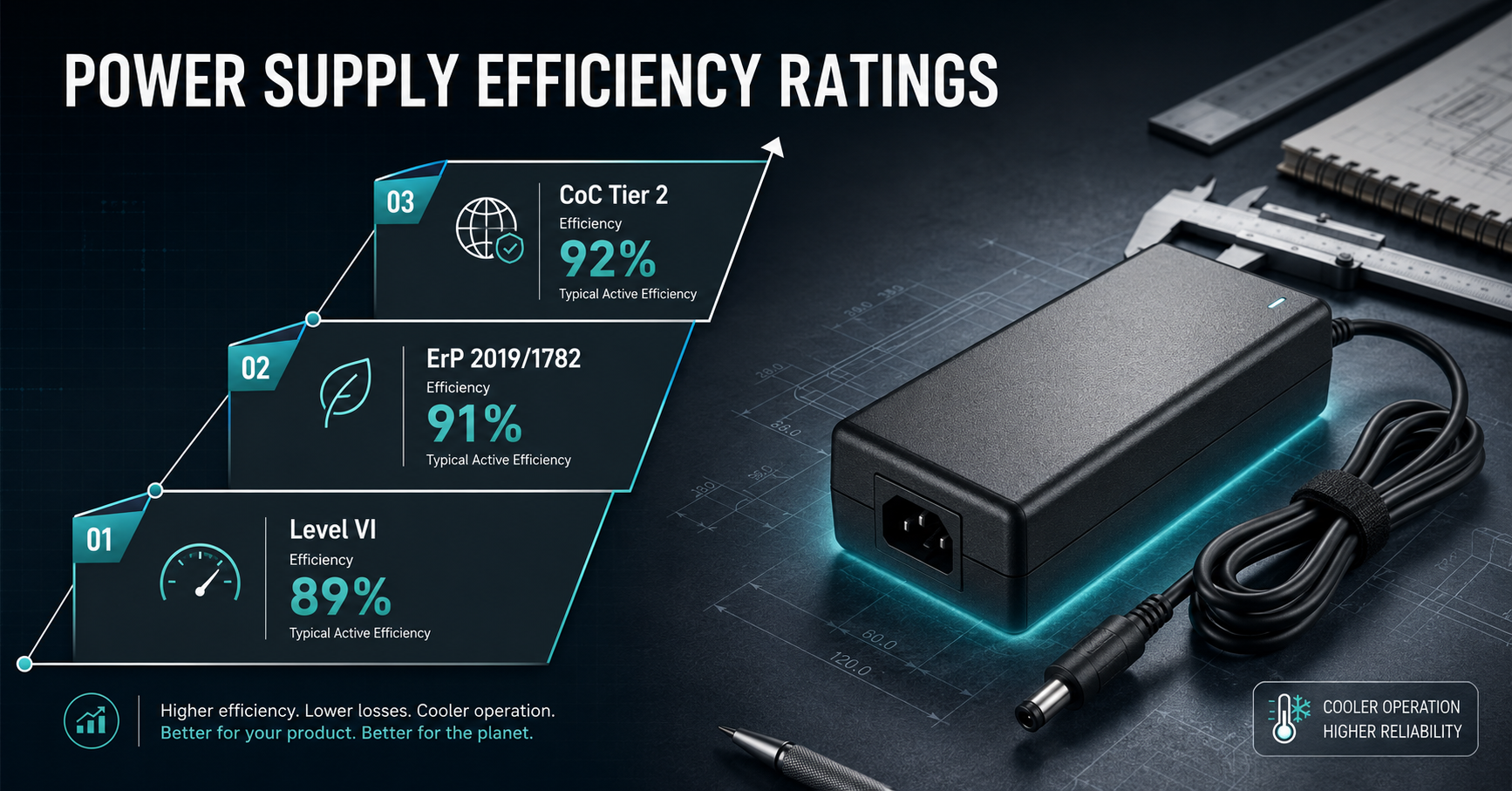
The European Code of Conduct (CoC) on Energy Efficiency of External Power Supplies is a voluntary framework, but major OEM brands increasingly specify it as a requirement. CoC Tier 2 sets approximately 2–3 percentage points higher efficiency than Level VI:
- Requires ≥ 89.0% average active-mode efficiency at 75–100% load for adapters ≥ 75 W
- No-load standby capped at ≤ 0.075 W for 1–250 W units
- Many Tier 2 designs employ synchronous rectification, advanced GaN (gallium nitride) FETs, or quasi-resonant flyback topologies
If your OEM product targets EU ecodesign compliance plus brand sustainability goals, CoC Tier 2 is the practical target.
California CEC — State-Level Additional Requirements
California’s Title 20 appliance efficiency regulations incorporate DoE Level VI as a baseline but add mandatory compliance documentation and registration through the MAEDbS (Modernized Appliance Efficiency Database System). Products sold in California—which effectively means most U.S.-distributed products—must be registered with a CEC-compliant mark.
Practical OEM Considerations
Heat, Enclosure, and Lifetime
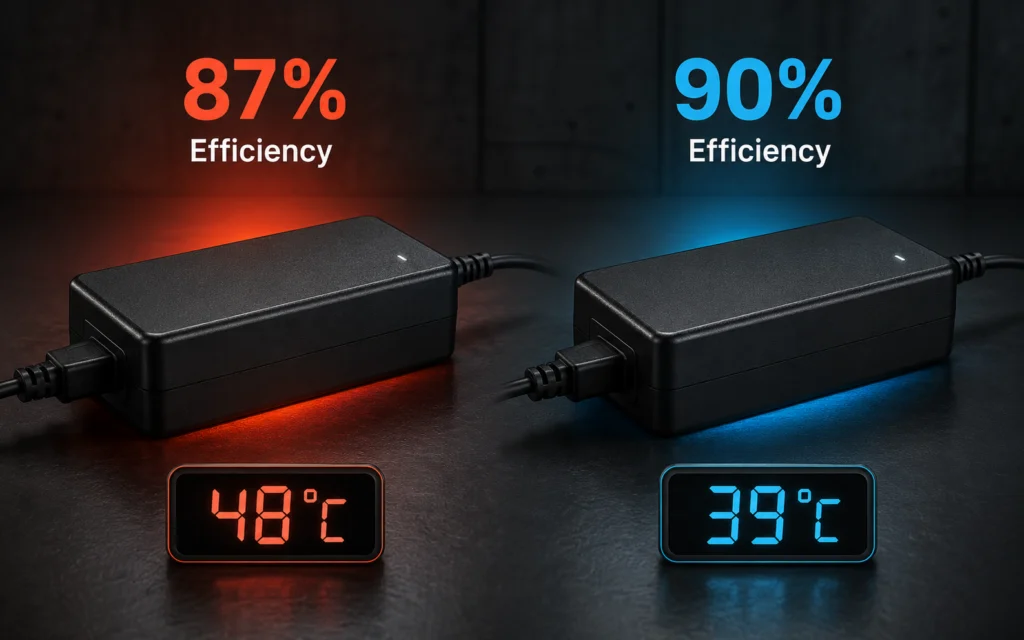
Efficiency isn’t just an environmental metric—it is a thermal one. A 90%-efficient 120 W adapter dissipates 12 W of heat internally. An equivalent adapter at 87% efficiency dissipates 15.6 W—a 30% increase in thermal load. That difference directly impacts:
- Enclosure temperature rise — A hotter adapter derates output current, may require vented enclosures, and accelerates electrolytic capacitor aging.
- MTBF (Mean Time Between Failures) — Every 10 °C drop in internal temperature roughly doubles capacitor lifetime per the Arrhenius model.
- Customer experience — Cooler adapters are safer to touch and less likely to trigger thermal shutdown in warm environments.
Selecting a higher-efficiency tier adapter often allows a one-size-down enclosure (e.g., an 80 W adapter in a 65 W mechanical footprint) because heat dissipation is lower.
No-Load Standby: The Hidden Compliance Trap
No-load power consumption has tightened across all standards. A 65 W adapter with a no-load draw of 0.210 W (Level VI maximum) consumes approximately 1.84 kWh per year if left plugged in continuously. The same adapter at 0.075 W (ErP-compliant) uses only 0.66 kWh per year.
While these numbers appear small at the unit level, multiply across thousands of deployed units and the difference becomes material—both for the OEM’s Scope 3 carbon reporting and for end-user electricity costs. Many OEM procurement RFQs now specify no-load ≤ 0.075 W as a hard requirement, effectively mandating ErP Lot 6 compliance even for U.S.-only products.
📞 CTA Block — Need Help Specifying the Right Efficiency Tier?
Our engineering team provides free efficiency-tier assessments for OEM projects. We’ll review your power requirements, target markets, and volume to recommend the optimal certification level — whether Level VI, ErP, or CoC Tier 2.
- Request a Quote → — Get a customized quotation for your OEM project
- Talk to an Engineer → — Discuss your technical requirements with our design team
Topology Choices and Their Efficiency Profiles
Different switching topologies offer different efficiency trajectories across the load curve:
| Topology | Best Efficiency Range | Typical Peak Efficiency | Cost Index | Common Application |
|---|---|---|---|---|
| Flyback (QR) | 30–100% load | 87–89% | 1.0× (baseline) | 5–65 W adapters |
| Flyback (ACF) | 10–100% load | 89–91% | 1.2–1.4× | 20–150 W adapters |
| LLC Resonant | 40–100% load | 91–94% | 1.5–2.0× | 90–300 W adapters |
| GaN-based | 5–100% load | 92–96% | 2.0–2.5× | 45–240 W adapters |
For an OEM targeting CoC Tier 2 at 65 W, a quasi-resonant flyback with synchronous rectification is usually sufficient. For ≥ 90 W, moving to an active-clamp flyback (ACF) or LLC topology is recommended.
FAQ
Q1: Can I use a Level VI adapter in the EU?
A: Level VI itself is not a recognized EU compliance mark. Your product must carry CE marking compliant with ErP Directive 2019/1782 (Lot 6). While the efficiency curves are similar, the no-load limits and documentation requirements differ. You need a separate model variant or a globally certified adapter that carries both marks.
Q2: What happens if my adapter fails an efficiency audit?
A: Regulatory consequences depend on the jurisdiction. In the EU, non-compliant products can be removed from the market, and the manufacturer may face fines proportional to sales volume. In California, uncertified products trigger penalties under Title 20 and can be blocked from sale. Most OEMs protect themselves by requiring third-party certification reports (e.g., UL or Intertek) at time of sample approval.
Q3: Does higher efficiency always mean higher cost?
A: Not linearly. Moving from Level V to Level VI typically adds 3–8% to the power supply BOM cost. Moving from Level VI to CoC Tier 2 adds 5–15% depending on power level and topology. However, the total system cost may decrease due to smaller enclosures, simpler thermal management, and longer product lifespan. We recommend a TCO (Total Cost of Ownership) analysis over a 3–5 year deployment horizon.
Q4: Do medical power supplies follow the same efficiency standards?
A: Medical-grade external power supplies are generally exempt from DoE Level VI and ErP Lot 6 requirements under current regulations, provided they are certified to IEC 60601-1 and properly labeled as medical devices. However, many OEMs voluntarily specify higher efficiency to reduce thermal stress in medical enclosures. Learn more in our Medical Device Power Guide →.
Q5: What documentation should I request from my power supply vendor?
A: At minimum, request: (1) a third-party test report showing average active-mode efficiency and no-load power at nominal input voltage, (2) the efficiency data at 25%, 50%, 75%, and 100% load, (3) DoE Level VI or ErP certificate, (4) CEC MAEDbS registration number (for U.S. distribution), and (5) a declaration of conformity with reference to the applicable regulation. For medical or industrial applications, request separate reports per certification standard.
Key Takeaways
- DoE Level VI is the legal minimum for U.S. market entry; ErP 2019/1782 is required for the EU.
- CoC Tier 2 adds 2–3 percentage points of efficiency over Level VI and is increasingly specified by premium OEM brands.
- No-load standby limits are the most commonly overlooked compliance trap — ErP caps at 0.075 W vs Level VI’s 0.210 W.
- Thermal benefits of higher efficiency are significant: a 3-point efficiency gain can reduce internal heat dissipation by 30%.
- Higher-efficiency adapters may allow downsized enclosures, reducing total system cost despite a higher BOM.
- Request third-party test reports at sample approval stage — don’t rely on vendor self-declarations.
Conclusion: Setting Your Efficiency Target
For most OEM products entering North America and the EU, the pragmatic recommendation is:
- Minimum standard: DoE Level VI + ErP 2019/1782 — covers legal market access in both regions.
- Recommended standard: Add CEC compliance and no-load ≤ 0.075 W — future-proofs against regulatory tightening.
- Premium standard: CoC Tier 2 — required by top-tier OEM brands and essential for sustainability-marketed products.
The gap between Level VI and CoC Tier 2 in active-mode efficiency is roughly 2–3 points—a delta that translates into tangible thermal and reliability benefits. As regulations continue to converge toward the EU’s stricter standby limits, choosing a higher tier today avoids obsolescence tomorrow.
Need help selecting the right efficiency tier for your OEM application?
- Request a Quote → — Submit your specifications for a detailed quotation
- Talk to an Engineer → — Discuss your technical requirements with our design team
About the Author
YHYadapter Engineering Team — Specialists in high-efficiency AC-DC power solutions for OEM applications. With over 15 years of experience designing and manufacturing external power supplies for industrial, medical, and commercial equipment, the YHYadapter engineering team has helped hundreds of OEMs navigate global efficiency compliance requirements.