
Powered speakers and PA amplifiers place different demands on the external power supply compared to other audio equipment. The amplifier stage draws current in proportion to the audio signal, creating dynamic load variations that the power supply must handle without audible degradation. The power supply’s ability to deliver peak current for transients, maintain stable voltage under varying load, and manage thermal dissipation directly affects the speaker’s output power, distortion, and reliability.
This guide covers power supply considerations for powered speakers and PA amplifiers using external AC/DC adapters: power budget calculation for amplifier and DSP stages, transient response requirements, thermal management, form factor selection, and protection feature matching.
Power Budget Calculation for Powered Speakers
A powered speaker typically contains three power-consuming stages: the amplifier, the DSP/crossover, and (in some designs) a wireless receiver or network interface. Each stage has distinct power requirements that must be included in the adapter selection budget.
Amplifier Power Requirements
The amplifier’s power consumption depends on its output power rating, efficiency, and the program material. A simple estimation approach:
For a Class-D amplifier module rated at 100W continuous output into 8Ω, with 85% efficiency:
- Output power: 100W
- Amplifier losses (15%): ~18W
- Total amplifier draw: ~118W from the power supply
Amplifier power consumption varies with the audio signal:
- Average (program) power: typically 20–30% of rated power for music
- Peak (transient) power: up to 100% of rated power for short durations (10–100ms)
- Idle power: 3–10W depending on amplifier design
DSP and Control Power
The DSP, ADC/DAC, crossover filters, and control electronics typically require 3–15W, depending on processing complexity. This stage is fed from a regulated voltage (typically 5V or 3.3V) derived from the adapter’s output through a DC-DC converter or LDO.
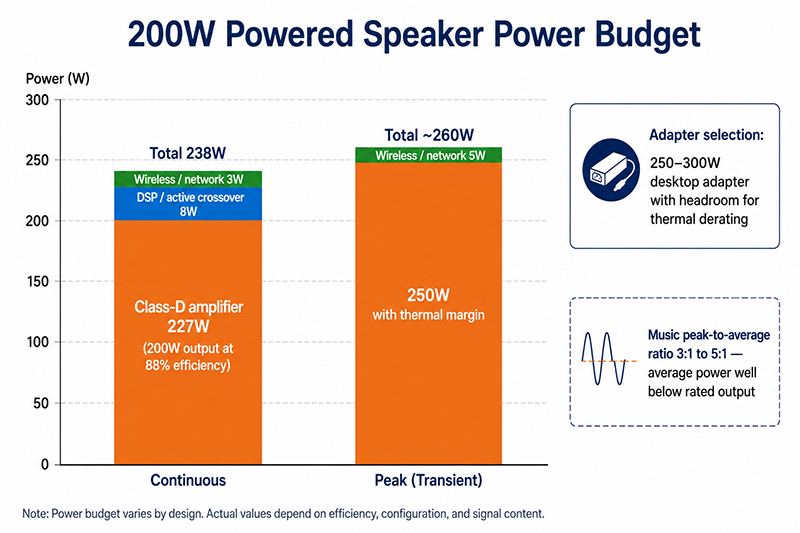
Total Power Budget Example (200W Powered Speaker)
| Stage | Continuous | Peak (Transient) |
|---|---|---|
| Class-D amplifier (200W output, 88% efficiency) | 227W | 250W (with thermal margin) |
| DSP / active crossover | 8W | 8W |
| Wireless / network interface (if applicable) | 3W | 5W |
| Total | 238W | ~260W |
For this speaker, a 250–300W desktop adapter would be selected, accounting for the continuous power requirement and providing headroom for thermal derating.
Why This Matters
- The power budget must distinguish between continuous (RMS) and peak power. The adapter must be rated for the continuous power draw, with peak transients handled by the adapter’s overload capability or the speaker’s bulk storage capacitance.
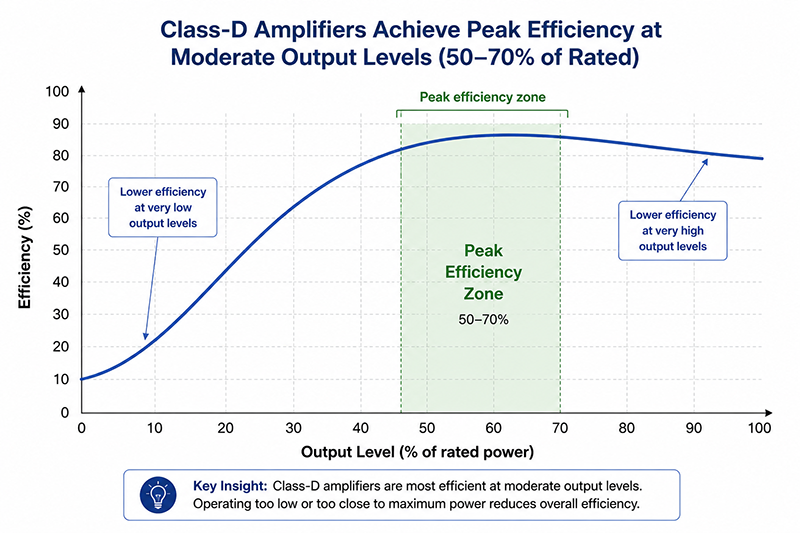
- Amplifier efficiency varies with output level. Class-D amplifiers achieve peak efficiency at moderate output levels (typically 50–70% of rated power) and lower efficiency at very low or very high output levels.
- The DSP and control stage power draw is constant regardless of audio output level. This should be subtracted from the adapter’s available power before calculating the amplifier headroom.
What OEMs Should Do Now
- Calculate the total system power budget using the amplifier’s rated output, efficiency at the expected operating level, and the DSP/control power draw. Add 20–30% margin for thermal derating and component tolerance.
- Verify the adapter’s continuous current rating at the expected operating temperature, not just at 25°C. Adapters derate at elevated temperatures.
- Consider the peak-to-average ratio of the program material. For music, a 3:1 to 5:1 peak-to-average ratio is common, meaning the amplifier draws average power well below its maximum rated output.
Transient Response and Bulk Capacitance
Audio signals contain transient peaks that can demand 3–5× the average power for milliseconds. The power supply’s ability to deliver these peaks without voltage sag or clipping depends on the adapter’s transient response and the speaker’s onboard bulk storage capacitance.
Transient Current Demands
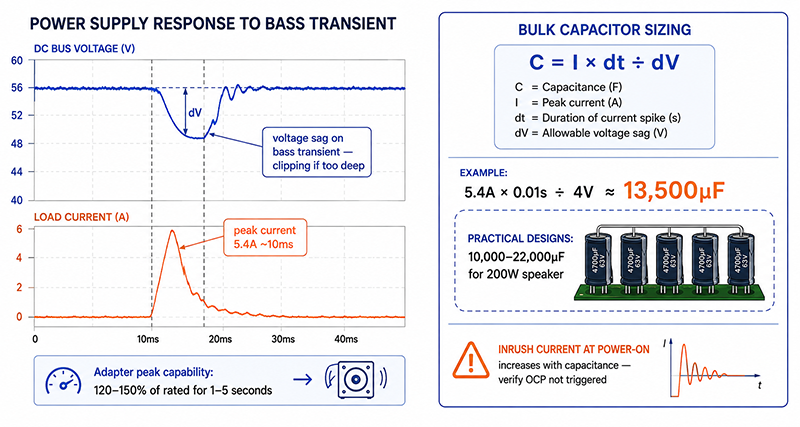
A 200W powered speaker playing music with a 4:1 peak-to-average ratio may draw:
- Average current: ~2A from a 48V adapter (96W average)
- Peak current: ~5.4A (260W peak, ~10ms duration)
Bulk Capacitance Sizing
Bulk storage capacitance inside the powered speaker supplements the adapter’s transient response. The required capacitance depends on:
- Adapter output voltage
- Minimum allowable voltage during a transient
- Peak current demand
- Transient duration
Example: For a 48V adapter, 5.4A peak transient, 10ms duration, and allowing a 4V drop (to 44V minimum):
C = I × dt / dV = 5.4A × 0.01s / 4V ≈ 13,500µF
Practical designs may use 10,000–22,000µF for a 200W powered speaker, depending on the amplifier module’s voltage tolerance and the adapter’s transient response.
Why This Matters
- Insufficient bulk capacitance causes voltage sag on bass transients, resulting in audible distortion (clipping) at the onset of low-frequency peaks.
- The adapter’s transient response and the speaker’s bulk capacitance work together. A fast-responding adapter with 5% transient deviation requires less onboard capacitance than a slower adapter with 10% deviation.
- Adding bulk capacitance increases inrush current at power-on, which may trigger the adapter’s overcurrent protection if the capacitance is too large.
What OEMs Should Do Now
- Calculate the required bulk capacitance based on the amplifier’s peak current demand, the adapter’s transient response specification, and the allowable voltage drop.
- Test the adapter + speaker combination with musical program material containing transient peaks, not just sine wave testing, to verify transient response in real operating conditions.
- Evaluate the power-on inrush characteristic of the combined adapter + capacitance to ensure the adapter’s OCP is not triggered during startup.
Form Factor Selection for Powered Speakers
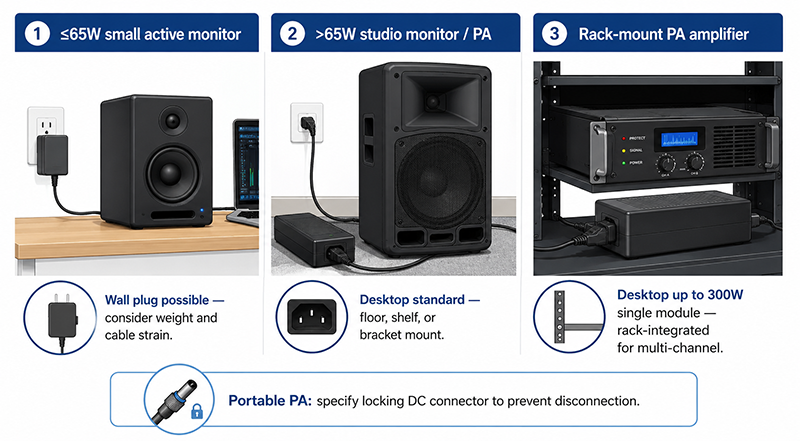
The adapter form factor (wall plug vs desktop) for a powered speaker depends on the power requirement, the speaker’s intended use, and the installation environment.
For speakers up to approximately 65W continuous power (small active monitors, desktop speakers):
- Wall plug adapters are possible from a form factor perspective, subject to mechanical and thermal constraints
- Desktop adapters are generally preferred as power requirements increase, particularly above approximately 65W, subject to mechanical, thermal, certification, and application constraints
- The adapter’s weight and the DC cable strain on the outlet should be considered
For speakers above 65W (studio monitors, PA speakers, subwoofers):
- Desktop adapters are the standard choice
- The adapter sits on the floor, on a shelf, or is mounted to the speaker cabinet with a bracket
- A 3-prong IEC inlet on the desktop adapter provides a protective earth connection where required by the equipment’s safety class, chassis construction, or applicable certification requirements
Rack-Mount PA Amplifiers
For rack-mount PA amplifier modules, the power architecture depends on total system power:
- Single-module units up to 300W may use an external desktop adapter
- Multi-channel systems where total power exceeds typical desktop adapter ratings may favor internal or rack-integrated power architectures, depending on total power, peak demand, thermal design, and system integration
Why This Matters
- For wall plug adapters, the mechanical stress on the AC outlet from the adapter weight and DC cable strain is a practical limitation at higher power levels.
- Desktop adapters provide thermal isolation from the speaker cabinet, which is beneficial for powered speakers where the amplifier and adapter heat sources are separated.
- For portable powered speakers (PA, live sound), a desktop adapter with a locking DC connector (screw-lock barrel or similar) prevents accidental disconnection during transport or setup.
What OEMs Should Do Now
- Select the adapter form factor based on the speaker’s total power consumption, intended installation (fixed vs portable), and the adapter’s thermal design.
- For portable speakers, specify a locking DC connector and a cable retention feature on the adapter to prevent disconnection during use.
- If the speaker has a metal chassis with exposed AC-connected components, evaluate the need for a protective earth connection through the adapter, based on the equipment’s safety class and applicable certification requirements.
Protection Features for Powered Speakers
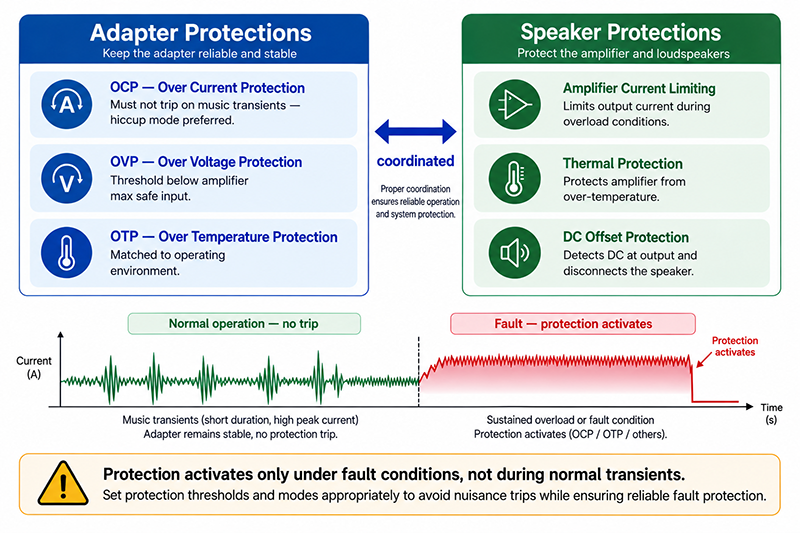
Powered speakers benefit from specific protection features in the external adapter, matched to the amplifier stage’s operating characteristics.
Protection coordination
- The adapter’s OCP, OVP, and OTP work together with the speaker’s internal protection circuitry (amplifier current limiting, thermal protection, DC offset protection)
- The adapter’s protection should activate only under fault conditions, not during normal transient operation
- A hiccup-mode OCP (automatic retry) is preferred for transient loads, while latching protection is appropriate for sustained faults
Over-Voltage Protection (OVP):
The OVP threshold should be coordinated with the adapter’s regulation range and the maximum safe input voltage of the amplifier module. An overvoltage condition at the amplifier input can damage the Class-D output stage and the DSP circuitry.
Over-Temperature Protection (OTP):
Thermal shutdown prevents the adapter from overheating in high-ambient-temperature installations. For PA equipment used outdoors or in poorly ventilated racks, the adapter’s OTP threshold should be matched to the expected operating environment.
Protection coordination:
- The adapter’s OCP, OVP, and OTP work together with the speaker’s internal protection circuitry (amplifier current limiting, thermal protection, DC offset protection)
- The adapter’s protection should activate only under fault conditions, not during normal transient operation
- A hiccup-mode OCP (automatic retry) is preferred for transient loads, while latching protection is appropriate for sustained faults
Why This Matters
- An adapter with fast-acting OCP may trip during music transients, causing the speaker to cut out momentarily. The adapter supplier can evaluate the OCP response characteristics to reduce the risk of nuisance tripping.
- OVP is especially critical because a sustained overvoltage can damage the amplifier module, DSP, and drivers (speaker cones) simultaneously. Repair costs can exceed the adapter replacement cost.
- For outdoor or touring PA applications, adapters with appropriate reliability specifications, temperature rating, and burn-in screening should be evaluated based on the application requirements.
What OEMs Should Do Now
- Provide the amplifier manufacturer’s input capacitance value and the expected inrush current profile to the adapter supplier so OCP response can be evaluated.
- Confirm that the adapter’s OVP threshold is below the maximum safe input voltage of the amplifier module. Verify this against the amplifier’s datasheet.
- For portable or touring PA products, request adapters with reinforced DC connectors, cable strain relief, and locking connector options.
Q: Can a powered speaker run the amplifier and DSP from the same external adapter?
A: Yes, but the DSP power stage should be post-regulated. A DC-DC converter with sufficient PSRR and an LDO provides clean power for the DSP and codec, while the amplifier stage runs directly from the adapter bus. This prevents amplifier load transients from coupling noise into the DSP supply.
Q: What happens if the adapter cannot deliver the amplifier’s peak current?
A: The adapter’s output voltage may sag during transients, causing the amplifier to clip or the DSP to reset if the voltage drops below the regulator’s minimum input. This is audible as distortion or dropouts on bass peaks. Matching the adapter’s transient capability to the amplifier’s peak demand through bulk capacitance and adapter selection is essential.
Q: What adapter voltage is typical for powered speakers?
A: Common voltages are 24V and 48V. A 24V adapter is typical for speakers up to 100W amplifier power. A 48V adapter provides higher voltage swing for the amplifier, enabling higher output power, and is common for 150W–300W powered speakers and subwoofers.
CONCLUSION
Selecting an external power supply for powered speakers and PA amplifiers requires a power budget that accounts for amplifier efficiency, DSP power draw, and transient peaks. The adapter’s transient response, the speaker’s bulk storage capacitance, and the protection feature coordination between adapter and amplifier determine real-world performance. Form factor selection depends on power level and installation requirements, with desktop adapters being the standard choice for higher-power applications.
Related Resources
🔌 Related Products
🏭 Related Applications
📖 Related Guides
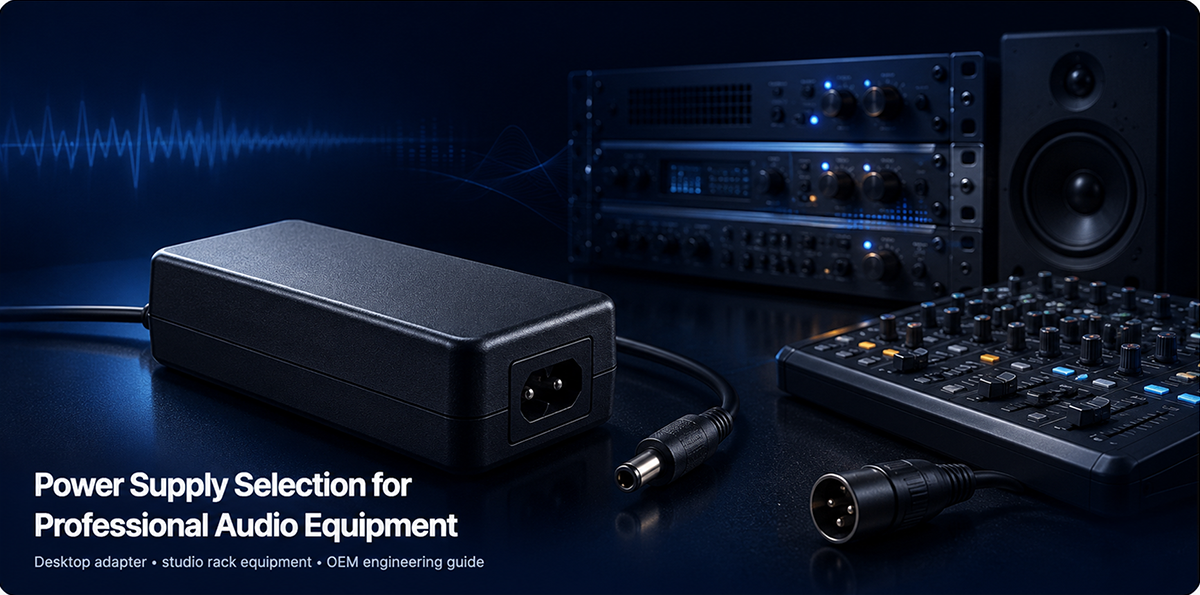
Audio Equipment Selection Guide
Cluster gateway: power supply selection for professional audio OEMs
✅ Related Certifications
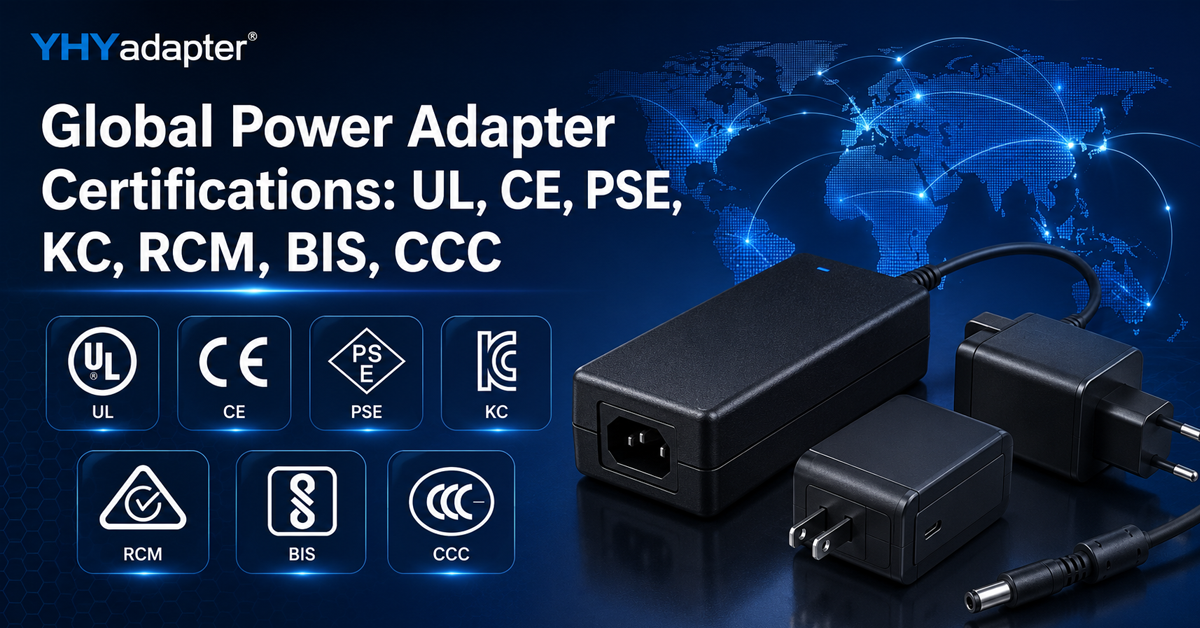
UL 62368-1 Safety Certification
Safety standard covering connector creepage/clearance, temperature rise, and strain relief requirements for IT/AV equipment power adapters.