
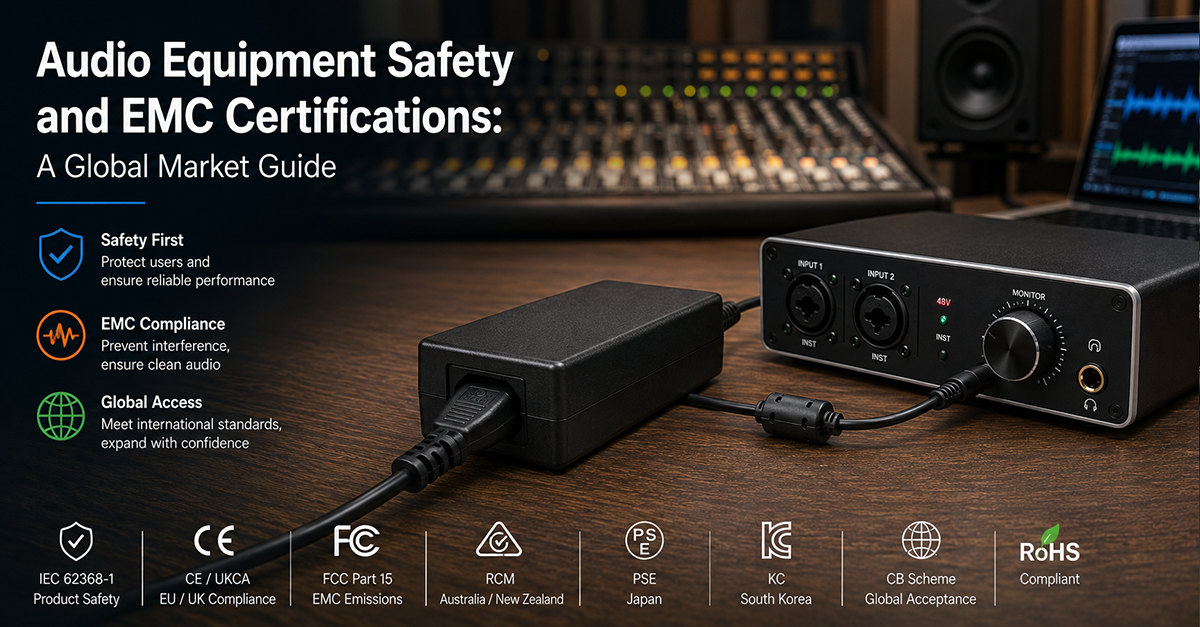
Audio equipment sold globally requires power supplies that carry the relevant safety and EMC certifications for each target market. Because the external power adapter is a component of the end product, its certification status directly affects the OEM’s market access. The adapter’s safety certification and EMC compliance must be coordinated with the end product’s certification strategy, because EMC compliance is a system-level property of the adapter + cable + product combination.
This guide covers the certification requirements for audio equipment power supplies across major global markets, including safety standards, EMC requirements, compliance pathways, and practical considerations for audio OEMs.
Safety Standards by Market
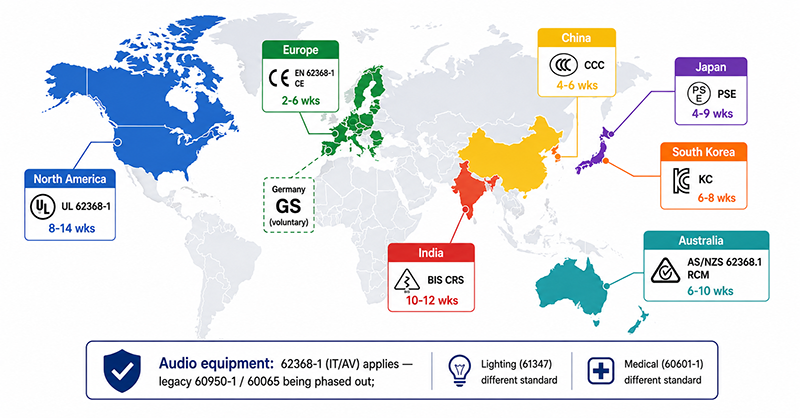
The safety standard for audio equipment power adapters is typically the applicable version of IEC/UL/EN 62368-1, the safety standard for audio/video, information, and communication technology equipment. Some legacy audio products may still reference IEC/UL/EN 60950-1 or 60065, but these are being phased out in favor of 62368-1.
| Market | Safety Standard | Applicability | Typical Timeline |
|---|---|---|---|
| USA | UL 62368-1 (NRTL listing) | All audio equipment with AC mains connection | 8–14 wks |
| EU | EN 62368-1 (CE conformity) | All audio equipment sold in EU | 2–6 wks |
| Japan | PSE depending on product category | External power adapters are within scope | 4–9 wks |
| South Korea | KC safety | Audio equipment and power adapters | 6–8 wks |
| Australia/NZ | AS/NZS 62368.1 (RCM/EESS) | Audio equipment and power adapters | 6–10 wks |
| India | BIS CRS registration | External power adapters within scope | 10–12 wks |
| China | CCC where product falls within mandatory catalogue | External power adapters may be within scope | 4–6 wks |
| Germany | GS mark (voluntary, additional to EU legal compliance) | Optional for EU-marketed products | 8–12 wks |
Available by model. Certification availability depends on product model, configuration, application requirements, and destination market. Not all options are available on every product model.
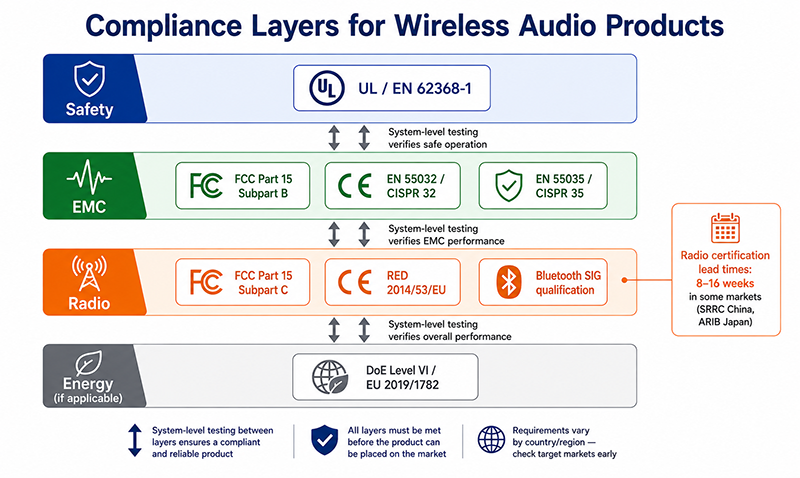
For audio equipment specifically, UL 62368-1 / EN 62368-1 is the applicable standard. Audio products with wireless connectivity (Bluetooth, Wi-Fi) are subject to additional radio standards (FCC Part 15C for intentional radiators in the US, RED in the EU).
Why This Matters
- Audio equipment power adapters typically fall under 62368-1 (IT/AV equipment safety), not 61347 (lighting) or 60601-1 (medical). Verify the applicable standard for your product classification.
- The transition from 60950-1/60065 to 62368-1 is complete or near-complete in most markets. New product certifications should be based on 62368-1.
- UL 62368-1 and EN 62368-1 are based on the same IEC standard but may have national differences. Verify the applicable edition for each target market.
What OEMs Should Do Now
- Identify the applicable safety standard edition for your audio product in each target market. Confirm the transition dates for legacy standards.
- Work with your adapter supplier to select a model with the appropriate certifications for your target markets.
- Begin certification planning early in the product development cycle—lead times vary by market, standard, and certification body.
EMC Requirements for Audio Equipment
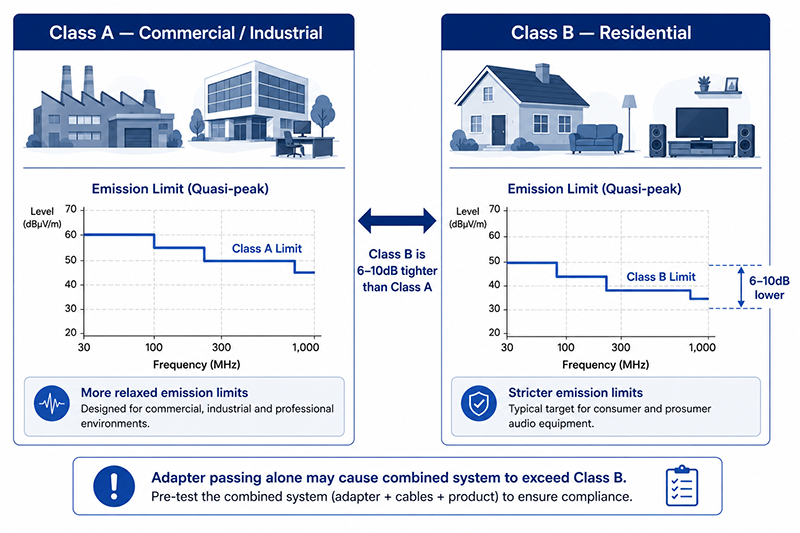
EMC compliance for audio equipment is a system-level consideration that involves the adapter, the DC cable, and the audio product itself. Even if the adapter independently passes FCC Part 15 or EN 55032, the combined system must be tested.
| Market | EMC Standard | Scope |
|---|---|---|
| USA | FCC Part 15 Subpart B | Radiated and conducted emissions for digital devices |
| EU | EN 55032 / CISPR 32 | Emissions for multimedia equipment |
| EU | EN 55035 / CISPR 35 | Immunity for multimedia equipment |
| International | CISPR 32 / 35 | Basis for many national regulations |
FCC Part 15 for Audio Products
- Class A: For commercial or industrial use. More relaxed emission limits.
- Class B: For residential use. Stricter emission limits, typically 6–10dB tighter than Class A.
The adapter’s conducted and radiated emissions contribute to the total product emissions. An adapter that passes FCC Part 15 when tested alone may cause the combined adapter + cable + product system to exceed Class B limits. Pre-testing the combined system is strongly recommended.
EN 55032 for EU Market
Similar in principle to FCC Part 15 but with different measurement bandwidths and limit lines. Audio products sold in the EU must comply. The adapter and the audio product are tested as a system.
Considerations for Audio Equipment
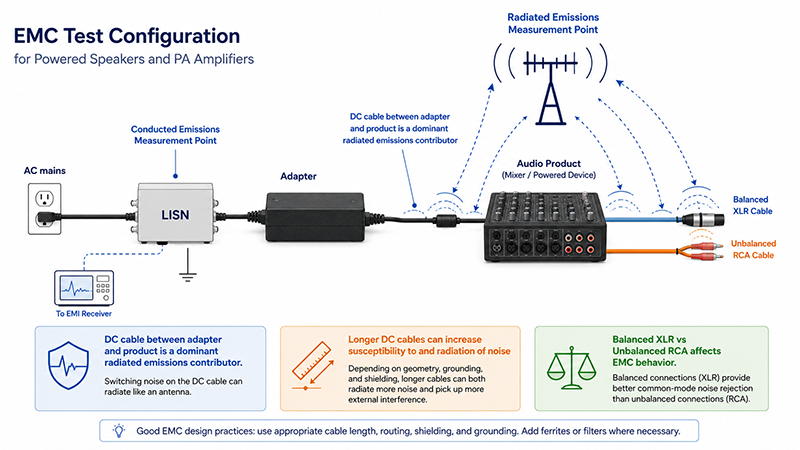
- The DC cable between the adapter and the audio product can be a dominant contributor to radiated emissions. Longer DC cables can increase susceptibility to and radiation of conducted or common-mode noise, depending on cable geometry, grounding, shielding, switching spectrum, and system layout.
- Audio equipment with balanced (XLR/TRS) input and output connections may have different EMC behavior than unbalanced (RCA) equipment due to the cable shield and ground reference configuration.
- Equipment with long cable runs (studio or installed sound applications) may need system-level shielding and filtering that should be addressed during product design.
Why This Matters
- The adapter’s FCC or CE EMC certification does not extend to the end product. The combined adapter + audio product must be tested as a system.
- Audio equipment with wireless connectivity must comply with both the EMC standard (Part 15B / EN 55032) and the radio standard (Part 15C / RED), adding another layer of compliance testing.
- The adapter’s conducted emissions on the AC mains and the radiated emissions from the DC cable are both contributors. An adapter that marginally passes EMC limits when tested standalone may fail when connected to the audio equipment.
What OEMs Should Do Now
- Request conducted and radiated emissions data for candidate adapters. Confirm adequate margin below the applicable limit for your target market.
- Plan for pre-compliance EMC testing of the complete system (adapter + cable + product) early in the design cycle.
- If the product has wireless connectivity, include both EMC and radio compliance in the certification plan.
Practical Certification Planning for Audio OEMs
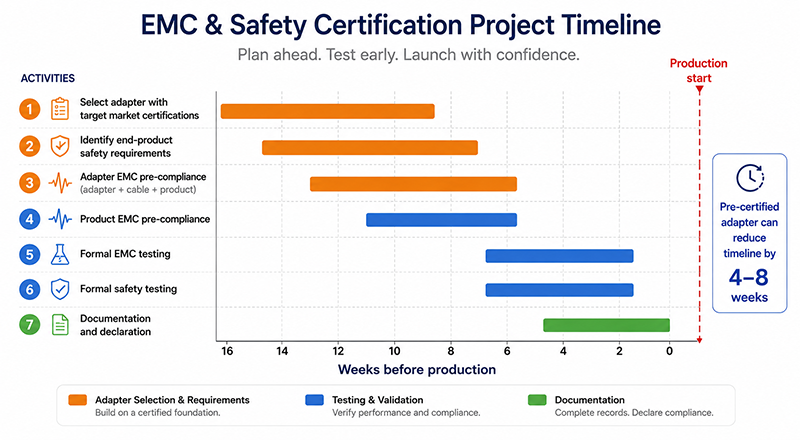
A typical certification timeline for an audio product with an external power adapter depends on the product complexity, the number of target markets, and whether the adapter is pre-certified.
Pre-Certified Adapter Approach:
If the adapter carries the required certifications for your target markets, the end product certification focuses on:
- The audio product’s own safety evaluation (may leverage the adapter’s certification)
- System-level EMC testing (adapter + cable + product)
- Radio testing (if the product has wireless connectivity)
New Adapter Certification:
If a new adapter certification is required, the timeline extends to include the adapter’s safety and EMC certification, which must be completed before the product’s system-level EMC testing.
Certification Planning:
| Activity | Timeline (Weeks Before Production) | Notes |
|---|---|---|
| Select adapter with target market certifications | 12–16 wks | Verify certification availability by model |
| Identify end-product safety requirements | 12–16 wks | Determine if product safety testing is needed |
| Begin adapter EMC pre-compliance | 10–14 wks | Test adapter + cable + product configuration |
| Begin product EMC pre-compliance | 8–12 wks | Identify and resolve emissions issues |
| Formal EMC testing | 4–8 wks | Submit for FCC / CE / other market testing |
| Formal safety testing | 4–8 wks | If required for the end product |
| Documentation and declaration | 2–4 wks | Technical file, DoC, labeling |
Timelines vary by market, standard, certification body, and product complexity. These are illustrative planning guidelines.
Why This Matters
- Using an adapter that is already certified for your target markets can reduce the certification timeline by 4–8 weeks compared to certifying a new adapter.
- EMC pre-compliance testing of the combined system is the most effective way to avoid late-stage failures that delay market entry.
- The certification strategy should be defined at the product specification stage, not after the design is complete.
What OEMs Should Do Now
- Identify the target markets for your audio product at the specification stage and verify that the candidate adapter carries the required certifications.
- Plan for system-level EMC pre-compliance testing. Allow sufficient time in the development schedule for at least one pre-compliance iteration.
- Work with your adapter supplier to select a certified model for each target market. Certification availability depends on product model, configuration, application requirements, and destination market.
Useful Links
Related article: Global Power Adapter Certifications →
Related article: Power Supply Selection Guide for Professional Audio Equipment OEMs →
Q: Does a UL 62368-1 certified power adapter automatically make my audio product compliant in the US market?
A: No. The adapter’s safety certification covers the adapter itself. The end product’s safety and EMC compliance must be evaluated separately. The adapter may simplify the end product’s certification pathway, but the combined adapter + product system must still comply with applicable standards.
Q: My audio product has Bluetooth. What additional certifications are needed?
A: Products with Bluetooth or other wireless transmitters require radio compliance in addition to safety and EMC. In the US, FCC Part 15C (intentional radiators) applies. In the EU, the Radio Equipment Directive (RED) applies. Bluetooth SIG qualification may also be required depending on the implementation.
Q: Can I use a power adapter certified to UL 62368-1 in a legacy product that was certified to UL 60065?
A: The adapter is certified to the standard applicable to the adapter itself. The end product’s certification is separate. Using a 62368-1 certified adapter with a product certified to 60065 is generally acceptable, but the end product’s certification should be verified against the applicable requirements. New designs should use the current standard edition.
CONCLUSION
Audio equipment certification requires coordination between the adapter’s certification and the end product’s compliance pathway. Safety standards (UL 62368-1, EN 62368-1) cover the adapter’s construction, while EMC compliance (FCC Part 15, EN 55032) is a system-level requirement involving the adapter, cable, and product. Pre-certified adapters can simplify the pathway, but system-level EMC testing is always required. Planning certification requirements at the specification stage, rather than after design completion, reduces the risk of delays and additional costs.
Related Resources
🔌 Related Products
🏭 Related Applications
📖 Related Guides
Audio Equipment Selection Guide
Cluster gateway: power supply selection for professional audio OEMs
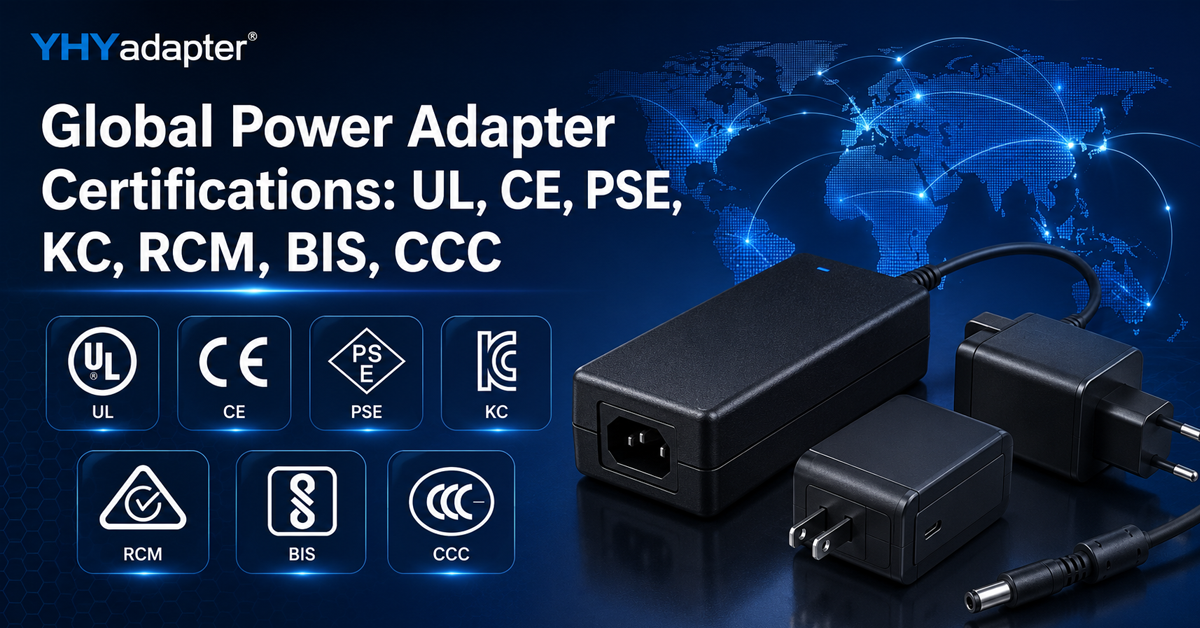
Global Certifications Guide
Global power adapter certification market guide (UL/CE/PSE/KC/RCM/BIS/CCC)
IEC 60601-1 Medical Cert Guide
IEC 60601-1 certification guide for medical/beauty power supplies
✅ Related Certifications
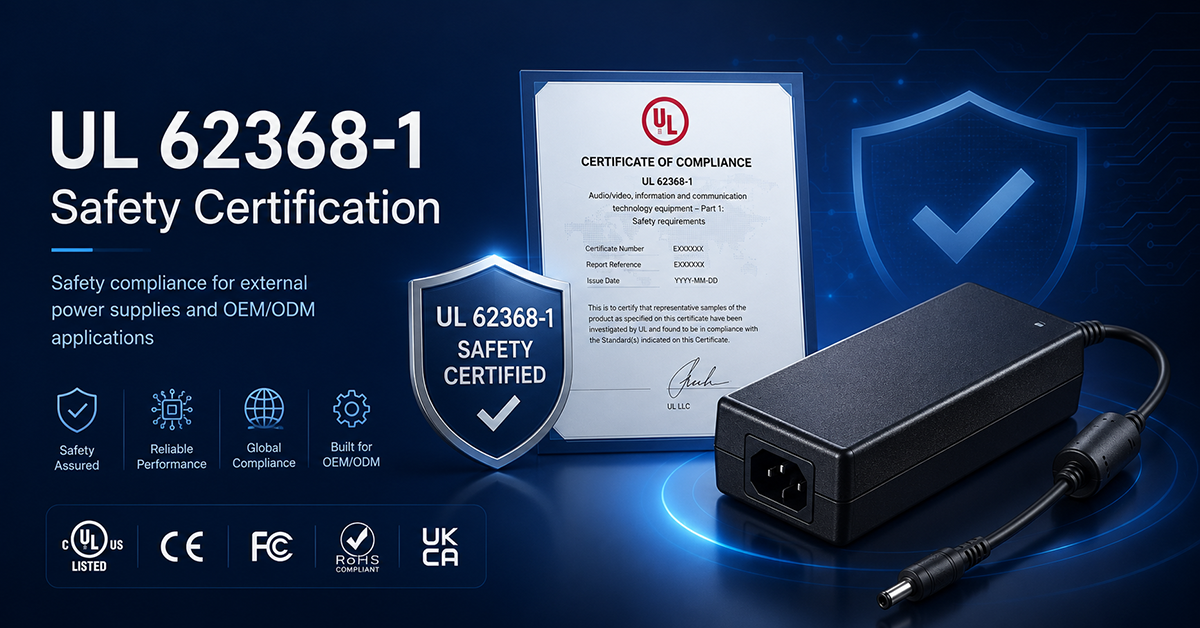
UL 62368-1 Safety Certification
Safety standard covering connector creepage/clearance, temperature rise, and strain relief requirements for IT/AV equipment power adapters.
IEC 60601-1
Medical electrical equipment safety standard — compliance reference for medical/beauty devices