
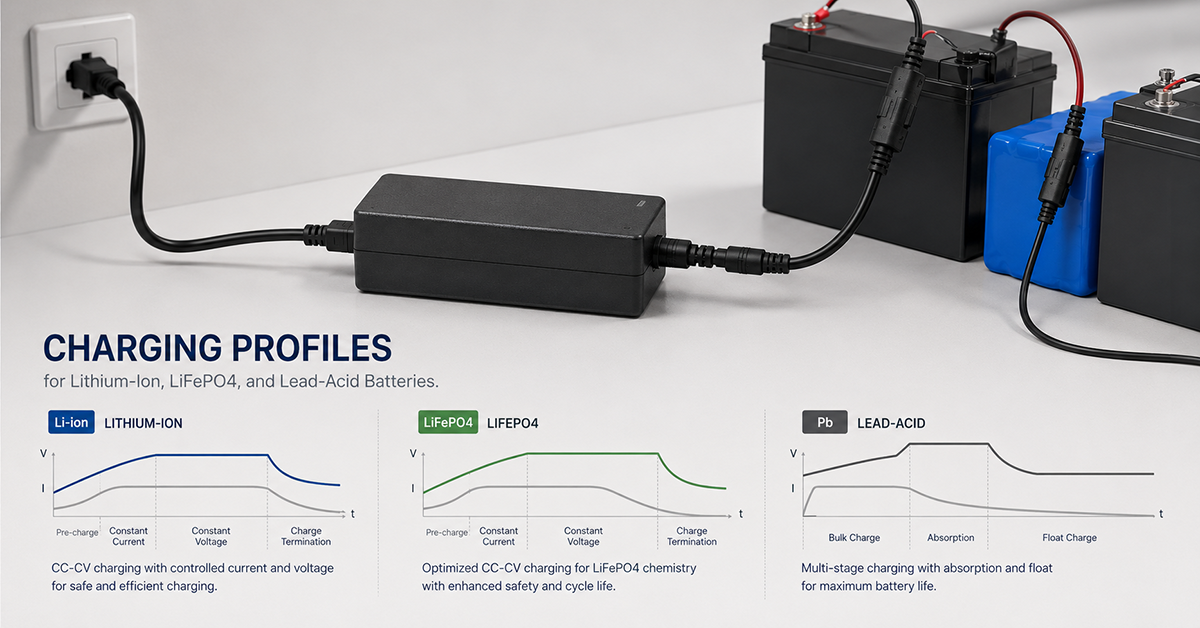
The charging profile—the voltage and current sequence applied to a battery during charging—is one of the most critical parameters in energy storage system design. An incorrect charging profile can reduce battery capacity, accelerate degradation, or cause immediate safety hazards including thermal runaway. Each battery chemistry requires a specific charging profile, and within each chemistry, the optimal profile depends on the battery’s temperature, age, and state of charge.
This guide covers the charging profiles for the three most common stationary ESS chemistries: lithium-ion (NMC), lithium iron phosphate (LiFePO4), and lead-acid (AGM, gel, flooded). It explains the CC/CV method, multi-stage charging, temperature compensation, and implementation considerations for ESS OEMs.
CC/CV Charging for Lithium Batteries
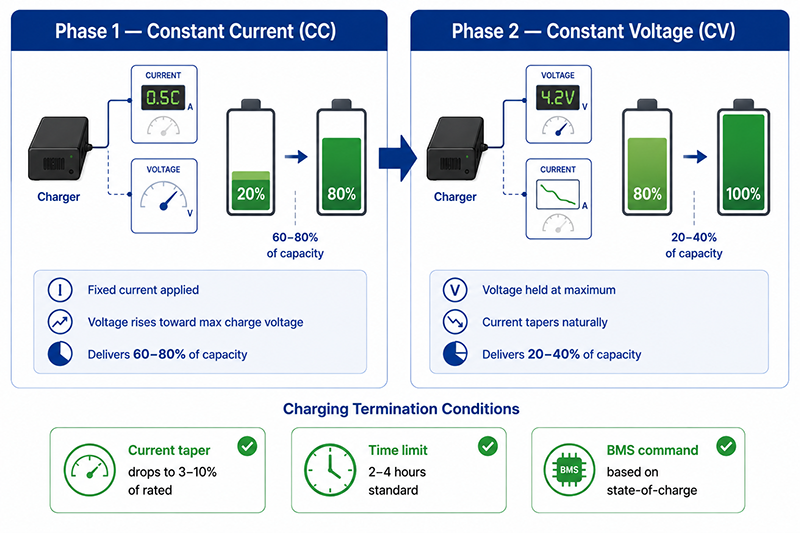
Constant current / constant voltage (CC/CV) is the standard charging method for all lithium-based batteries, including NMC and LiFePO4.
The CC/CV Process
The charging process consists of two phases:
1. Constant Current (CC) Phase: The charger applies a fixed current (typically 0.3C–1C depending on the cell specification) while the battery voltage rises from its current state of charge toward the maximum charge voltage. The CC phase delivers approximately 60–80% of the battery’s capacity, depending on the C-rate.
2. Constant Voltage (CV) Phase: When the battery reaches its maximum charge voltage, the charger transitions to CV mode, maintaining the voltage while the current decreases naturally as the battery approaches full charge. The CV phase delivers the remaining 20–40% of capacity, with the charge current tapering to a termination threshold.
Charge Termination
Charging is terminated when one of these conditions is met:
- Current taper termination: The charge current drops below a specified threshold, typically 3–10% of the rated CC current. For example, a 50A CC charger terminates at 1.5–5A.
- Time termination: A maximum charge time is enforced, typically 2–4 hours for a standard charge cycle.
- BMS command: The BMS sends a charge termination command based on its own state-of-charge estimation.
Charge Current and C-Rate
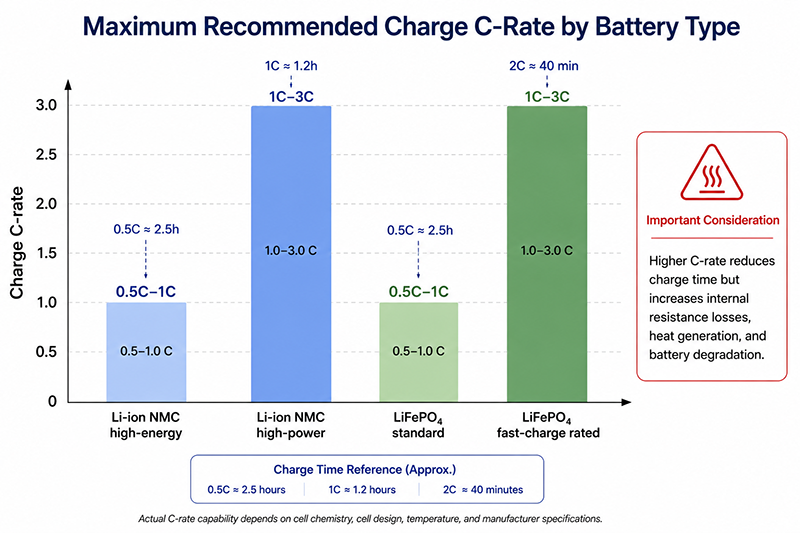
The C-rate describes the charge or discharge current relative to the battery’s capacity. A 100Ah battery charged at 0.5C receives 50A. The maximum recommended charge C-rate depends on the cell manufacturer’s specification:
| Battery Type | Typical Max Charge C-rate | Notes |
|---|---|---|
| Li-ion NMC (high energy) | 0.5C–1C | Standard charging for energy cells |
| Li-ion NMC (high power) | 1C–3C | Higher rate acceptable for power-optimized cells |
| LiFePO4 (standard) | 0.5C–1C | Matches NMC in typical charge capability |
| LiFePO4 (fast-charge rated) | 1C–3C | Some cells are rated for faster charging |
Why This Matters
- Charging a lithium battery beyond its maximum charge voltage (4.20V/cell for NMC, 3.65V/cell for LiFePO4) is the primary cause of lithium battery safety incidents, including thermal runaway.
- The CV phase is essential for lithium batteries because it allows the battery to reach full charge without exceeding the maximum voltage. Attempting to charge without CV regulation results in either undercharging or overvoltage.
- The C-rate directly affects charge time but also affects battery cycle life. A 2C charge generates more heat and stresses the electrodes more than a 0.5C charge.
Multi-Stage Charging for Lead-Acid Batteries
| Stage | Charging Mode | Voltage Setting | Current Setting | Purpose |
|---|---|---|---|---|
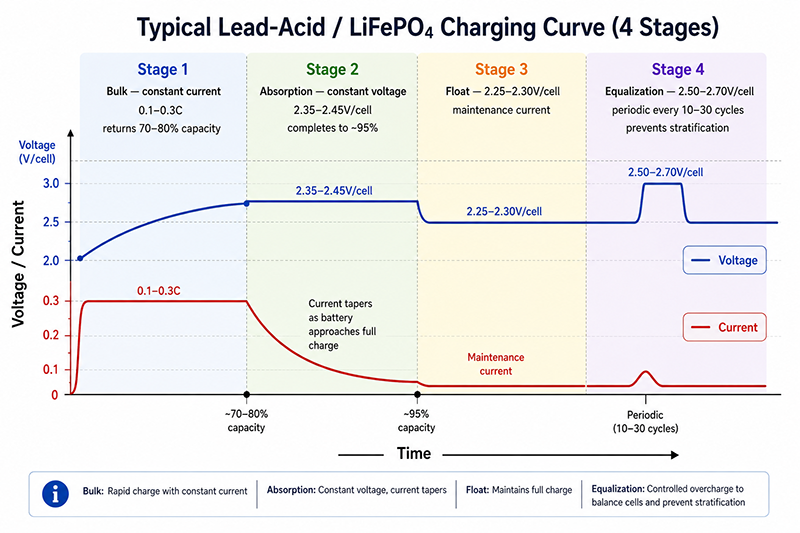
| Bulk | Constant current | — | 0.1C–0.3C typical | Returns 70–80% of capacity; most efficient charging phase |
| Absorption | Constant voltage | 2.35–2.45V/cell (25°C) | Current decreases naturally | Completes charging to ~95%; important for sulfation prevention |
| Float | Constant voltage | 2.25–2.30V/cell (25°C) | – | Maintains full charge without overcharging; minimal current |
| Equalization | Constant voltage (elevated) | 2.50–2.70V/cell | Limited | Periodic (every 10–30 cycles); remixes electrolyte, prevents stratification |
Temperature Compensation
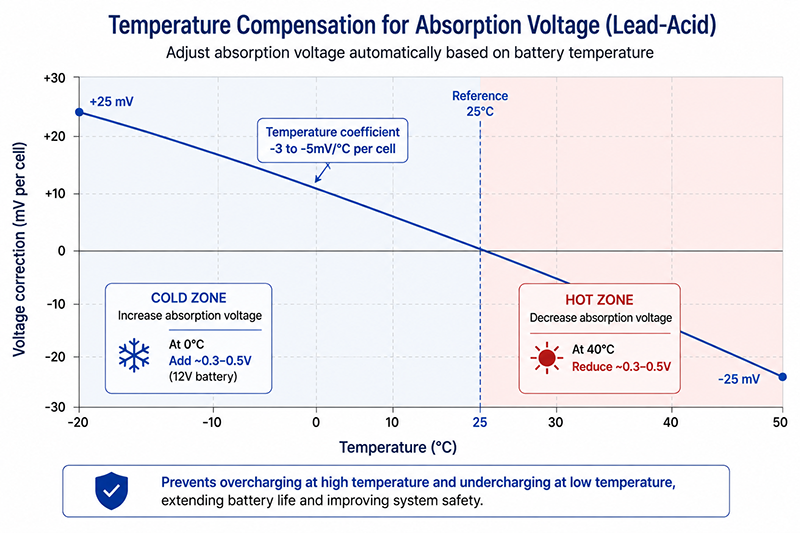
- Temperature coefficient: −3 to −5mV per °C per cell (negative coefficient)
- At 0°C: Increase absorption voltage by approximately 0.3–0.5V (for a 12V battery)
- At 40°C: Decrease absorption voltage by approximately 0.3–0.5V (for a 12V battery)
Why This Matters
- Lead-acid batteries can tolerate some overcharging (unlike lithium), which allows the absorption stage to complete charging. However, sustained overcharging causes gassing and water loss in flooded cells.
- Without an equalization charge, flooded lead-acid batteries develop electrolyte stratification (acid concentration gradient), reducing capacity and causing plate sulfation.
- Temperature compensation is essential for lead-acid batteries installed in environments with wide temperature variation. Without it, the battery may be overcharged in summer and undercharged in winter.
Comparing Charging Profiles
| Characteristic | Li-ion NMC | LiFePO4 | Lead-Acid (AGM) |
|---|---|---|---|
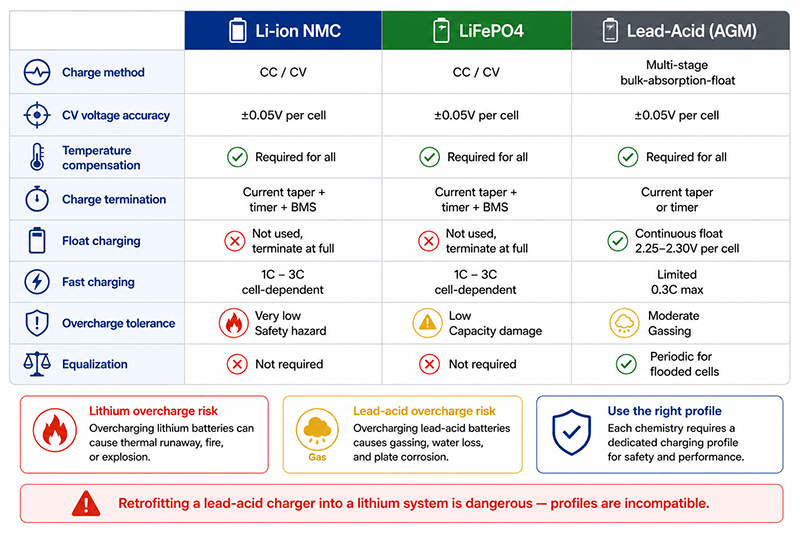
| Charge method | CC/CV | CC/CV | Multi-stage (bulk/absorption/float) |
| CV voltage accuracy required | ±0.05V/cell | ±0.05V/cell | ±0.05V/cell (absorption) |
| Temperature compensation | Required | Required | Required |
| Charge termination | Current taper + timer + BMS | Current taper + timer + BMS | Current taper or timer |
| Float charging | Not used (terminate at full) | Not used (terminate at full) | Continuous float (2.25–2.30V/cell) |
| Fast charging possible | 1C–3C (cell-dependent) | 1C–3C (cell-dependent) | Limited (0.3C max) |
| Overcharge tolerance | Very low (safety hazard) | Low (capacity damage) | Moderate (gassing) |
| Equalization | Not required | Not required | Periodic (flooded cells) |
Implementation Considerations
| Factor | Lithium (NMC/LiFePO4) | Lead-Acid |
|---|---|---|
| Charger control | BMS communicates charge parameters to charger via CAN/RS-485 | Charger operates independently; timer-based stage transitions common |
| Safety monitoring | BMS monitors cell voltages, temperatures; can halt charging | Charger monitors battery voltage and temperature; limited cell-level visibility |
| Charge interruption | BMS can disconnect charge path at any time if cell limits are exceeded | Charger may not receive signals from BMS; relies on charger’s own monitoring |
Why This Matters
- Lithium batteries require active BMS control of the charging process for safety. Lead-acid systems can operate with a standalone charger that uses voltage and time thresholds.
- For ESS with lithium batteries, the charger and BMS must have a compatible communication interface to coordinate charge termination and fault response.
- Retrofitting a lead-acid charger into a lithium battery system is dangerous because the charging profile is incompatible and the charger may not have the voltage accuracy required for lithium.
Q: What happens if I charge a LiFePO4 battery with a charger set for Li-ion NMC?
A: The LiFePO4 battery’s maximum charge voltage is 3.65V/cell (58.4V for a 16S pack), while the NMC charger delivers 4.20V/cell (58.8V for a 14S pack). For a 16S LiFePO4 pack, the voltage mismatch is significant. Even if the pack voltages happen to align, the charger’s CV setting may exceed the LiFePO4 cells’ maximum voltage, causing overcharge damage. Chargers must be configured for the specific battery chemistry.
Q: Do I need temperature compensation for a lithium battery charger?
A: Yes. Lithium batteries should not be charged below 0°C (most NMC) or below −10°C to −20°C (some LiFePO4 specifications) to avoid lithium plating, which causes permanent capacity loss and creates a safety hazard. Some chargers reduce charge current at low temperatures or prevent charging entirely until the battery warms. Verify the charger’s temperature compensation or charge inhibit behavior matches the battery’s specifications.
Q: How does the charger know when to switch from CC to CV mode?
A: In CC mode, the charger monitors the battery voltage. When the voltage reaches the charger’s programmed CV setpoint (e.g., 58.4V for a 16S LiFePO4 pack), the charger transitions from CC to CV mode. This voltage detection is performed by the charger’s feedback circuitry. The charger does not need BMS communication for the CC-to-CV transition, but BMS communication is needed for charge termination and fault response.
Conclusion
The charging profile is a critical parameter that must match the battery chemistry for safe and effective energy storage system operation. Lithium batteries (NMC and LiFePO4) require the CC/CV method with precise voltage regulation, current taper termination, and BMS coordination for fault response. Lead-acid batteries use a multi-stage profile with bulk, absorption, float, and equalization stages, with temperature compensation for accurate charging across temperature ranges. Understanding the charging requirements of each chemistry is essential for selecting or specifying the correct AC/DC battery charger.
Related Resources
🔌 Related Products
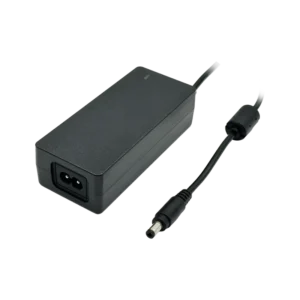
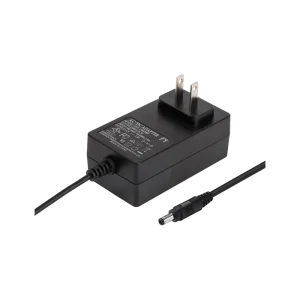
12.6V 4A 50W Li-Ion Charger (3-series Li-Ion charging)
12.6V 4A CC/CV Li-Ion charger for 3-series battery packs
🏭 Related Applications
📖 Related Guides
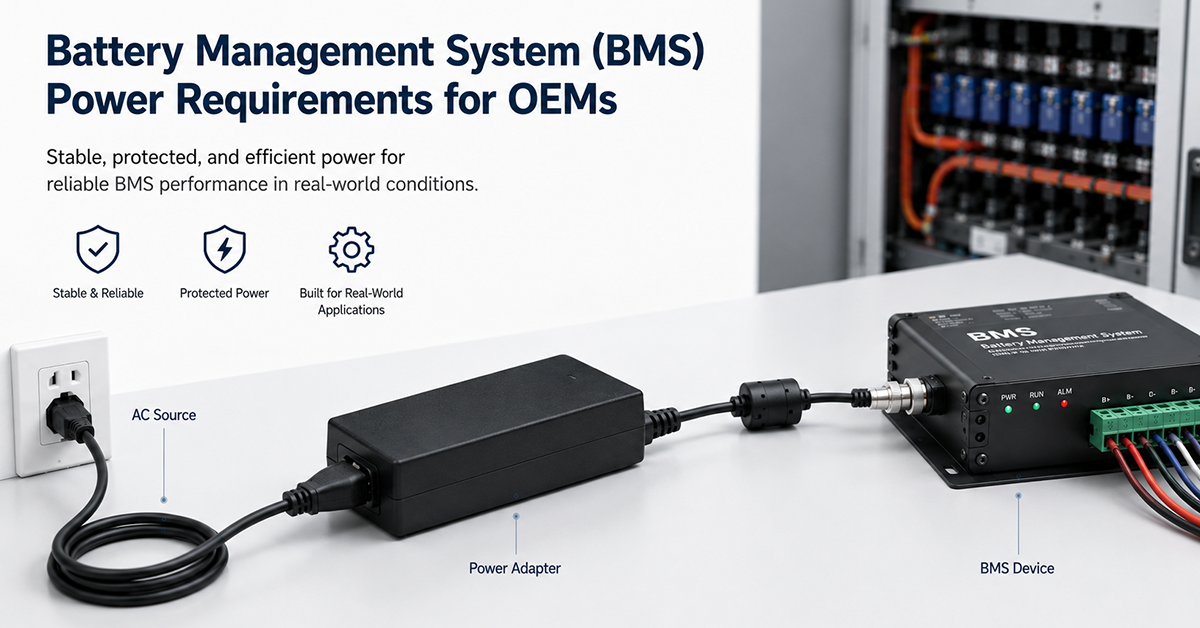
BMS Power Requirements
BMS power requirements and design
Read Guide →
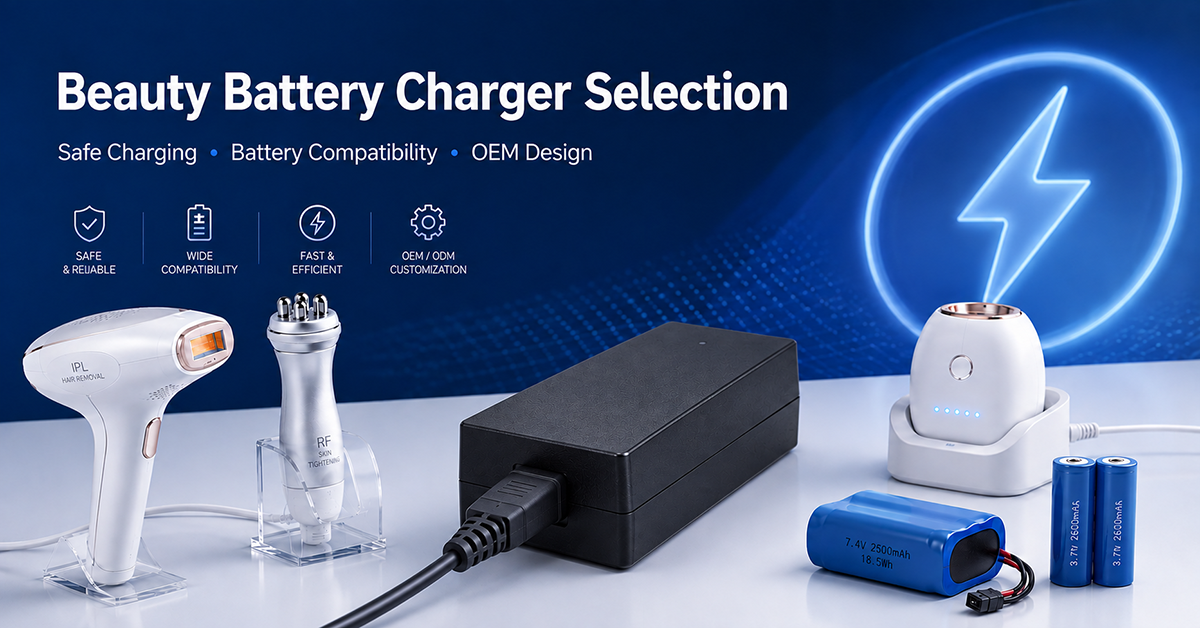
Beauty Battery Charger Selection
Battery charger selection for rechargeable beauty devices
✅ Related Certifications
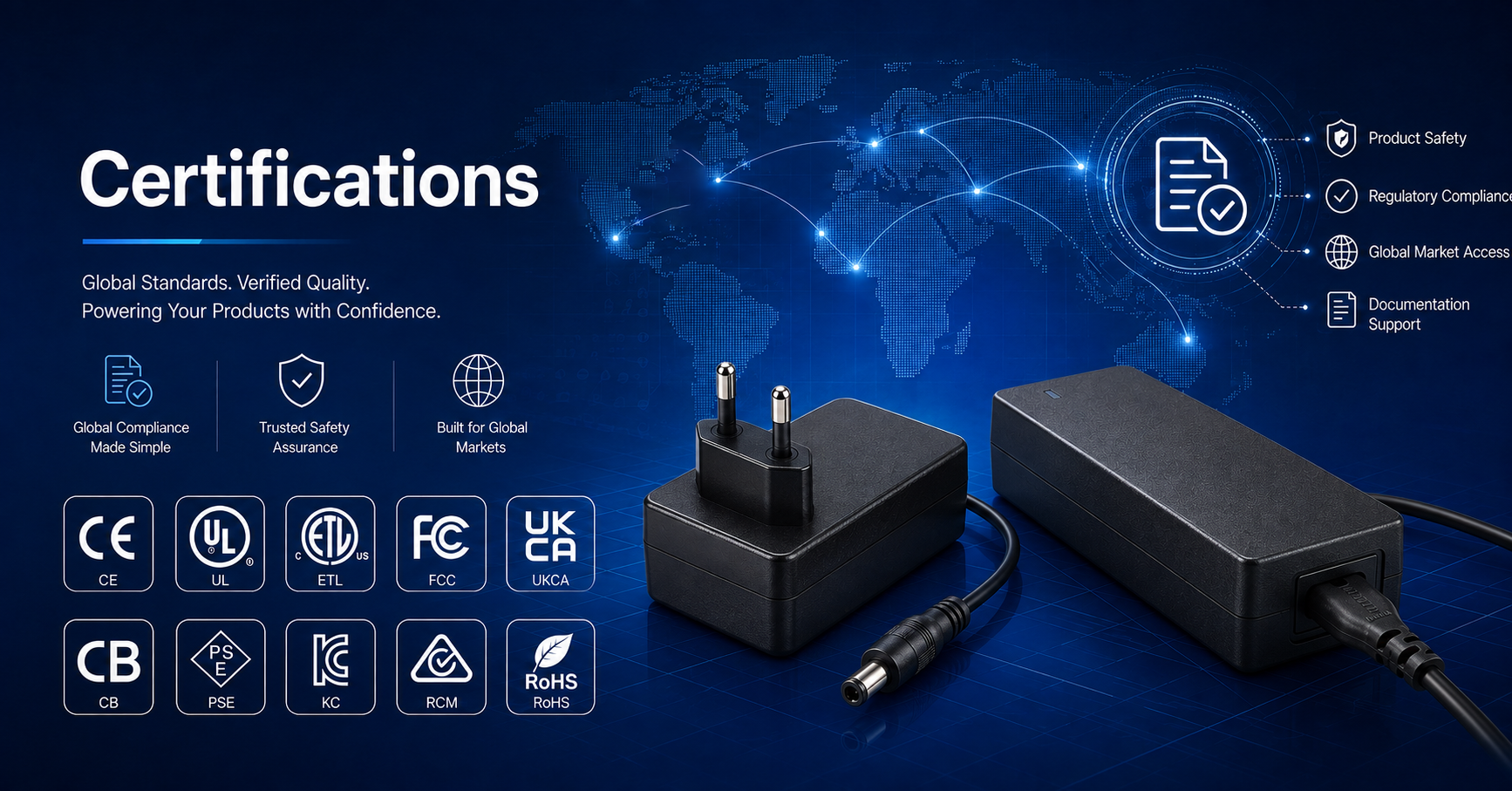
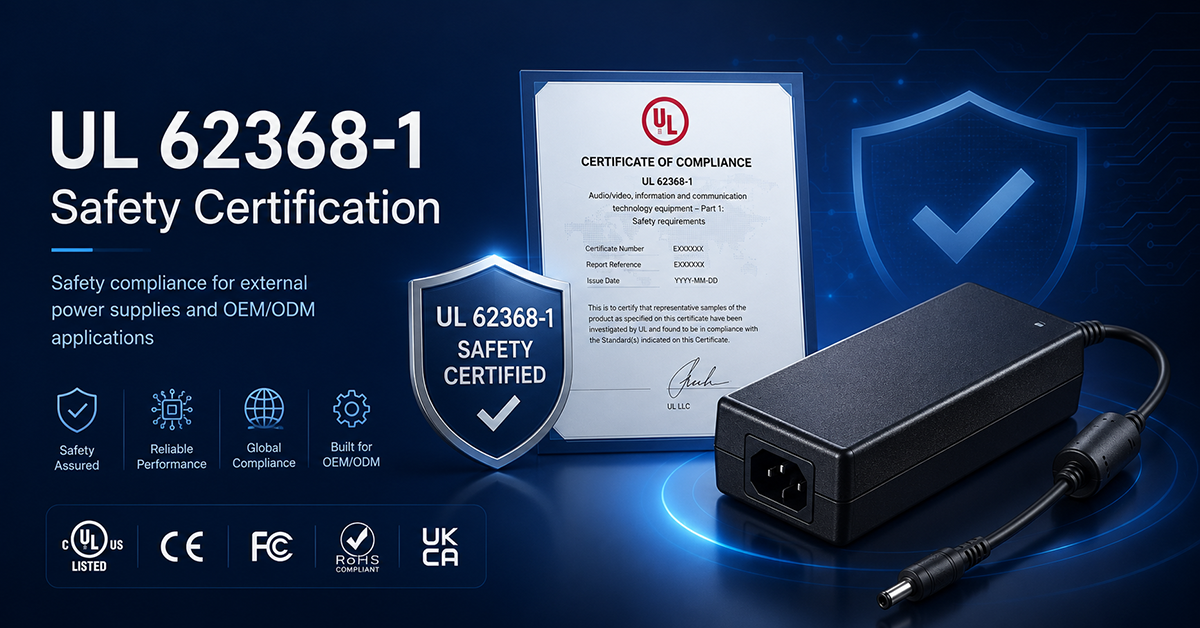
UL 62368-1 Safety Certification
Safety standard covering connector creepage/clearance, temperature rise, and strain relief requirements for IT/AV equipment power adapters.