
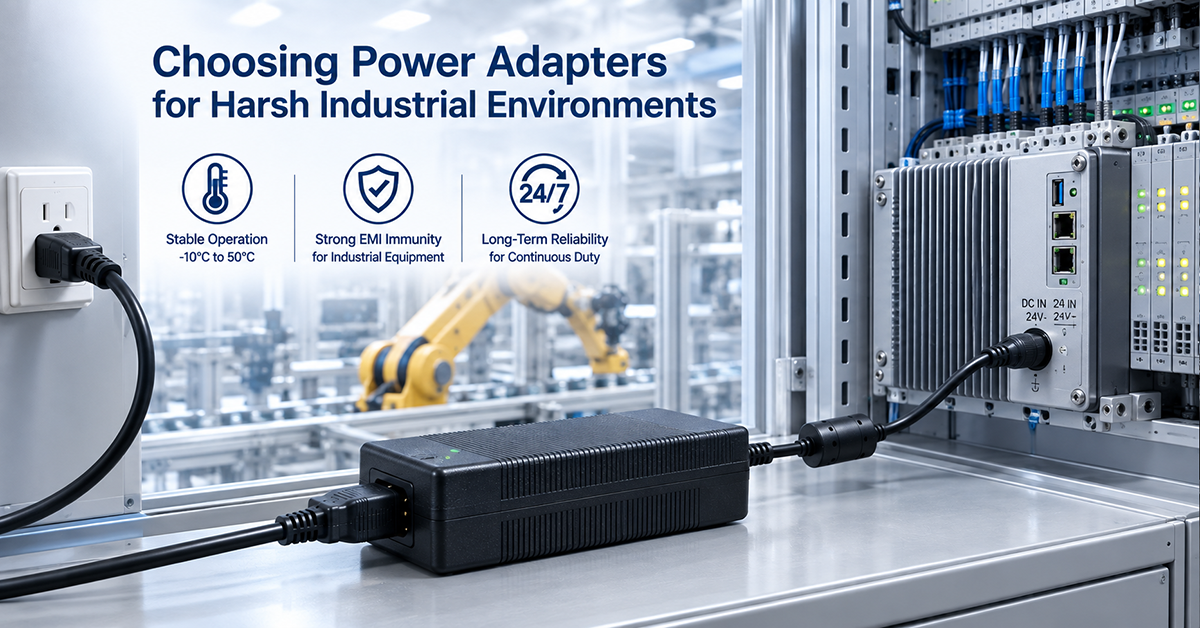
1. Introduction: What Is a Harsh Environment?
A harsh environment is any operating condition that exceeds the specifications of a standard commercial power supply. In industrial settings, harsh conditions typically combine multiple stress factors: dust and moisture that compromise insulation, vibration and shock that loosen connections, temperature extremes that push components beyond their ratings, and chemical exposure that corrodes materials.
Standard commercial adapters fail in these environments — not because they’re poorly made, but because they’re designed for controlled indoor conditions. This guide helps you identify the environmental challenges in your application and select power adapters specifically built for them.
For the mechanical and protection aspects of industrial power, see Industrial Power Protection Design (IA09) and Industrial Power Connector Selection Guide (IA10), which cover complementary topics. Start with How to Choose the Right Power Adapter for Your Industrial Application (IA01) for general selection methodology.
2. Environmental Protection (Ingress)
Understanding IP Ratings
The IP (Ingress Protection) rating system classifies a power supply’s resistance to solids and liquids. For harsh industrial environments, the second digit (liquid protection) is often the deciding factor.
Solid particle protection (first digit):
| Digit | Protection | Meaning |
|:—–:|:———–|:——–|
| 5 | Dust-protected | Ingress of dust not entirely prevented, but does not interfere with operation |
| 6 | Dust-tight | No ingress of dust; complete protection |
Liquid protection (second digit):
| Digit | Protection | Meaning |
|:—–:|:———–|:——–|
| 4 | Splashing water | Water splashed from any direction has no harmful effect |
| 5 | Water jets | Water projected by nozzle (6.3mm) against enclosure has no harmful effect |
| 6 | Powerful water jets | Water projected by nozzle (12.5mm) at high flow has no harmful effect |
| 7 | Immersion (1m) | Temporary immersion in 1m water for 30 minutes |
| 8 | Continuous immersion | Continuous immersion at specified depth |
Common industrial ratings and typical applications:
| IP Rating | Application | Cost Impact |
|---|---|---|
| IP20 | Control cabinet interior — clean, dry, no wash-down | Baseline |
| IP54 | Sheltered outdoor, light industrial — limited dust and splash | +10–15% |
| IP65 | Factory floor, wash-down areas — dust-tight, hose-proof | +15–25% |
| IP67 | Outdoor exposed, wet environments — temporary immersion | +20–35% |
| IP68 | Continuous submersion — underwater or constant flooding | +40–60% |
How Manufacturers Achieve IP Protection
Sealed enclosures: gasketed seams between housing halves (silicone or EPDM), with all entry points (cable glands, vents, mounting feet) sealed by O-rings or gasket material.
Potting (encapsulation): The entire circuit board is encased in epoxy, polyurethane, or silicone resin — complete moisture and dust exclusion, vibration damping, thermal conduction to the housing, and creepage protection. Trade-off: non-repairable, heavier, higher manufacturing cost.
Conformal coating: A thin (25–250µm) protective layer applied to the circuit board. Options include:
| Coating Type | Moisture | Chemical | Temperature | Cost |
|---|---|---|---|---|
| Acrylic (AR) | Good | Fair | -55°C to +125°C | Low |
| Silicone (SR) | Excellent | Poor | -55°C to +200°C | Medium |
| Urethane (UR) | Excellent | Excellent | -55°C to +125°C | Medium |
| Parylene (XY) | Excellent | Excellent | -55°C to +200°C | High |
Parylene coating provides the most complete protection (pinhole-free, conformal to all surfaces including under components) but requires vacuum deposition equipment and is the most expensive option.
3. Mechanical Stress
Vibration Resistance (IEC 60068-2-6)
Vibration testing per IEC 60068-2-6 exposes the power supply to sinusoidal vibration across a frequency range (typically 10–500 Hz or 10–2000 Hz) at specified amplitudes.
Vibration severity classes for industrial applications:
| Class | Acceleration | Frequency Range | Typical Environments |
|---|---|---|---|
| Light | 0.35g (3.5 m/s²) | 10–150 Hz | Control cabinets, office-adjacent |
| Moderate | 2g (20 m/s²) | 10–500 Hz | Factory floor, conveyors, packaging |
| Severe | 5g (50 m/s²) | 10–2000 Hz | Near heavy presses, crushers, engines |
| Extreme | 10g (100 m/s²)+ | 10–2000 Hz | Vehicle-mounted, handheld equipment |
Effects of vibration on power supplies: connector fretting (micro-motion wears plating, raising resistance), capacitor lead fatigue, solder-joint cracking (worsened by thermal cycling), transformer core damage from magnetostriction, and screw-terminal loosening.
Design features for vibration resistance:
– Potting: Encapsulated components cannot vibrate relative to each other
– Locking connectors: Threaded (M12, GX) or bayonet types prevent disconnection
– Screw mounting: Multiple mounting points with vibration-dampening grommets
– DIN rail with locking clips: Prevents dislodging from the rail during vibration
– Low-profile components: Shorter leads = less leverage = less fatigue
– Conformal coating: Adds mechanical support to surface-mount components
Mounting recommendations by vibration level:
| Vibration Level | Recommended Mounting |
|---|---|
| Light (0.35g) | Standard DIN rail or screw mount |
| Moderate (2g) | DIN rail with locking clip + cable tie |
| Severe (5g) | Screw mount on vibration dampers |
| Extreme (10g+) | Screw mount + potting + locking connectors |
Shock Resistance (IEC 60068-2-27)
Shock testing exposes the power supply to half-sine pulses at specified peak acceleration and duration.
| Severity | Peak Acceleration | Duration | Typical Events |
|---|---|---|---|
| Low | 15g | 11ms | Forklift bump, door closing |
| Medium | 30g | 11ms | Drop from 1m, machine impact |
| High | 50g | 6–11ms | Forklift collision, dropped tool |
| Extreme | 100g | 6ms | Explosive environment, military |
Design features for shock:
– Potting (most effective — prevents internal component displacement)
– Foam padding inside enclosures
– Reinforced PCB mounting (additional standoffs, corner brackets)
– Heatsink bonded with thermally conductive adhesive (not clips)
4. Thermal Challenges
High Temperature Operation
Temperature is the most common stressor in industrial environments. Every 10°C rise above rated temperature approximately halves the lifetime of electrolytic capacitors — the most common failure component in power supplies.
Derating curves: A power supply’s rated output power assumes a specific ambient temperature (typically 25°C or 40°C). Above this temperature, output must be reduced.
Derating example — typical industrial supply rated 120W at 40°C:
| Ambient Temperature | Maximum Output Power | Percentage of Rated |
|:——————:|:——————-:|:——————:|
| 40°C | 120W | 100% |
| 50°C | 108W | 90% |
| 60°C | 96W | 80% |
| 70°C | 72W | 60% |
| 80°C | 48W | 40% |
Derating formula: P_max(T_amb) = P_rated × factor(T_amb)
Thermal management methods:
– Natural convection: No fan — relies on airflow through a vented enclosure. Zero noise, zero moving parts, suitable for clean environments.
– Conduction cooling: Heat transfers through potting compound to the enclosure walls, which act as the heatsink. Fully sealed, but limited to ~100W in practice.
– Forced air (fan): Much higher capacity — up to 1000W+ in a small enclosure. Moving parts reduce reliability, and fans must be sealed against dust ingress.
Small sealed enclosures with no fan are typically limited to 60–120W by thermal constraints; use potted designs or larger surface area for higher power.
Low Temperature Operation
Cold environments present different challenges.
| Effect | Cause | Mitigation |
|---|---|---|
| Reduced output current | Higher ESR of capacitors at low temperature | Select low-ESR / polymer capacitors rated for low temp |
| Slower startup | PWM controller startup threshold takes longer | Wide-temperature-rated controller ICs |
| Output voltage drift | Zener reference voltage shifts | Temperature-compensated references |
| Reduced battery charging | Li-Ion cells cannot charge below 0°C (safety risk) | Heated battery compartment or charge disable below 0°C |
Cold start: Starting at -40°C requires specially selected components — low-temperature electrolyte capacitors, controller ICs rated for -40°C, and low-drift oscillator crystals.
Thermal Cycling
Repeated temperature changes cause mechanical stress from differential expansion.
CTE (Coefficient of Thermal Expansion) mismatch between PCB (14–17 ppm/°C), ceramic capacitors (6–8 ppm/°C), and solder joints (25+ ppm/°C) creates stress that accumulates over cycles.
Thermal cycle resistance: potting (reduces relative component movement — most effective); flexible interconnects (absorb expansion rather than transmitting it to solder joints); leaded solder (Sn63Pb37) is more ductile than lead-free under cycling; underfill beneath large BGA/QFP packages distributes stress.
Decision guide — thermal requirements:
| Condition | Standard Supply | Wide Temp Supply | Extreme Temp Supply |
|---|---|---|---|
| Temperature range | 0°C to +50°C | -20°C to +70°C | -40°C to +85°C |
| Thermal cycling | Few cycles/year | Daily cycles | Hourly cycles |
| Typical applications | Indoor cabinet | Factory floor, outdoor | Mining, arctic, desert |
5. Environmental Corrosion
Chemical Resistance
Power supplies in industrial environments may be exposed to oils, coolants, solvents, and cleaning agents.
Housing material resistance:
| Material | Oil/Coolant | Solvent | UV | Cost |
|---|---|---|---|---|
| ABS plastic | Fair | Poor | Poor | $ |
| Polycarbonate | Good | Fair | Fair | $$ |
| ABS/PC blend | Good | Fair | Fair | $$ |
| Aluminum (anodized) | Excellent | Excellent | Excellent | $$$ |
| Stainless steel | Excellent | Excellent | Excellent | $$$$ |
Seal material compatibility:
| Seal Material | Oil | Solvent | Water/Glycol | Temperature Range |
|---|---|---|---|---|
| NBR (Buna-N) | Excellent | Fair | Good | -40°C to +120°C |
| EPDM | Poor | Poor | Excellent | -50°C to +150°C |
| Silicone (VMQ) | Good | Fair | Good | -60°C to +200°C |
| FKM (Viton) | Excellent | Excellent | Good | -20°C to +200°C |
Selection rule: match seal and housing to the specific chemical when exposure is known; where exposure is unknown or variable, use FKM seals and stainless steel housings as the safe default.
Salt Spray / Coastal Environments
Salt spray (sodium chloride aerosol) accelerates corrosion through electrochemical attack.
Testing: IEC 60068-2-52 (salt spray cyclic), ISO 9227 (neutral salt spray). Common test durations: 48h, 96h, 168h, 240h, 720h.
| Test Duration | Typical Environment | Connector Requirement |
|---|---|---|
| 48h | Light coastal atmosphere | Gold-plated contacts, sealed enclosure |
| 96h | Coastal industrial | Gold-over-nickel plating, stainless steel shell |
| 168h | Shipboard / offshore | All-stainless construction, hermetic sealing |
| 720h | Direct marine exposure | Full marine-grade (IMO, DNV certified) |
Corrosion prevention methods: gold-plated contacts (0.75µm minimum) for harsh environments; stainless steel (316L) connector shells for maximum resistance; potting to eliminate internal air gaps; and galvanic compatibility — avoid direct contact between dissimilar metals (e.g. aluminum housing with copper cable), using tin- or nickel-plated interfaces.
Gas Corrosion (H₂S, SO₂, Cl₂)
Some industrial environments contain corrosive gases. Hydrogen sulfide (H₂S) appears in mining, wastewater treatment, and oil & gas; sulfur dioxide (SO₂) in smelting, chemical processing, and paper mills; chlorine (Cl₂) in water treatment and chemical plants.
Material selection for gas resistance:
– Avoid silver (tarnishes rapidly in H₂S) and copper (corrodes in SO₂)
– Use gold plating on all exposed contacts (≥0.75µm)
– Nickel-plated or stainless steel housings
– Parylene conformal coating for PCB protection; full potting for maximum protection
6. Industry-Specific Applications
Factory Floor
Conditions: Dust (conductive and non-conductive), vibration 0.5–2g, temperature swings 10°C–50°C, occasional wash-down cleaning.
Typical equipment: Automation controllers (PLCs), HMIs, sensor networks, conveyor controls. Key requirements: IP54 minimum (IP65 preferred for wash-down zones), −20°C to +70°C, DIN rail or panel mount with vibration retention, and protection against conductive dust ingress.
Recommended YHYadapter solution: YHY-24002500 (60W) for sensor networks and small PLCs; YHY-24005000 (120W) for larger automation cells; higher-power options available by model.
Mining (Underground and Surface)
Conditions: Extreme shock (50g+ from blasting), heavy dust (explosive in coal mines), moisture and water ingress, wide temperature variation (-20°C to +60°C), and underground pressure variation.
Typical equipment: Conveyor controls, ventilation systems, communications equipment, monitoring sensors.
Key requirements:
– IP67 minimum
– Full potting for vibration and moisture resistance
– Ruggedized connectors (M12 or cable gland, not standard barrel jacks)
– Wide temperature range (-40°C to +80°C preferred)
– Locking connectors with secondary retention
– Hazardous-area (explosive atmosphere) classification is determined by the installation zone and is the equipment OEM’s compliance responsibility
Recommended YHYadapter solution: Custom ruggedized adapter with full potting, extended temperature range, and IP67-rated sealed construction — subject to engineering feasibility review and per OEM specification. Hazardous-area (explosive atmosphere) certification is outside standard scope and is addressed by the equipment OEM’s own compliance program.
Transportation (Rail, Commercial Vehicle)
Conditions: Vibration 2–5g with broad frequency range, temperature variation (-40°C to +70°C), salt spray exposure (winter road salt or coastal), humidity cycling, DC input fluctuations.
Typical equipment: Telematics units, surveillance systems, passenger infotainment, signaling equipment.
Key requirements:
– Vibration per EN 50155 (railway) or ECE R100 (vehicle)
– Salt spray resistance per IEC 60068-2-52
– Extended temperature range
– DC input with wide voltage tolerance (24V system: 16.8V–30V rail, 72V system: 50V–90V)
– Screw-mount or bracketed installation
Recommended YHYadapter solution: Custom adapter configuration for transportation programs with locking connectors and vibration-isolated mounting — the compliance path (e.g. EN 50155 or E-mark) is subject to engineering review and per OEM specification.
Outdoor Equipment
Conditions: Direct sunlight (UV radiation), rain and moisture, temperature extremes (-30°C to +55°C), dust, wind-driven rain, and in coastal areas, salt spray.
Typical equipment: Security cameras, outdoor signage, telecom equipment, remote monitoring stations.
Key requirements:
– IP65 minimum (IP67 preferred)
– UV-stable housing (polycarbonate or painted aluminum — avoid ABS)
– Wide temperature range
– Surge protection on AC input for lightning-prone areas
Recommended YHYadapter solution: Outdoor configurations are defined per model — enclosure material (UV-stable polycarbonate or painted aluminum), IP rating, and AC input surge protection are confirmed against the specific model datasheet and OEM specification.
General Automation (Control Cabinets)
Conditions: Controlled cabinet environment; thermal management must still account for heat from other equipment inside the cabinet, and vibration is typically low (<0.5g in a well-mounted cabinet).
Typical equipment: Control cabinets, assembly line controllers. Key requirements: IP20 sufficient (the cabinet provides the seal), DIN rail mount, 85–264VAC universal input, and good efficiency to limit cabinet temperature rise.
Recommended YHYadapter solution: Standard industrial adapters with DIN rail mount option; efficiency is model-specific — confirm the efficiency rating and the applicable compliance level (e.g. DoE Level VI) on the model datasheet.
7. Selection Checklist
Use this checklist when specifying a power adapter for harsh environments:
| Factor | Your Requirement | Specification Match |
|---|---|---|
| IP rating required | IP__ | ✅ |
| Operating temperature range | °C to °C | ✅ |
| Vibration severity | Light / Moderate / Severe | ✅ |
| Shock rating required | __g | ✅ |
| Chemical exposure | Oil / Solvent / Salt / Gas / None | ✅ |
| UV exposure | Indoor / Partial sun / Full sun | ✅ |
| Mounting method | DIN rail / Screw / Panel / Free-standing | ✅ |
| Connector type | Terminal block / M12 / Locking DC / Other | ✅ |
| Input voltage range | VAC or VDC | ✅ |
| Output power required | W (with % derating margin) | ✅ |
| Certifications required (customer-side) | CE / UL / ATEX / Other | ✅ |
8. Recommended YHYadapter Products
| Product | Environmental Rating | Best Application |
|---|---|---|
| YHY-24002500 (60W) | OCP/OVP/SCP; IP rating and temperature range per model datasheet | Factory floor, automation, light vibration |
| YHY-24005000 (120W) | OCP/OVP/SCP; IP rating and temperature range per model datasheet | General industrial, moderate vibration |
| Available by model (240W) | Confirm enclosure, IP rating, and protection features with engineering | Large systems, outdoor cabinets |
| Custom ruggedized | Per spec — e.g. IP67 sealing, conformal coat/potting, -40°C to +85°C (confirm with engineering) | Mining, transportation, extreme environments |
Environmental Rating Comparison
| Capability | Standard Industrial | Ruggedized (Custom) |
|---|---|---|
| IP Rating | IP65 | IP67 / IP68 |
| Temperature | -20°C to +70°C | -40°C to +85°C |
| Vibration (IEC 60068-2-6) | 2g | 5g–10g |
| Conformal coating | Optional | Standard |
| Full potting | Optional | Standard |
| Salt spray | Not rated | 168h+ |
| Chemical resistance | Standard | Enhanced (FKM seals, SS housing) |
Capability values above are model-dependent — confirm the exact IP rating, temperature range, vibration class, and protection features for your model against the datasheet and specification.
For OEM programs, YHYadapter can customize environmental protection levels to match your specific operating conditions — subject to engineering feasibility review and per OEM specification.
Related Resources
- IA10 — Industrial Power Connector Selection Guide — Connectors for harsh environments
- IA09 — Industrial Power Protection Design — Protection design (complementary: environment + protection)
- Thermal Design — Fanless Design: Thermal Management in 150W Power Adapter — Thermal design for high-temperature environments
- IA01 — How to Choose the Right Power Adapter for Your Industrial Application — Cluster gateway
- IA06 — 24V Industrial Power Supply Selection Guide — Enable link after IA06 is live
- Certifications Hub — /certifications/ — Safety and compliance references
- Industrial Application Hub — /industrial-control-power-solutions/
CTA: Discuss Your Harsh Environment Power Requirements | Browse Power Adapters | Request Custom Conformal Coating / Potting