
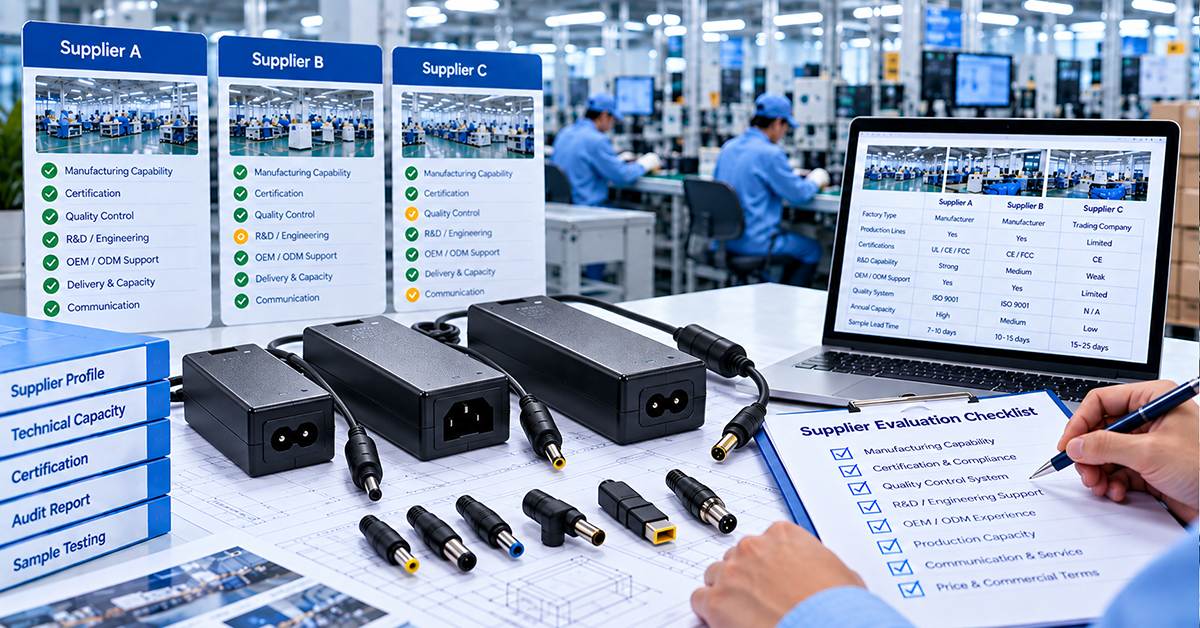
To choose a power adapter manufacturer in China for an OEM project, first separate a real manufacturer from a trading company, then verify what the factory can support by model: safety and EMC certification, process control, test coverage, and the customisation scope you need — connector, cable, labelling, packaging. Ask for evidence for your specific requirement rather than for the range as a whole.
What Makes a Power Adapter Manufacturer “Real” for an OEM Project?
A real manufacturer owns the production processes that determine the product: PCB assembly, transformer winding where applicable, final assembly, functional test and packaging. A trading company sells product it does not produce, and its technical answers usually route through a third party.
Both exist legitimately. The difference is not moral — it is who is accountable for design changes, production consistency and corrective action on your project.
How Do You Verify That a Supplier Is a Manufacturer, Not a Trading Company?
- Technical depth test. Ask questions only the producer can answer: why a specific topology was chosen, how derating behaves at your ambient, what happens to output at low mains. A trader relays; a manufacturer answers.
- Process questions. Ask which processes are in-house and which are outsourced, and by whom.
- Documentation for a batch. Request a test record tied to a specific lot, not a generic datasheet.
- Sample behaviour. Ask for a sample built to your specification — including a non-standard connector or cable. A trader tends to propose an existing model instead.
- Traceability. Ask how a unit is identified and how far back records reach.
Related guides: how to verify a real manufacturer · pre-order factory audit checklist.
What Certification Should a Chinese OEM Manufacturer Be Able to Support?
Certification is model and market specific. Ask for each market separately, and for the document that names the model and configuration:
| Route | Typical standards | What it addresses |
| Safety (IT/AV) | IEC/EN 62368-1, UL 62368-1 | Hazard-based safety for ITE/AV equipment |
| Safety (medical) | IEC/EN 60601-1 | Medical electrical equipment — model, application and market dependent |
| Safety (Class 2) | UL 1310 | Class 2 power units |
| EMC / harmonics | IEC 61000-3-2, FCC Part 15, EN 55032 | Harmonic current, conducted and radiated emissions |
| Market schemes | CE, PSE, KC, RCM, CCC, BIS | Market-specific routes |
Misconception to avoid: a manufacturer’s certificate list is not a promise about your product. Availability is available by model and confirmed against the destination market.
What Signals Suggest Higher Procurement Risk?
| Signal | Why it matters |
| Design answers that arrive without questions | Consistent answers that ignore your operating conditions rarely reflect engineering involvement |
| Certificates without model scope | A document that does not name a model cannot be verified against your requirement |
| No batch-level records | Makes a field problem unbounded |
| Rework handled informally | Process control is not in place at the station level |
| Component sources undisclosed | Second-source and availability risk lands on you later |
| Sample differs from specification without explanation | The configuration you approved is not the one being built |
How Do You Judge Process Control Remotely?
You cannot audit everything from a desk, but you can ask for process-shaped answers:
- What are the critical parameters for this product, and how are they recorded?
- At which points is the product checked, and what happens to a unit that fails?
- How does an engineering change reach the operator?
- Which records accompany a lot to the customer?
- Who signs off a change that affects a certified configuration?
Answers that reference stations, records and sign-offs describe a process. Answers that reference intentions describe a hope.
What Should the First Project Include?
- A written specification: output rating, peak case, ambient, connector, cable, target markets
- An approved physical sample, retained as a comparison reference for production lots
- A certification route and market list
- Label and packaging specification
- Agreed test documentation for first article and production lots
Frequently Asked Questions
Should I only consider large manufacturers in China?
Size is not the selection criterion; fit is. A smaller manufacturer with the right process, certification route and customisation scope can serve an OEM programme well, and a large one can still be wrong for your requirement.
Can I verify a factory without visiting?
Partially. Documentation, process questions, sample behaviour and batch records can be checked remotely. Physical verification — or a competent third-party audit — remains the stronger evidence where the programme risk justifies it.
Is a lower price a warning sign?
Not by itself. The useful question is what the price assumes: which components, which test coverage, and which configuration. A price without a specification is not comparable.
What should a manufacturer provide for a certified product?
The documentation that names the model, configuration and market — plus the change control that explains when re-testing would be required. Availability is confirmed by model.
Does the manufacturer need to be near my other suppliers?
Co-location helps with logistics and visiting, but it is not a qualification criterion. Process control, certification and communication matter more than geography.