
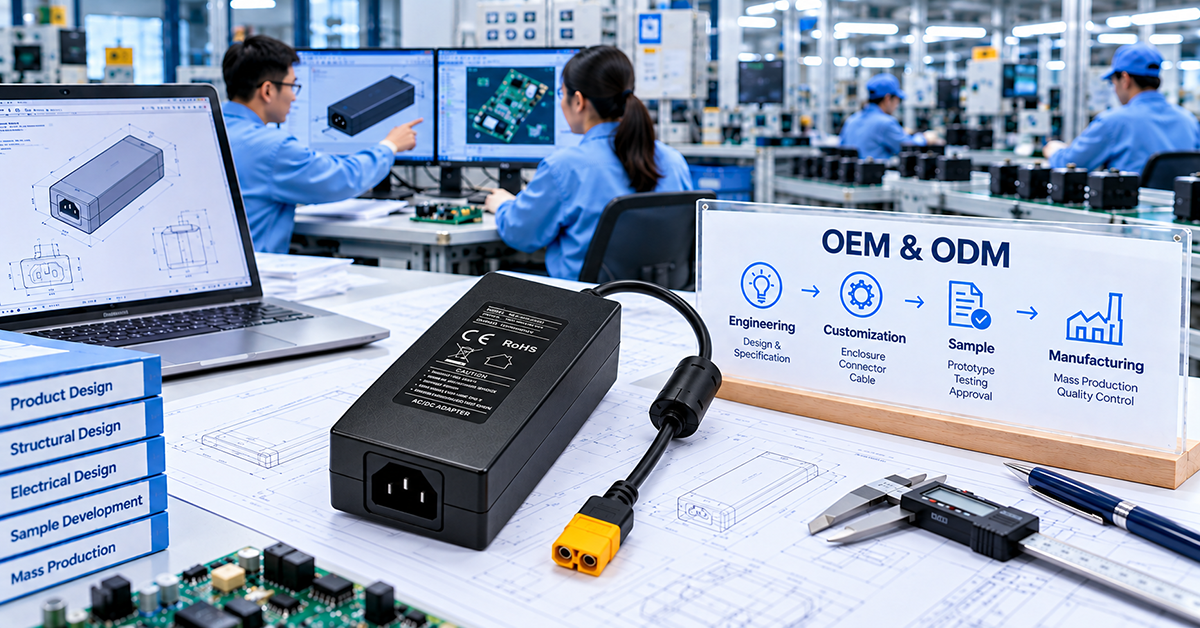
To choose an OEM power adapter factory, verify four things before commercial terms: whether it designs as well as assembles, which safety and EMC certifications it can support by model, how it demonstrates process control in production, and whether it can configure the output interface — connector, cable, labelling, packaging — to your requirement. Ask for each as evidence, not assurance.
What Should an OEM Power Adapter Factory Be Able to Do?
An OEM power adapter factory builds to a customer’s specification and configuration — output rating, connector, cable, labelling and packaging — rather than only selling catalogue models. That definition sets the first question: is the candidate structured to do that, or to resell someone else’s catalogue?
Capability criteria (use as a checklist):
| Criterion | What to ask for |
| Design capability | Who defines the circuit, transformer and thermal design — the candidate’s engineers, or a third party? |
| Manufacturing scope | Which processes are in-house: SMT, assembly, test, packaging? |
| Certification scope | Which standards can be supported available by model (e.g. IEC/EN 62368-1, IEC 60601-1, UL 1310, IEC 61000-3-2, FCC Part 15, EN 55032) — and for which markets? |
| Quality system | Documented process control, not only a certificate on a wall |
| Test capability | Functional test at defined load points, protection verification (OCP / OVP / SCP / OTP), and burn-in where applicable |
| Sampling | Can it produce a sample to your specification before tooling or volume commitments? |
| Supply chain | How are critical components and second sources managed? |
| Customisation | Which items are configuration, and which require a design programme? |
How Do You Verify Certification Claims Before Awarding a Project?
Verification steps:
- Ask which model and configuration the certificate covers, and for the documentation itself.
- Confirm the standard and edition the document references.
- Check who issued it, under which scheme.
- Ask which changes would require re-testing.
- Treat availability as model-specific: certification is available by model and depends on the model and the target market — not on the brand.
Common misconception: a certification badge on a website is evidence about *a* product. It is not evidence about your model, your configuration or your market.
What Evidence Shows That Manufacturing Is Under Control?
Process evidence is what separates a factory that has built a good sample from one that will ship a consistent batch:
- Written work instructions at the stations that affect the product
- Defined critical parameters — which may include torque, soldering conditions, seating or routing, depending on the design
- In-process checks positioned where a defect can still be corrected
- Batch or lot identification, so a later question can be traced to a production window
- An engineering change process that reaches the operator
Factory or Trading Company — Which Am I Talking To?
Comparison table:
| Signal | Manufacturer-typical | Trading-company-typical |
| Technical answers | Answers design questions directly (topology, derating, thermal) | Routes questions through a third party |
| Documentation | Can show process records for a specific batch | Supplies a generic catalogue and certificates |
| Change requests | Can explain what a change touches | Defers without a defined path |
| Sampling | Builds samples to a specification | Sends existing models |
| Traceability | Lot marking and records exist | Records may originate elsewhere |
Neither structure is automatically better — but the requirement changes: a trading company has to be managed as a supply-chain intermediary, while a manufacturer has to be managed as a production partner.
How Do You Compare Candidates Fairly?
- Send the same written requirement set to every candidate: output rating, peak case, ambient, connector, cable, markets.
- Ask each to state which items are configuration and which need engineering work.
- Ask for the same evidence type from each: certification coverage by model, process description, test approach.
- Compare on the requirement, not on the catalogue.
What Should You Settle Before the First Purchase Order?
- Approved specification and drawing set, plus an approved physical sample as a comparison reference
- Certification route and target market list
- Label and packaging specification
- Test and inspection records that will accompany a lot
- What may be changed later, and what triggers review
Frequently Asked Questions
Does an OEM factory need to be the design owner?
Not necessarily, but you should know who owns the design and who is accountable for changes. If design sits with a third party, the accountability path should be written down.
How do I confirm UL or CE coverage for my model?
Ask for the documentation that names the model and configuration, and confirm the standard and market it covers. Availability is confirmed by model — never assumed across a range.
Is a larger factory always the safer choice?
Size does not determine fit. What matters is whether the factory’s process, certification route and customisation scope match your requirement, and whether the evidence supports the claim.
What is the minimum I should ask for before sampling?
A written specification, the intended markets, and the interface requirements — connector, cable, mounting. Sampling costs money and time on both sides when these are left open.
Can packaging and labelling be part of the same programme?
Yes, where the programme is set up that way. Brand requirements are easier to plan with the product than to add at the end.
Next Step
Request a quote — “Send your specification, target markets and interface requirements, and we will respond against them.”