
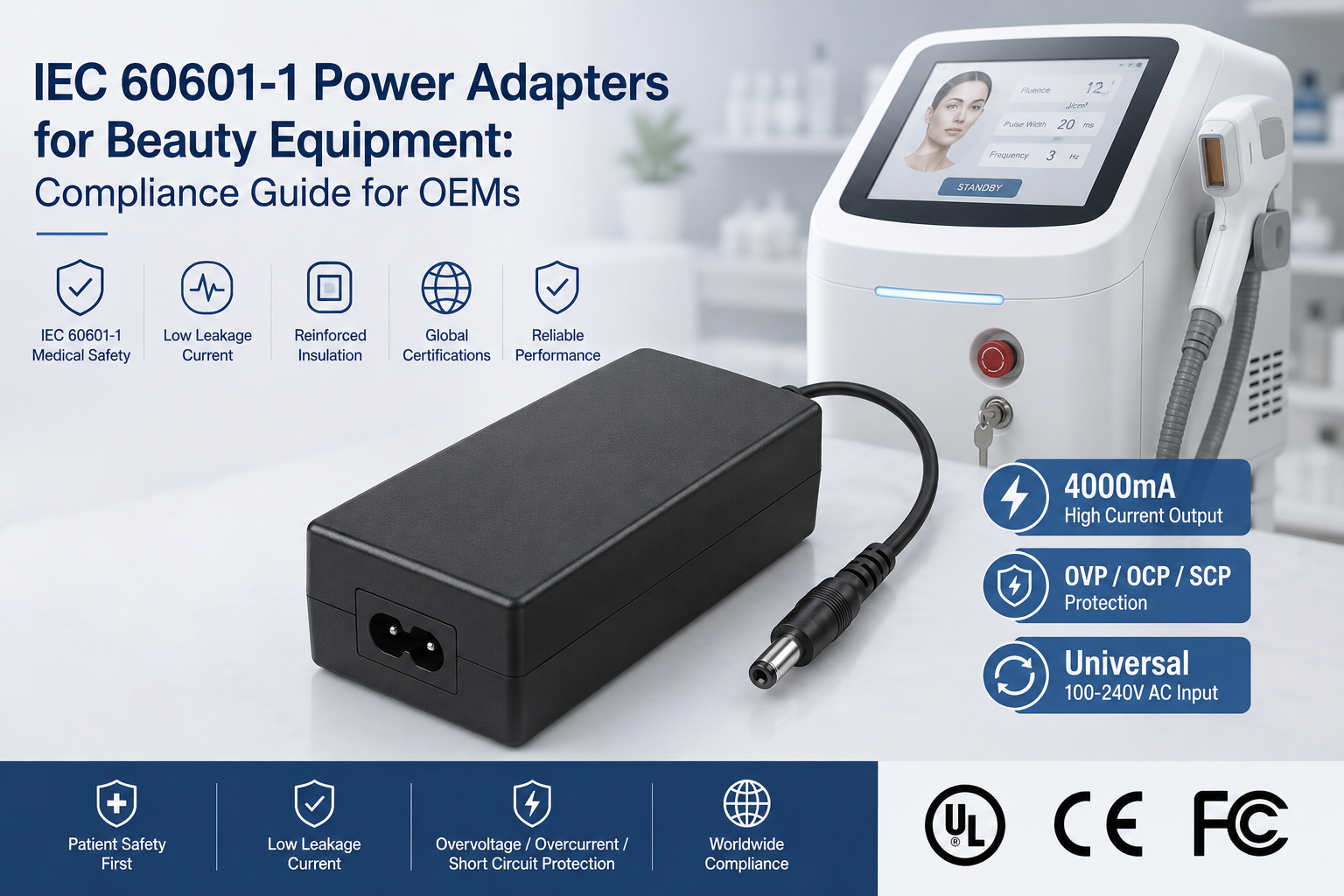
Beauty equipment manufacturers—producing IPL hair removal systems, diode laser platforms, RF skin tightening devices, and phototherapy equipment—increasingly need IEC 60601-1 certified power supplies for devices that are classified as medical electrical equipment. Whether IEC 60601-1 applies depends on the device’s intended use, therapeutic claims, and target market regulations—classification is confirmed case by case with the applicable certification body. The external power adapter is a critical component in this certification pathway, as it determines the isolation, leakage current, and safety characteristics at the interface between the AC mains and the patient-contact device.
This compliance guide addresses the specific IEC 60601-1 requirements that apply to beauty equipment power adapters, the certification pathway from component selection to end-product clearance, and the documentation protocol OEMs must follow to ensure regulatory acceptance. The focus is on commercial aesthetic devices—professional and home-use—not hospital or life-support equipment.
Which Beauty Equipment Types Typically Fall Under IEC 60601-1?
The following beauty and aesthetic device categories are commonly classified as medical electrical equipment and typically require IEC 60601-1 certified power adapters. Final classification depends on the device’s intended use, claims, and target market—confirm with your certification body before locking in the adapter specification:
| Device Type | Technology | Typical Power | Patient Contact Type |
|---|---|---|---|
| IPL hair removal | Intense pulsed light (flashlamp) | 120–240W | BF (body floating) |
| Diode laser hair removal | 808nm / 810nm diode laser | 150–300W | BF |
| RF skin tightening | Radio frequency (1–6MHz) | 100–200W | BF |
| Fractional laser resurfacing | CO₂ or Er:YAG laser | 100–250W | BF |
| LED phototherapy panels | LED arrays (visible/NIR) | 36–100W | BF (skin contact) |
| Cryolipolysis devices | Controlled cooling | 65–180W | BF |
| HIFU skin lifting | High-intensity focused ultrasound | 120–200W | BF |
| Microcurrent facial devices | Low-level electrical current | 12–36W | BF |
Why This Matters
- For devices classified as medical electrical equipment, using a non-certified adapter prevents end-product IEC 60601-1 certification—there is no exception for “low-risk” classifications
- The classification tier (B, BF, or CF) determines the adapter’s required isolation level—skin-contact devices are at minimum Type BF when in scope
- Home-use devices with therapeutic claims sold in the EU generally fall under MDR and require IEC 60601-1 compliance—confirm your device’s classification with your notified body
- Determine the patient contact classification for your specific device early in development—Type BF is the minimum for any skin-contact device
- Map your target markets (EU MDR, US FDA 510(k), Health Canada, etc.) to their IEC 60601-1 adoption status—most markets accept Edition 3.1
- Include the power adapter’s certification documentation timeline in your overall project schedule—adapter certification is on the critical path
Useful Links
Application page: Medical Aesthetic Power Solutions →
Related article: IEC 60601-1 Certification Guide →
Q: Are home-use IPL devices exempt from IEC 60601-1?
A: Generally no. Home-use IPL devices with therapeutic claims sold in the EU are typically subject to MDR (Medical Device Regulation), which requires IEC 60601-1 compliance. The applicable product-specific standard is IEC 60601-2-115 for home-use aesthetic equipment, and the power adapter must meet the same IEC 60601-1 requirements as professional-grade devices. Classification should be confirmed with your certification body.
Q: Do RF skin tightening devices have different power adapter requirements than IPL?
A: The certification requirements are the same (IEC 60601-1, 2×MOPP, ≤100µA leakage for BF type). However, RF devices may have higher current draw at the operating frequency, requiring attention to the adapter’s current output capability and low-frequency ripple performance.
The IEC 60601-1 Adapter Certification Pathway for Beauty OEMs
The pathway from selecting a power adapter to achieving end-product IEC 60601-1 certification for a beauty device follows these stages:
Stage 1: Component Selection (Weeks 1–4)
- Identify adapters with published IEC 60601-1 Edition 3.1 certification — medical-grade options are available by model (e.g., YHY-12005000 12V/5A and YHY-24002500 24V/2.5A carry IEC/EN 60601-1 certification, certificate CTC20231117SC01/EC; other models available on request)
- Verify model-specific CB certificate matches the exact model number
- Confirm leakage current ≤100µA (BF-type) and 2×MOPP isolation
- Request the manufacturer’s test reports (leakage current, dielectric strength, EMC)
- Check national deviation coverage for target markets (EU, US, Canada, Australia, etc.)
Stage 2: Design Integration (Weeks 4–10)
- Integrate the adapter into the device design with proper connector and cable management
- Design the device’s internal DC input circuitry (input protection, filtering, boost converter)
- Plan the adapter placement and thermal management per manufacturer specifications
- Document the adapter’s compliance contribution to the risk management file
Stage 3: Pre-Compliance Testing (Weeks 10–14)
- Conduct internal leakage current and dielectric testing with the selected adapter
- Perform pre-scan EMC testing (radiated and conducted emissions, immunity)
- Verify the adapter maintains stable output under the device’s pulsed or variable load
- Address any interference coupling between the adapter and the device’s energy delivery circuits
Stage 4: Certification Testing (Weeks 14–22)
- Submit to a notified body or accredited testing laboratory
- Full IEC 60601-1 safety testing (leakage current, dielectric, enclosure, protection)
- IEC 60601-1-2 EMC testing (complete system, including adapter)
- Risk management file review per ISO 14971
- If applicable, product-specific standard (IEC 60601-2-115 for home-use aesthetic)
Stage 5: Documentation & Filing (Weeks 22–26)
- Compile the CB certificate, test reports, and risk management file
- Prepare the technical documentation for CE marking (EU) or 510(k) submission (US)
- Ensure the adapter’s certification documents are organized by model number and target market
- Include the adapter as a declared component in the device’s certification application
The total certification timeline is approximately 18–26 weeks from adapter selection to end-product certification, depending on the complexity of the device and the notified body’s capacity.
Why This Matters
- The adapter selection stage determines the floor for leakage current and isolation—changing adapters after design integration can set the project back 4–8 weeks
- Pre-compliance testing at Stage 3 is the most cost-effective point to identify adapter-related issues—a full certification failure at Stage 4 adds $10,000–25,000 and 8–16 weeks
- The risk management file must document the adapter as a safety-critical component, including its certification status and the rationale for its selection
What OEMs Should Do Now
- Create a certification timeline graph with adapter selection as the gating milestone—no adapter selection = no certification start
- Send the adapter manufacturer’s certification documentation to your notified body for pre-review before full submission
- Budget for two adapter qualification samples (one for device integration, one for component-level testing)
Useful Links
Related article: IEC 60601-1 Certification Guide →
CTA: Discuss Your Certification Requirements →
Q: Can the power adapter certification be done in parallel with the device certification?
A: If selecting an already-certified adapter (not requiring new certification), the adapter documentation can be prepared in parallel with device design. If the adapter itself requires new certification (custom output voltage, etc.), this adds 12–20 weeks and should be started as early as possible.
Q: How long is the adapter’s IEC 60601-1 certification valid for my device submission?
A: Adapter certification is typically valid for 3–5 years, subject to the standard edition. As long as the adapter’s certification is current and covers Edition 3.1, it can be used for device submissions. Confirm the expiry date with the manufacturer.
Model-Specific Verification — Avoiding Certification Gaps
The single most common compliance error beauty equipment OEMs make is assuming a manufacturer’s “IEC 60601-1 certified” product family guarantees each model’s certification. IEC 60601-1 certification is model-specific, not family-wide. The following verification workflow prevents this gap:
1. Identify the exact model number of the adapter you intend to use (e.g., YHY-12005000 or YHY-24002500 medical-grade models) 2. Request the CB certificate for that specific model from the manufacturer 3. Verify the model number on the certificate matches the model number on the product label (these must be identical) 4. Confirm the certificate covers IEC 60601-1 Edition 3.1 (the standard edition identifier must be on the certificate) 5. Check that the certificate lists all required national deviations for your target markets 6. Review the test report to confirm leakage current ≤100µA for BF-type patient connection 7. Document all verification steps in the device’s technical file
Why Model-Level Verification Matters
A 65W and a 90W adapter from the same medical series may appear similar but can have significantly different certification coverage. For example:
- 65W model: CB certificate covers EU (EN 60601-1), US (UL 60601-1 via CB), Canada (CSA), Australia (AS/NZS)
- 90W model: CB certificate covers EU and US only—Canada and Australia require separate testing due to higher output affecting leakage current and thermal performance
On the surface, both are “IEC 60601-1 certified.” But the 90W model lacks the coverage the OEM needs for Canadian and Australian market access. This gap is only discovered during the certification documentation review—ideally before production, not during notified body submission.
Why This Matters
- A certification gap discovered during notified body review stalls the submission and requires either a new adapter search (4–8 weeks) or additional regional certification (8–12 weeks)
- The investment in model-specific verification at selection stage is negligible compared to the cost of a certification gap during submission
- The adapter manufacturer’s sales materials may not list the certification coverage per model—you must request the specific certificate
What OEMs Should Do Now
- Create a certification coverage matrix: List each target market in rows, each adapter candidate in columns, mark coverage based on actual CB certificates
- Request certification documents from at least two manufacturers, even if you have a preferred supplier—this creates a verification baseline
- Keep a digital library of certification documents organized by model number and market, updated annually
Useful Links
Related article: IEC 60601-1 Certification Guide →
Certification page: Global Certifications Overview →
Q: If my device only targets the EU market, do I need to check national deviations?
A: Yes. Even within the CB scheme, the CB report must include the EN 60601-1 national deviation for EU acceptance. Without it, the notified body may request additional testing. Always request the full CB report including national deviation pages.
Q: Can a component-level CB certificate be reused for multiple device models from the same OEM?
A: Yes, as long as the adapter model and configuration remain the same. The adapter’s CB certificate documents the component’s compliance, which can be referenced in multiple end-product certification submissions. Keep the original certificate file accessible for each submission.
Leakage Current Requirements for Beauty Equipment
Beauty equipment that contacts the patient’s skin—whether through a conductive handpiece (RF), optical window (IPL, laser), or direct electrode (microcurrent)—is classified as Type BF under IEC 60601-1. The leakage current limits for BF-type equipment are:
| Leakage Type | Normal Condition | Single Fault Condition |
|---|---|---|
| Earth leakage | ≤500µA | ≤1000µA |
| Enclosure leakage | ≤100µA | ≤500µA |
| Patient leakage (BF) | ≤100µA | ≤500µA |
| Patient leakage (CF) | ≤10µA | ≤50µA |
- The power adapter typically accounts for 30–60µA of earth leakage at nominal voltage
- The device’s internal circuitry (EMI filters, boost converters, control electronics) adds 10–40µA
- The combined patient leakage must remain below 100µA, leaving 20–40µA of headroom for internal circuitry
- Additional filtering components (Y-capacitors) in the device’s power input can increase leakage current, reducing available headroom
Why This Matters
- Selecting an adapter with lower earth leakage (e.g., 30µA instead of 55µA) provides more headroom for the device’s internal circuitry
- Adding internal EMI filters at the device’s power input can increase leakage current by 10–20µA—test this early
- Leakage current increases with applied voltage: the IEC 60601-1 requirement tests at 110% of rated voltage, so a 240V-rated adapter will be tested at 264VAC
- Request the adapter’s leakage current test report showing values at nominal and 110% rated voltage for all three leakage types
- Add a leakage current budget worksheet to your device specification: adapter contribution + internal circuitry contribution ≤ 100µA
- If your device includes additional input filtering, measure the system-level leakage current (adapter + device) at the prototype stage
Useful Links
Product page: YHY-12005000 Medical Desktop Adapter →
Related article: IEC 60601-1 Certification Guide →
Q: Can a beauty device achieve ≤100µA patient leakage if the adapter alone measures 80µA?
A: It depends on the internal circuitry. With only 20µA of headroom remaining, the device’s input filtering, boost converter, and control electronics must be carefully designed to stay below this limit. Professional medical adapters targeting aesthetic applications typically achieve 30–50µA earth leakage to provide adequate design margin.
Q: Does the leakage current requirement change for home-use vs professional beauty devices?
A: No, for devices within IEC 60601-1 scope. Professional and home-use beauty devices that contact the patient’s skin are classified as Type BF under IEC 60601-1, and the ≤100µA patient leakage limit applies equally. There is no “relaxed” home-use leakage limit for devices with skin contact.
Documentation Requirements for Beauty Device Certification
When submitting a beauty device for IEC 60601-1 certification, the following power adapter documentation must be included in the technical file:
Required Documents (from adapter manufacturer)
1. CB test certificate (IEC 60601-1 Edition 3.1) — showing exact model number 2. CB test report — includes national deviation pages for all target markets 3. Leakage current test report — earth leakage, enclosure leakage, patient leakage at nominal and 110% voltage 4. Dielectric strength test report — 4kVAC type test and 2.5kVAC production test results 5. IEC 60601-1-2 EMC test report — emissions and immunity for medical equipment 6. ISO 9001:2015 certificate — confirming quality management system 7. Manufacturer’s declaration of conformity (CE) — for EU market submissions
Internal Documents (from beauty device OEM)
8. Risk management file entry (ISO 14971) — documenting the adapter as a safety-critical component 9. Component specification — adapter electrical parameters, operating limits, and derating conditions 10. Integration verification — test results showing the adapter operates within specifications when integrated with the device 11. Labeling verification — confirming the adapter’s label matches the certified model number
The notified body or certification lab will review these documents as part of the device’s technical file audit. Missing or incomplete adapter documentation is one of the most common reasons for certification delays in beauty equipment submissions.
Why This Matters
- Notified bodies report that 30–40% of beauty equipment certification submissions have incomplete or incorrect power adapter documentation on first review
- A request for additional documents from the notified body adds 2–4 weeks to the review cycle per iteration
- Having the documentation organized and pre-reviewed before submission can save 4–8 weeks in total certification time
What OEMs Should Do Now
- Create a certification documentation checklist based on the list above and track each item’s status
- Request all documents from the adapter manufacturer at the beginning of the selection process, not when certification submission is imminent
- Have your quality or regulatory team pre-audit the adapter documentation package before sending to the notified body
Useful Links
CTA: Discuss Your Certification Requirements →
Certification page: Global Certifications Overview →
Q: Is the adapter manufacturer’s ISO 9001 certificate sufficient, or is ISO 13485 required?
A: ISO 9001:2015 is the minimum accepted standard for component suppliers in most medical device certifications. ISO 13485 (medical device QMS) is preferred but not always required for component manufacturers. Confirm with your notified body whether ISO 13485 is expected for power adapter suppliers in your specific device category.
Q: How should the adapter documentation be organized in the technical file?
A: Create a dedicated “Critical Components” section with sub-folders by component type. The adapter folder should organize documents by: certification certificates, test reports, manufacturer declarations, and integration verification. Use a consistent naming convention: [Model Number]_[Document Type]_[Date].
Conclusion
IEC 60601-1 compliance for beauty equipment requires a systematic approach to power adapter selection and verification. The key requirements—2×MOPP isolation from mains to output, ≤100µA patient leakage current for BF-type devices, and model-specific certification documentation—are non-negotiable for skin-contact aesthetic devices classified as medical electrical equipment.
The certification pathway follows a predictable sequence: component selection with model-specific verification (4 weeks), design integration (6 weeks), pre-compliance testing (4 weeks), certification testing (8 weeks), and documentation filing (4 weeks). Proper planning at the adapter selection stage is the single highest-impact step for avoiding delays.