
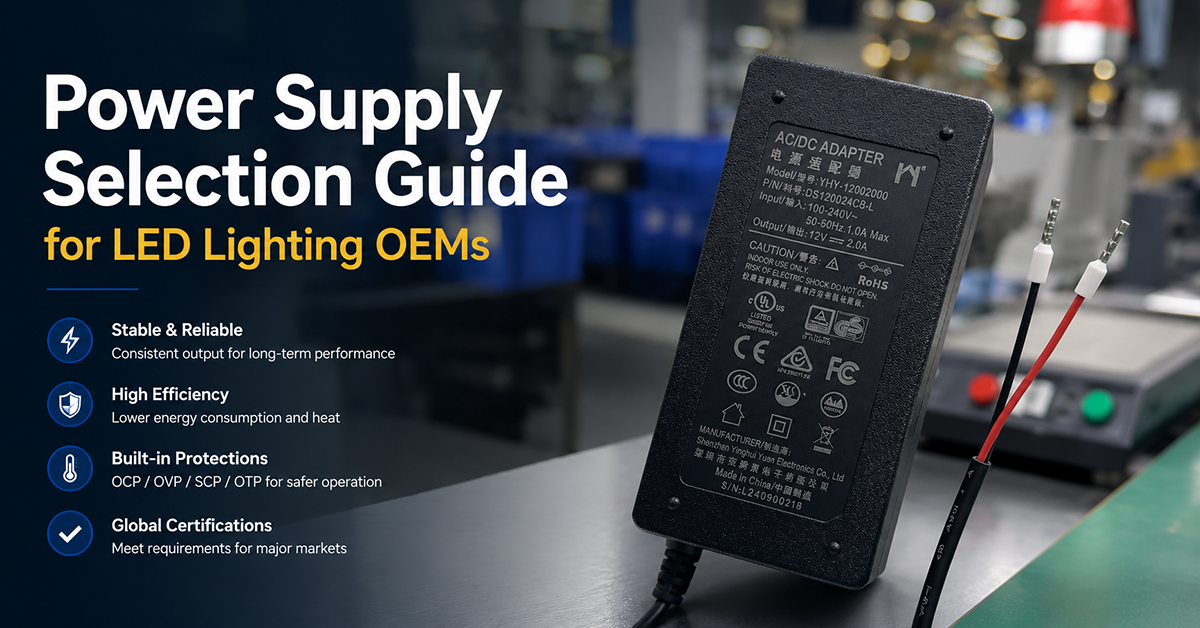
For an LED lighting OEM, the power supply is where several requirements meet: the electrical characteristic of the load, the dimming method, the power quality rules of the target market, and the thermal reality of the luminaire. Getting the architecture right first makes the later decisions simpler.
This guide covers the parameters that matter most when selecting a power supply for an indoor LED lighting system: constant current versus constant voltage architectures, how to size a constant-voltage supply, dimming compatibility, power factor and harmonic requirements by market, thermal derating inside a luminaire, and the certification pathway for the target markets.
YHYadapter product positioning: YHYadapter provides regulated constant-voltage (CV) AC/DC power adapters for indoor LED lighting systems where a CV bus supplies LED modules, strip, signage and panels with their own current-limiting or driver stages. Constant-current (CC) LED drivers are discussed here as an industry architecture option and are outside YHYadapter’s current product scope; for luminaire-integrated direct LED drive, dedicated CC drivers from lighting driver manufacturers apply.
Constant Current vs Constant Voltage: Which Architecture Suits Your Design?
The first decision is whether the load needs a regulated current or a regulated voltage. The two architectures behave differently, and using the wrong one is a common cause of poor light output and premature LED failure.
Constant current (CC) — an industry architecture. A CC driver regulates output current to a fixed value, letting the voltage settle wherever the LED string requires. This suits direct LED array drive, where the string’s forward voltage shifts with temperature and with binning. Output ratings are commonly expressed as a current (for example several hundred milliamps to about one amp) with an output voltage window that has to bracket the string voltage at all operating conditions.
Constant voltage (CV). A CV supply holds a fixed output voltage — commonly 12 V or 24 V — and delivers whatever current the load draws. This suits LED strip, signage modules and panels that contain their own current-limiting or driver stages, because each module regulates its own current from a fixed rail.
Matching the architecture to the load:
- If the fixtures regulate their own current, a CV supply is the design choice.
- If the luminaire drives an LED string directly, a CC driver is required, and its output voltage window must cover the string.
- Some designs combine the two: a CV supply feeding a driver stage, which is effectively a CV front end with local current regulation.
Sizing a Constant-Voltage Supply for an LED Load
Where the supply provides a constant-voltage rail, the sizing exercise is to establish the load’s real range rather than a single figure.
- Total current at full output. Sum the modules’ currents at maximum brightness, not at a typical setting.
- Voltage tolerance. The rail has a tolerance, and the connected modules have their own input range; both are part of the requirement.
- Start-up behaviour. Modules and their input capacitors draw a brief current at power-up, and the supply must start into that load.
- Load variation. Dimming changes the current the supply delivers, and the load may change again as modules are added or removed.
- Margin over life. The current drawn can shift with ageing and with the modules’ own tolerance, so the sizing margin is a design decision rather than an overhead.
Recording these in the specification is what keeps the selection unambiguous; a supply chosen against an average figure leaves the full-output case undefined.
Dimming Compatibility
Dimming is where the lighting design and the power design meet, and the interfaces are not interchangeable. The dominant methods each expect something different from the supply.
0–10 V (analog). A two-wire analog signal where the control voltage sets the output level. It is polarity-sensitive, and it is widely supported on commercial drivers. The control wiring is low voltage and follows the applicable wiring rules for the installation.
DALI (digital, addressable). A two-wire digital bus with a defined DC bus voltage and individually addressed devices. It supports scene control, grouping and status feedback, and it requires the supply or driver to provide the bus interface.
PWM (pulse-width modulation). The output current is switched at a fixed frequency with a varying duty cycle. The frequency matters for perceived flicker, and the driver must have a PWM input.
Phase-cut (leading or trailing edge). The AC input is phase controlled, which suits legacy dimmer infrastructure but is the most demanding for a supply. Compatibility is system-specific: a phase-cut-capable supply still has to be tested with the particular dimmer it will be installed with.
Why compatibility matters: a supply that expects 0–10 V and a control system that sends a digital bus will not dim at all. The method, and who interprets it, has to be settled before the supply is chosen.
Power Quality: Power Factor and Harmonics by Market
Power factor and harmonic current requirements are set by the target market, the product type and the power level. They are a selection input, not a final check.
| Market | Requirement area | Common reference | Typical scope |
| EU | Harmonic current limits | EN 61000-3-2, lighting equipment class | Lighting equipment above the threshold the standard defines |
| EU | EMC (emissions, immunity) | EN 55015 / EN 61547 family | Lighting equipment |
| USA | Power factor (where specified) | Energy-programme requirements | Products claiming the programme |
| USA | EMC | FCC Part 15 Subpart B | Digital electronic products |
| International projects | Project specification | Depending on the project | Often specified per project |
Power factor and harmonic limits differ by market, product class and power level. The applicable standard edition and the product’s classification decide what applies, and the supply’s documentation has to match.
Active power-factor correction is one common route to meeting harmonic limits, and the design approach depends on the required performance and the applicable standard edition. Efficiency figures are design- and platform-dependent; they are confirmed against the specific model’s test data rather than assumed across a range.
Thermal Derating for Indoor Lighting Installations
A luminaire is a warm enclosure by design: the LEDs are a heat source, and the enclosure retains what they produce.
- The supply’s rated output may reduce as ambient temperature rises, following the derating curve for the specific model
- The temperature that matters is the one inside the luminaire, not the room
- Continuous operation means the steady-state case is the design case
- Where the supply is mounted remotely from the LED array, the ambient it sees can be lower, which changes the derating position
The practical consequence is that the derating position should be evaluated against the internal ambient of the installation. A supply selected for room temperature may be operating outside its comfortable range inside a closed fitting.
Certification and Documentation for LED Lighting Products
Certification follows the model and the market, so the questions to settle early are which markets the product targets and what documentation each requires.
- Which requirements apply, given the product class and the destination market
- What the supplier’s documentation covers: which standard, which edition, which model or configuration
- Whether the document set is current when the product or the configuration changes
Certification availability for a given supply is by model and depends on the model and the target market.
Frequently Asked Questions
Should an indoor LED system use a constant-voltage supply or a constant-current driver?
It depends on where the current is regulated. LED strip and modules that contain their own current-limiting stages suit a constant-voltage supply; a luminaire that drives an LED string directly requires a constant-current driver.
Can a standard constant-voltage adapter drive a bare high-power LED module?
A constant-voltage source does not regulate current, so the LED current would be uncontrolled. Direct LED drive needs a constant-current stage, either a CC driver or a current regulator in series.
Which dimming methods should I support?
The one the installation uses. Analog, digital, pulse-width and phase-cut methods have different interfaces and are not interchangeable, so the method is settled before the supply is chosen.
Do power factor and harmonic requirements apply to every LED product?
No. They depend on the target market, the product class and the power level, and the applicable standard edition decides what is required.
Is certification the same across a power supply range?
No. Certification availability is by model and depends on the model and the target market, so the applicable requirements are confirmed for the specific product and destination.
Related Resources
- LED Lighting
- Indoor LED Power Supply Design (link after publication)
- Reading Efficiency Figures (link after publication)