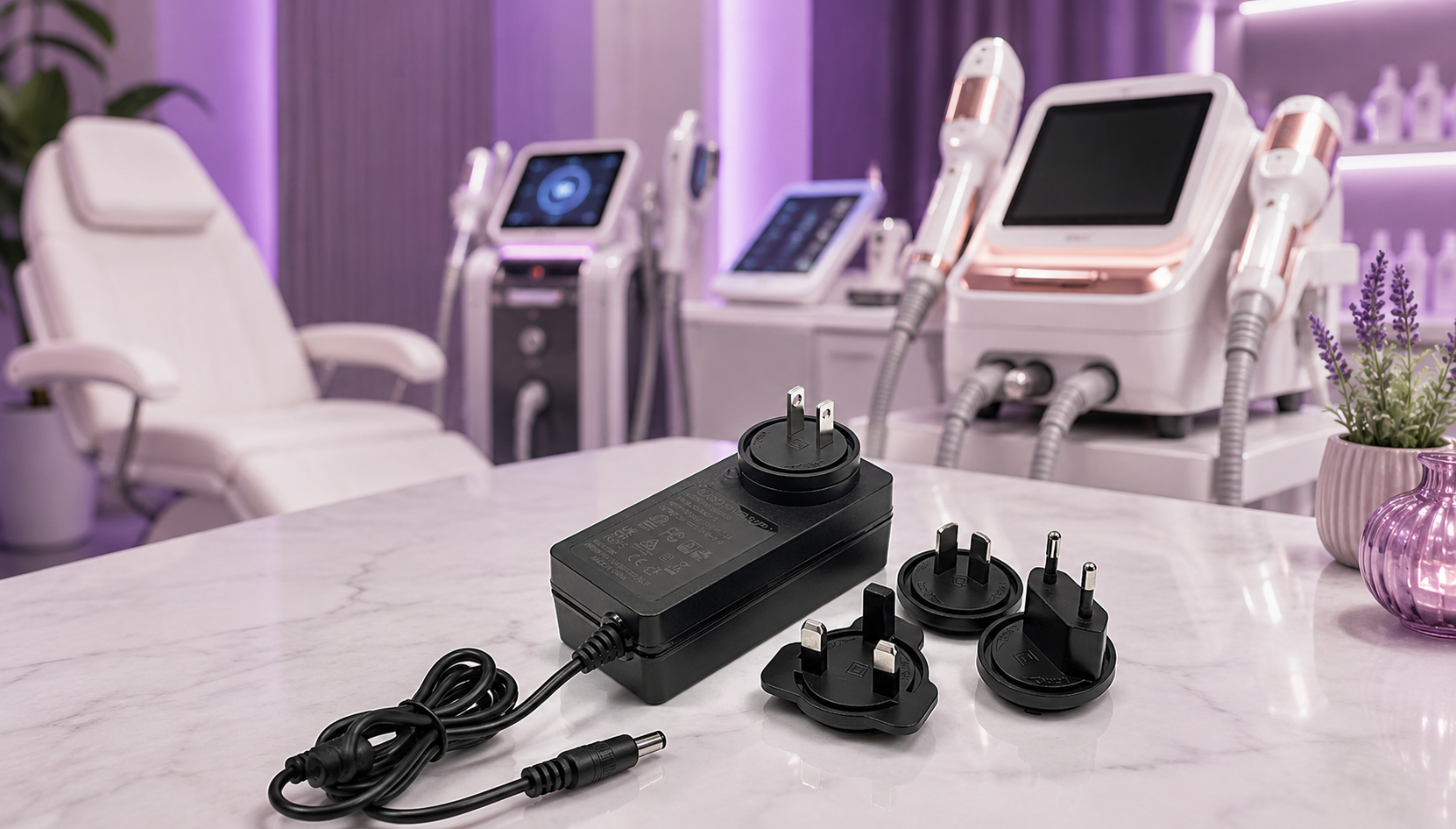
An engineering guide for OEMs integrating charging solutions into professional beauty equipment
Professional beauty devices — including handheld IPL units, RF skin treatment tools, microcurrent devices, and portable aesthetic equipment — increasingly rely on rechargeable battery systems for cordless operation. Selecting the correct battery charger is not a simple accessory decision; it directly affects device safety, battery life, regulatory compliance, and end-user experience.
This guide covers the key engineering considerations when selecting a battery charger for rechargeable professional beauty equipment.
Understanding the Charging Profile
Rechargeable beauty devices commonly use lithium-ion (Li-ion) or lithium-polymer (LiPo) battery packs. These chemistries require a specific charging profile — typically CC/CV (Constant Current / Constant Voltage).
Why this matters for beauty equipment OEMs:
- Voltage match: Most professional rechargeable beauty devices use a 12.6V charging voltage (for 3S Li-ion packs). Using an incorrect voltage charger can damage the battery or trigger protection circuits.
- Current rating: The charger’s current output determines charge speed. A 2A charger charges faster than a 1A charger, but the device’s Battery Management System (BMS) must support the current draw.
- Charge termination: Quality chargers implement auto-cutoff when the battery reaches full charge — essential for both safety and battery cycle life.
Recommendation: Always match the charger’s output voltage to the battery pack’s full-charge voltage (e.g., 12.6V for 3S Li-ion). Confirm the current rating is within the BMS specification.
Connector Types and Mechanical Fit
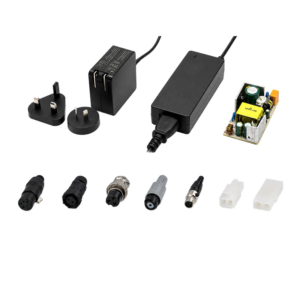
The physical interface between charger and device must be reliable over thousands of charge cycles. Common connector types for professional beauty equipment include:
| Connector Type | Typical Use | Durability |
|---|---|---|
| DC Barrel (5.5×2.1mm / 5.5×2.5mm) | Most common for ≤60W chargers | Good — widely available |
| Mini / Micro DC | Compact handheld devices | Moderate — smaller contact area |
| Magnetic / Pogo Pin | Premium, wear-reduction designs | Excellent — no mechanical wear |
| Custom OEM Connector | Branded docking stations | Project-specific |
Engineering considerations:
- Insertion/removal cycle life (test to 5,000+ cycles for professional devices)
- Strain relief at the device entry point
- Locking mechanism for devices subject to movement during charging
- IP rating if charging in non-clean environments
Protection Circuits — Safety Is Not Optional
A properly designed battery charger for professional beauty equipment should include multiple protection layers:
- Over-Voltage Protection (OVP) — Prevents the charger from outputting voltage above the safe limit
- Over-Current Protection (OCP) — Limits output current to prevent overheating
- Short-Circuit Protection (SCP) — Disables output in the event of a short
- Reverse Polarity Protection — Prevents damage if the connector is accidentally reversed
- Over-Temperature Protection (OTP) — Thermal shutdown if internal temperatures exceed safe limits
These protections are particularly important in beauty equipment, where devices may be charged in various environments and by end users who may not follow ideal charging practices.
Certification Considerations
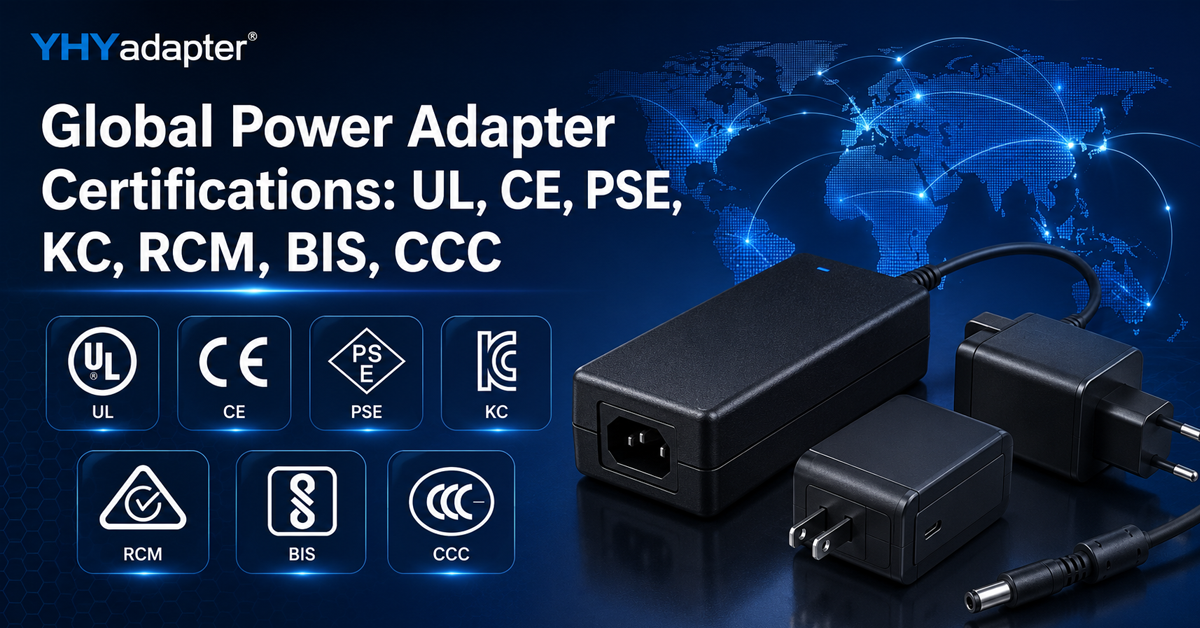
Battery chargers for beauty equipment sold in regulated markets require applicable safety certifications. The specific certifications depend on the target market:
| Market | Certifications | Notes |
|---|---|---|
| North America | UL / ETL (UL 1310 for Class 2 power units) | Safety standard for power adapters and chargers |
| European Union | CE (LVD + EMC directives) | Self-declaration with technical documentation |
| Japan | PSE (Electrical Appliance and Material Safety Law) | Mandatory for power adapters sold in Japan |
| South Korea | KC (KC 60950-1 / KC 62368-1) | Mandatory certification |
| Australia / NZ | RCM (EMC + Electrical Safety) | Compliance mark for supply to Australian market |
| Global | CB Scheme | Facilitates certification in multiple markets |
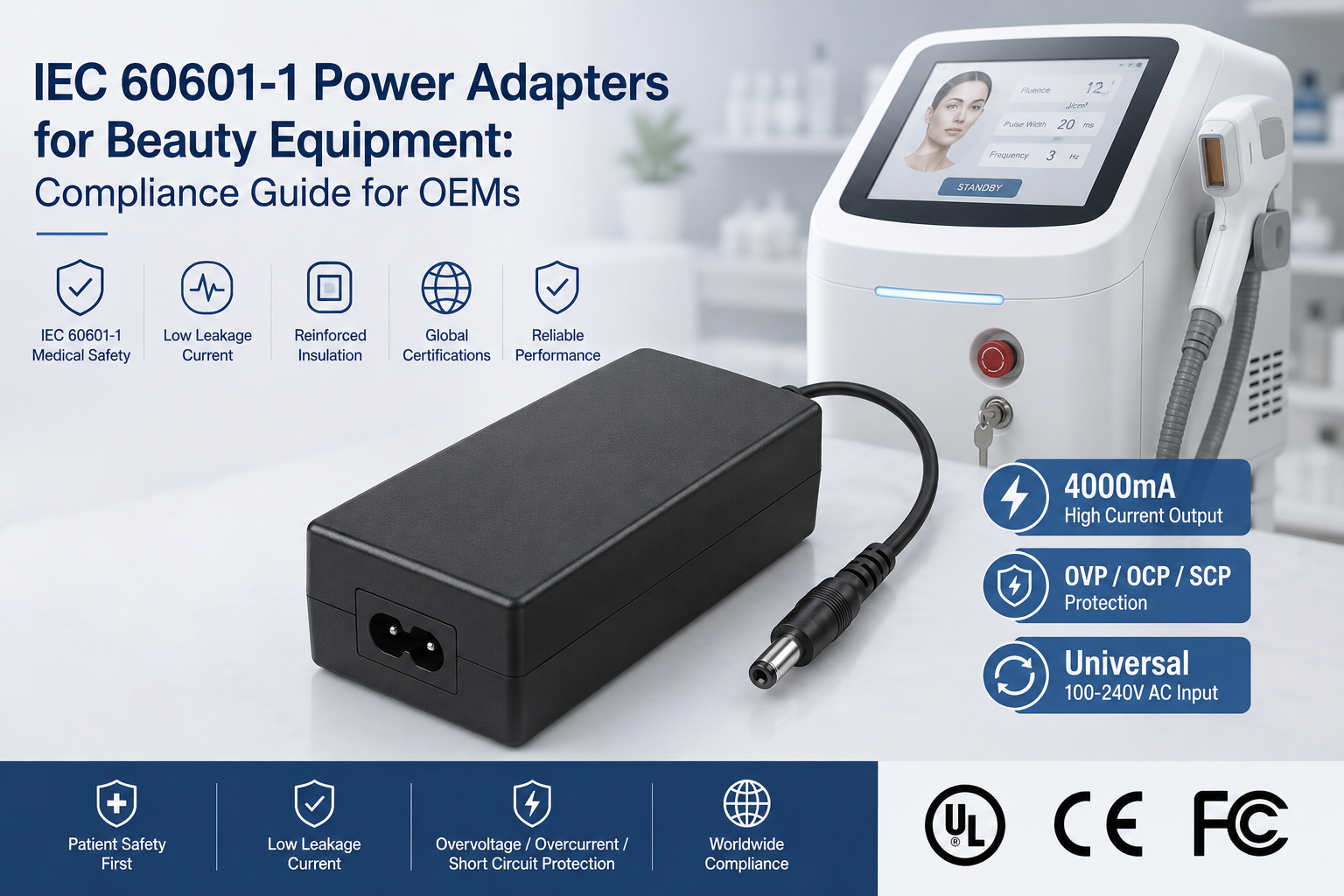
Important note for beauty devices: If the complete device is submitted for medical safety certification (e.g., IEC 60601-1), the charger may be evaluated as part of the Medical Electrical System. This should be discussed with your certification body on a per-project basis. YHYadapter can provide technical documentation to support end-device certification.
Recommendation: Identify target markets early in the product development cycle. Charger certification lead times vary by market — plan for 4–12 weeks depending on certification body workload.
OEM Customization Options
For beauty equipment OEMs, the charger is often customized to match the device’s brand identity and functional requirements:
- Custom voltage and current — Non-standard outputs for proprietary battery configurations
- Custom cable length — Short cables for travel kits, long cables for stationary charging stations
- Custom connector — Branded magnetic tips or proprietary docking interfaces
- Label and packaging — OEM branding on the charger body and retail packaging
- LED indicators — Custom charge status indication (color, pattern, brightness)
YHYadapter supports OEM customization projects for battery chargers used in professional beauty equipment, with minimum order quantities that scale from pilot runs to volume production.
Engineering Checklist for Charger Selection
Before specifying a battery charger for your rechargeable beauty device, verify the following:
| Check | Question |
|---|---|
| □ | Is the charger output voltage matched to the battery pack’s full-charge voltage? |
| □ | Is the current rating compatible with the BMS charge current specification? |
| □ | Does the charger implement CC/CV charging with auto-cutoff? |
| □ | Are over-voltage, over-current, and short-circuit protections present? |
| □ | Does the connector meet cycle-life and mechanical reliability requirements? |
| □ | Are the required certifications identified for all target markets? |
| □ | Has the charger been tested with the actual device to verify compatibility? |
CTA Section
Need a battery charger for your rechargeable beauty device?
YHYadapter manufactures desktop battery chargers (12.6V, 2A–3A) and AC/DC adapters for professional beauty equipment. Contact our engineering team to discuss your charging requirements, connector preferences, and certification needs.
Related Resources
🔌 Related Products
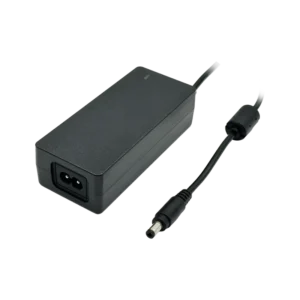
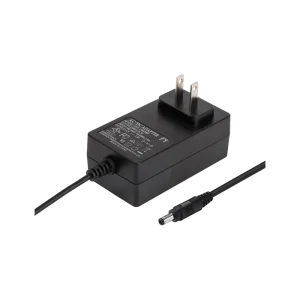
12.6V 4A 50W Li-Ion Charger
Recommended charging platform for the 3-series Li-Ion devices covered in this article
🏭 Related Applications
📖 Related Guides
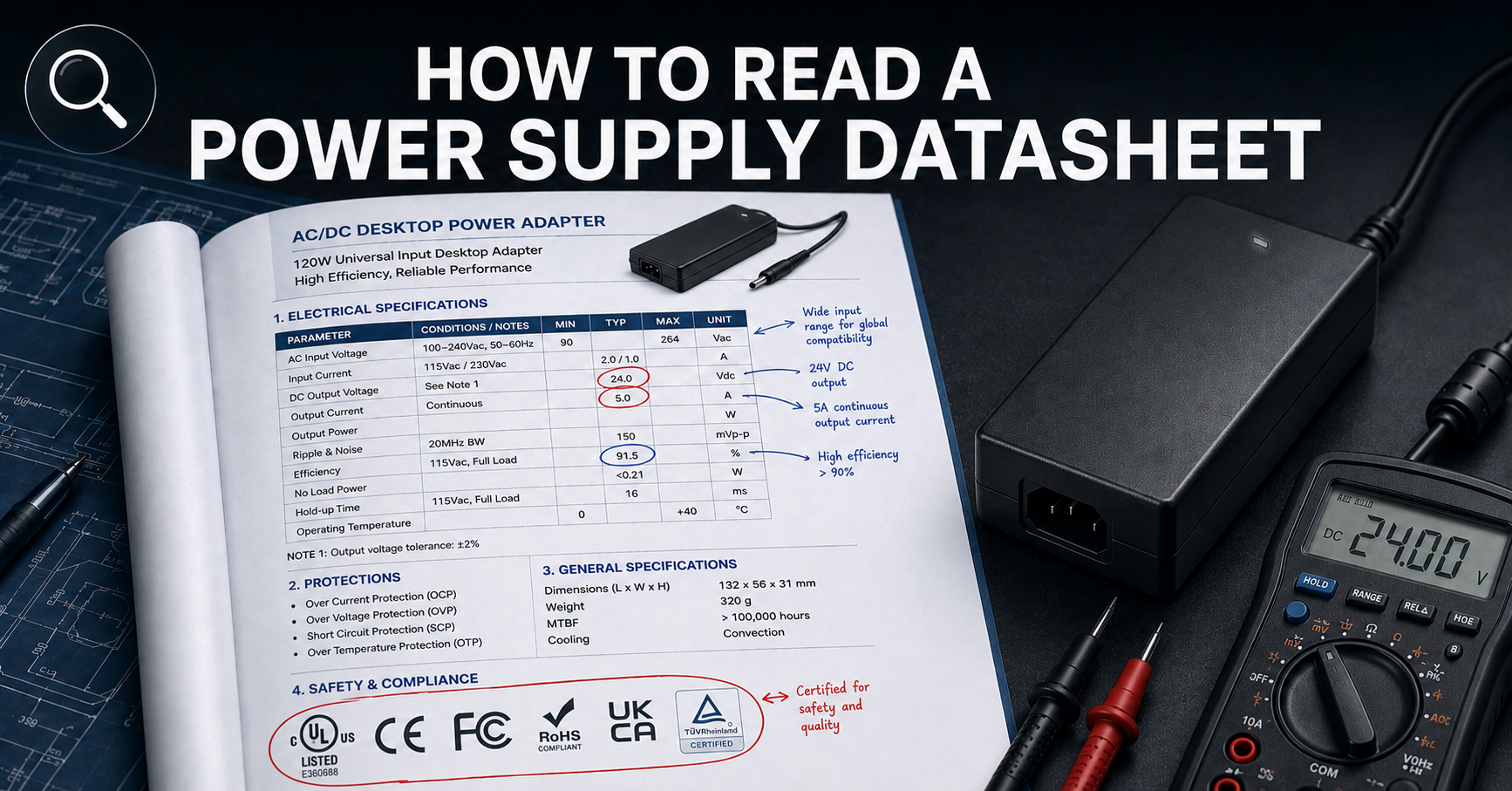
How to Read a Power Supply Datasheet
Learn how to evaluate connector specifications in a datasheet — current ratings, derating curves, certification verification.
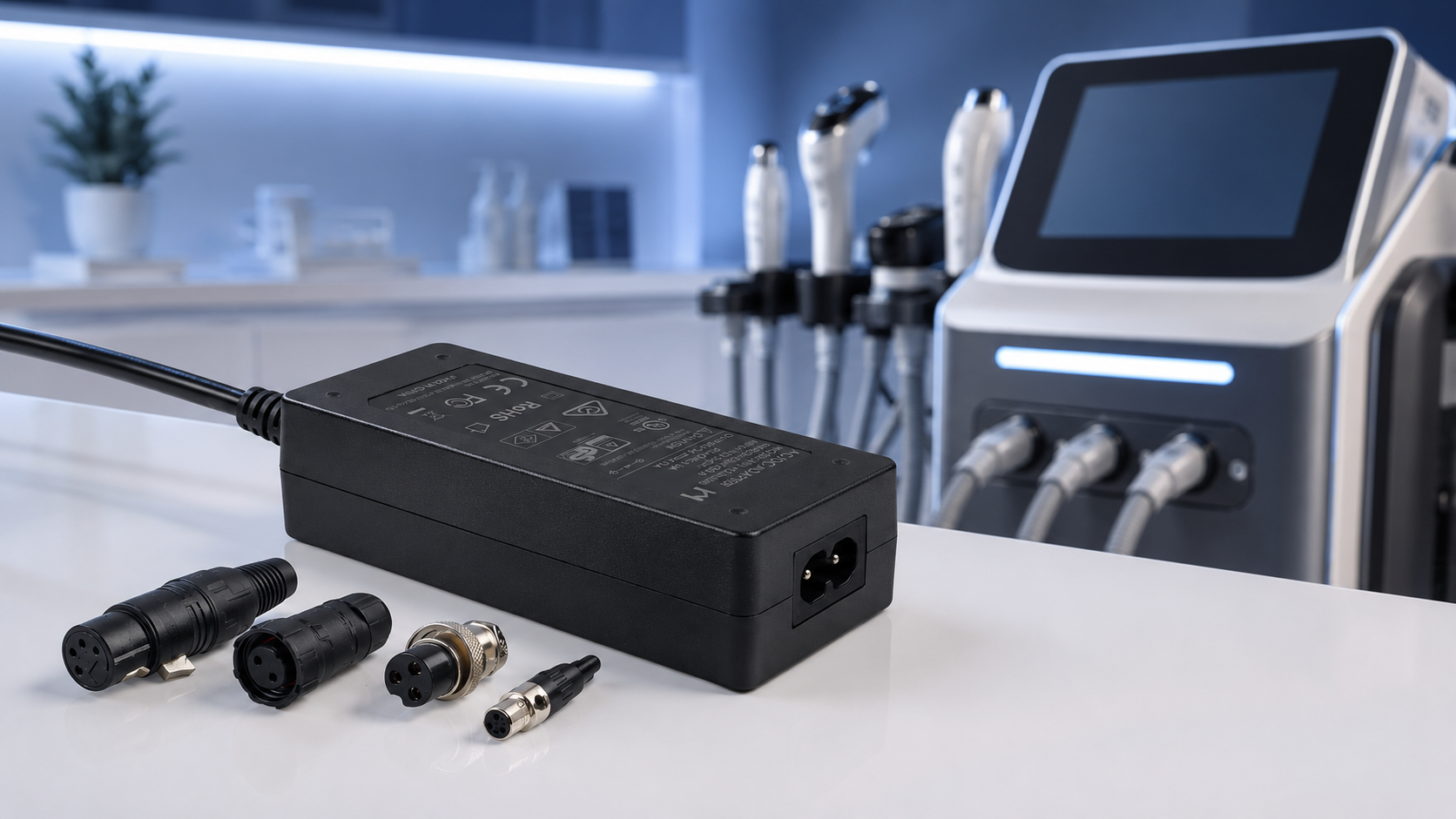
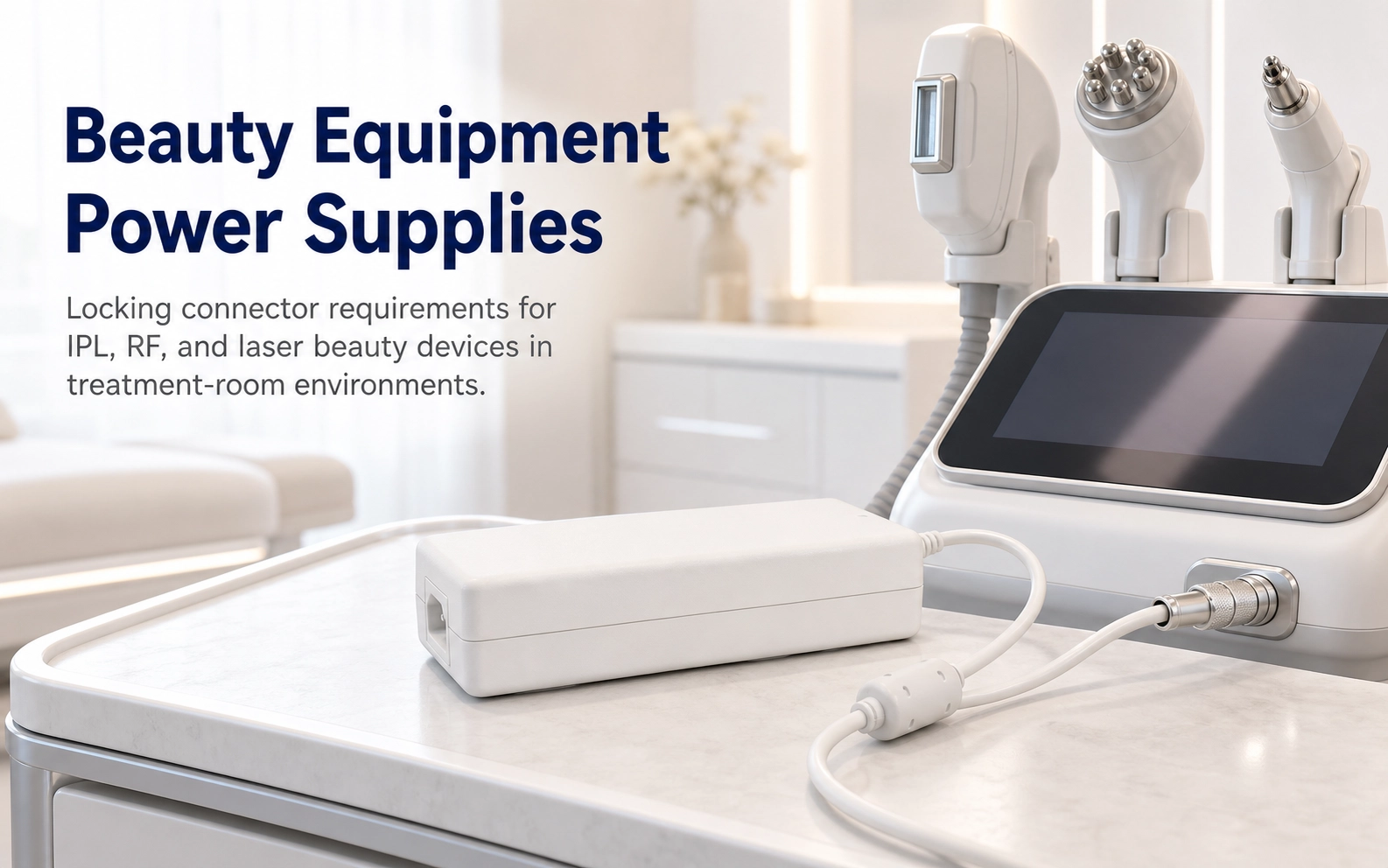
Beauty Equipment AC/DC Solutions
Companion relationship between AC/DC power and charging solutions
✅ Related Certifications
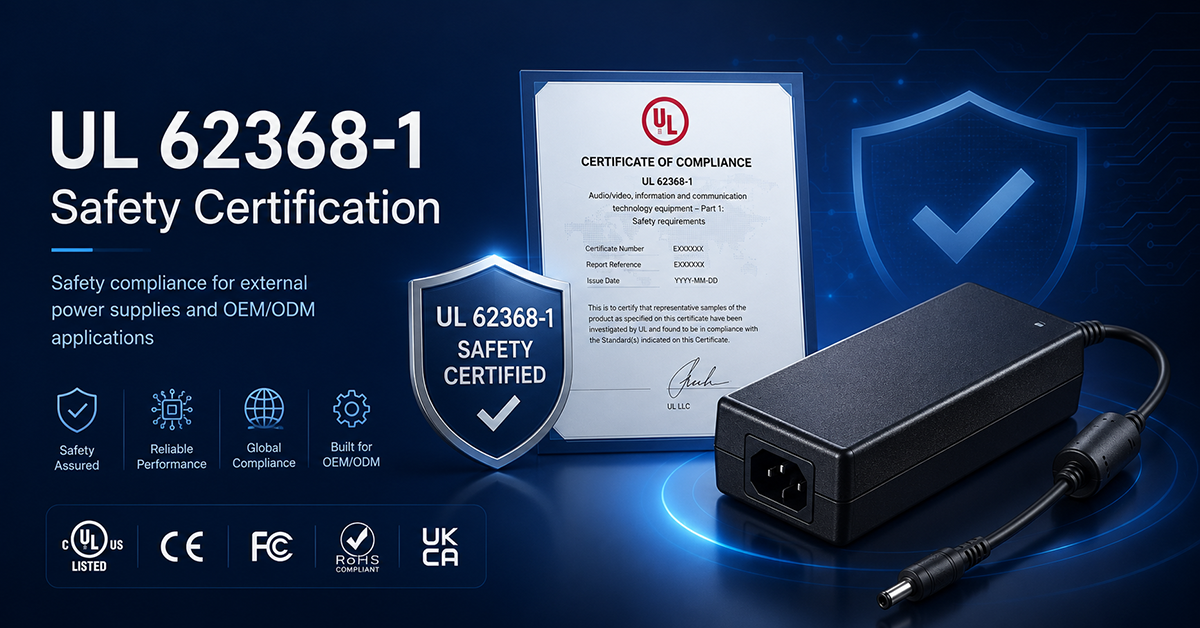
UL 62368-1 Safety Certification
Safety standard covering connector creepage/clearance, temperature rise, and strain relief requirements for IT/AV equipment power adapters.