A power adapter failure in the field is rarely just a component failure — it is a process failure that should have been caught at incoming inspection, final test, or aging. For OEMs that integrate third-party adapters into their products, QC is the difference between a reliable product and a support nightmare. This checklist gives you the concrete inspection points, sample rates, and pass/fail logic used in professional power-supply incoming inspection.
The guide covers the five QC stages that matter: documentation verification, incoming quality control (IQC), electrical testing (ATE), aging/burn-in, and packaging/labeling inspection. A downloadable PDF version of the full checklist is available for your inspectors.
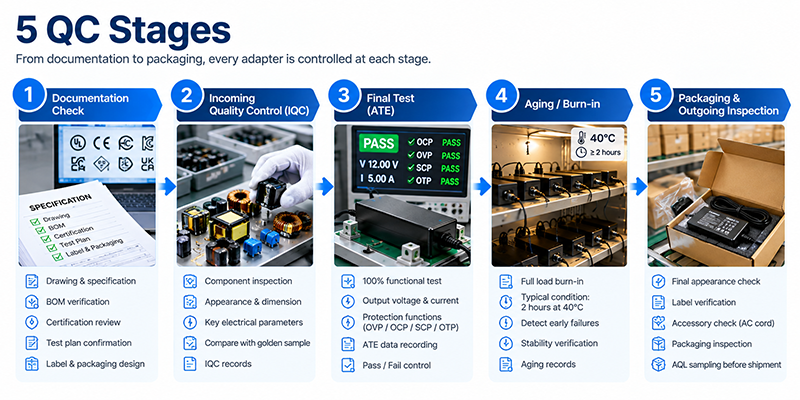
Stage 1 — Documentation and Compliance Verification
Before a single unit is unpacked, verify the paperwork. Missing or mismatched documents are the most common source of customs and market-surveillance problems.
- Certificate of Conformity / test reports match the exact model being delivered
- Certification listing numbers (UL, CE, etc.) verified in public databases against the model
- Certificate holder name matches the manufacturer on the purchase order
- Batch/lot number on the packing list matches the units in the shipment
- Country of origin and customs declarations consistent with the invoice
- Material declarations (RoHS/REACH where required) on file and current
What to do on failure: quarantine the batch, request corrected documents, and do not release stock until documentation is complete. Certification availability depends on product model, application requirements and destination market — a report for a different model is not coverage for yours.
Why This Matters
▸ Market surveillance and customs audits check documents first — your product can be compliant and still held for paperwork errors
▸ A certificate for the wrong model is a certification failure, not an administrative one
▸ Document verification is free — do it before paying for freight
Stage 2 — Incoming Quality Control (IQC) Sampling
IQC follows a sampling plan rather than 100% inspection for most attributes. The industry-standard approach is AQL (Acceptable Quality Limit) sampling: define an acceptable defect rate (commonly AQL 1.0 for major defects, 2.5 for minor), sample per the plan, and reject the lot if defects exceed the limit.
Inspection points per sample unit:
- Visual: enclosure finish, seams, mold marks, scratches
- Label: model number, input/output ratings, certification marks, polarity, date code
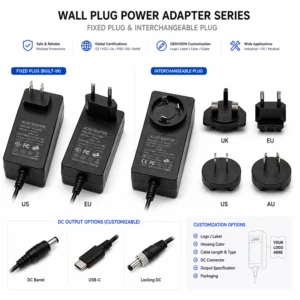
- Dimensions: length/width/height, connector fit, blade alignment (wall plug)
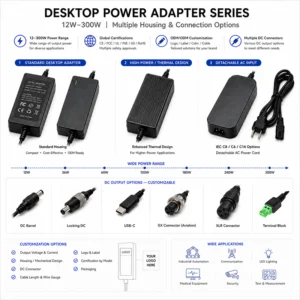
- Connector: plug type, wire gauge, wire length, strain relief, polarity
- Accessories: interchangeable plug set completeness, cables, packaging inserts
- Markings legibility and permanence (label adhesion test)
Compare each unit against the approved golden sample. Any deviation in model number, ratings, or connector configuration is a major defect regardless of sample size.
Why This Matters
▸ The golden sample is the physical reference your inspectors need — without it, “looks fine” replaces “matches spec”
▸ Label and marking errors are major defects: they can invalidate certification compliance
▸ AQL protects you from both over-inspection cost and under-inspection risk
What OEMs Should Do Now
▸ Retain one golden sample per model with signed approval
▸ Agree the AQL levels and sampling plan with the supplier before the order
▸ Photograph defects and maintain a defect register by batch
Stage 3 — Electrical Testing (ATE and Functional Checks)
Electrical verification is where adapters reveal their true quality. Depending on your capability, test 100% of units or a statistically valid sample with automated test equipment (ATE).
Core electrical checks:
- Output voltage at no load, nominal load, and full load — within datasheet tolerance (typically ±5%)
- Output current limit / over-current protection (OCP) trip point
- Short-circuit protection (SCP) — unit must shut down safely and recover
- Over-voltage protection (OVP) where applicable
- Ripple and noise at full load — within datasheet limits (typical values in mVpp)
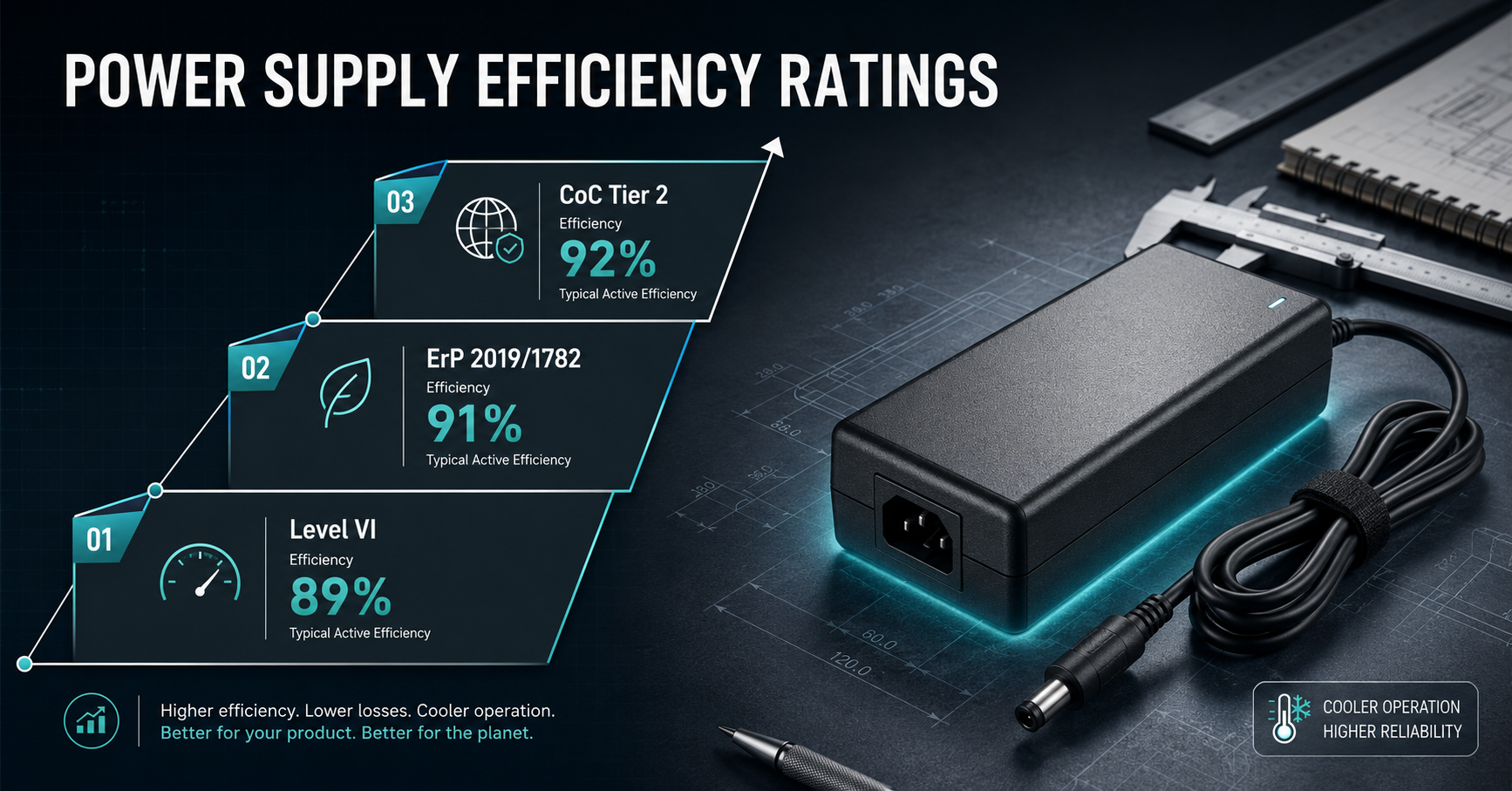
- Efficiency at 25/50/75/100% load — meets the declared efficiency tier (Level VI / ErP)
- Input current and inrush behavior
- Polarity and connector wiring correctness
For a robust pass/fail rule: any unit failing a safety-related check (OCP, SCP, OVP, isolation) is a lot-rejecting defect, not a unit-level repair. Electrical safety parameters are the ones that protect your end customer.
Why This Matters
▸ Safety protections are your last line of defense — a unit without working OCP/SCP is a hazard, not a cosmetic issue
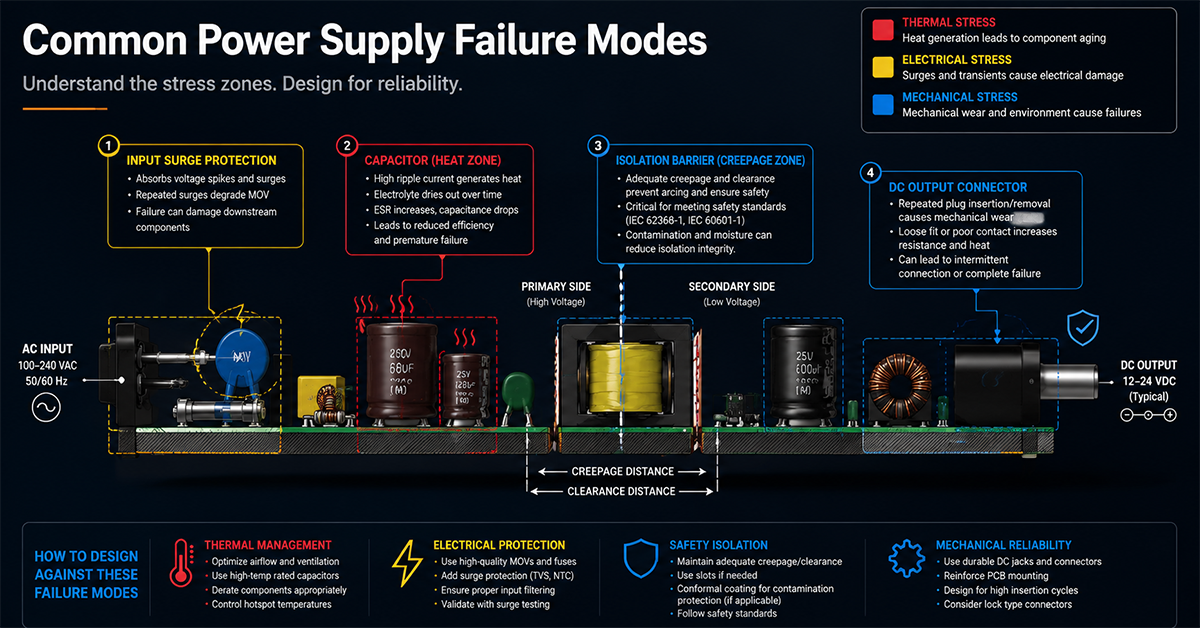
▸ Ripple and efficiency drift are early indicators of component quality problems (aging capacitors, counterfeit parts)
▸ 100% ATE coverage is standard for quality adapter factories; ask for the test report
What OEMs Should Do Now
▸ Define the electrical test set and pass/fail limits in your spec
▸ Request the factory’s ATE reports with each shipment
▸ Re-test a sample on your own bench — do not rely solely on supplier data
Stage 4 — Aging / Burn-In
Aging (burn-in) is the process of running units under load at elevated temperature to expose early-life failures before shipment. It is one of the clearest differentiators between quality manufacturers and price-cutters.
What to verify about the supplier’s aging process:
- Aging duration — a common industry practice is 2 hours at 40°C under full load (YHYadapter’s manufacturing process uses this profile)
- Load condition during aging — full load or representative load
- Ambient/temperature control of the aging room
- Post-aging retest — units should be functionally retested after aging
- Aging failure rate records — ask for the batch report
If you run your own incoming aging: run a sample (for example, 2 hours at full load at elevated temperature), then retest electrical parameters. Units that pass fresh but fail after aging indicate marginal components — exactly what burn-in is designed to catch.
Why This Matters
▸ Early-life failures (infant mortality) concentrate in the first hours of operation — aging shifts that risk from your field to the factory floor
▸ Aging conditions are a verifiable, auditable quality signal
▸ Skipped aging saves the factory minutes per unit and costs you field returns
What OEMs Should Do Now
▸ Put the aging profile (duration, temperature, load) in the purchase agreement
▸ Ask for the aging report with each batch
▸ Spot-check aging on your side for new suppliers
Stage 5 — Packaging, Labeling, and Shipping Inspection
The last stage protects the units in transit and ensures the shipment matches the order. Inspect:
- Packaging type per agreement (individual bag, retail box, bulk, ESD-safe where required)
- Unit label matches the order: model, rating, certifications, date code
- Outer carton marking: model, quantity, batch, destination, handling marks
- Quantity verification per carton and per shipment
- Foam/insert condition and protection adequacy for the freight mode
- Desiccant/instructions where specified
For retail or branded products, label artwork approval should be a controlled document — the supplier must not change artwork without your sign-off, since label changes can affect certification compliance.
Why This Matters
▸ Packaging defects cause hidden damage that appears as field failures weeks later
▸ Carton quantity errors create inventory discrepancies that are expensive to trace
▸ Label control protects certification compliance and brand consistency
What OEMs Should Do Now
▸ Approve label artwork as a controlled revision, not an email
▸ Count cartons at receiving before signing the freight release
▸ Include packaging compliance in the AQL inspection
The QC Decision Rules — When to Accept, Reject, or Re-inspect
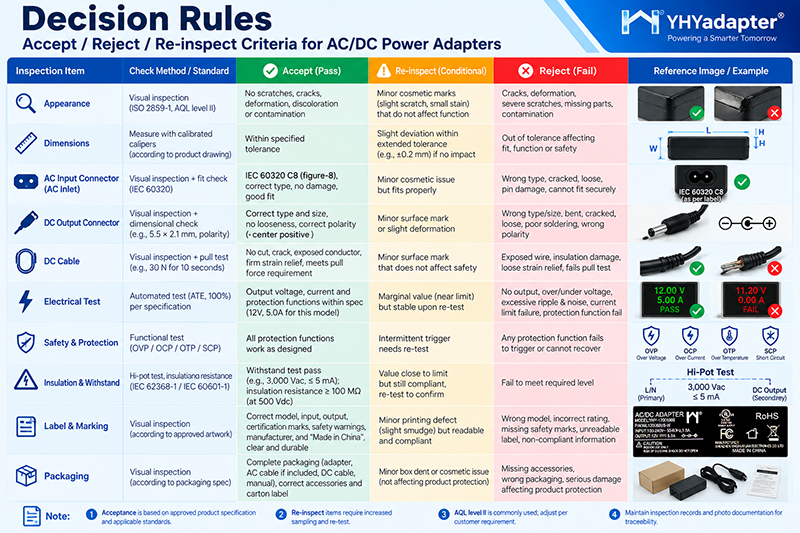
Summarize every batch with three possible outcomes:
| Outcome | Condition | Action |
| Accept | All documentation OK, AQL within limits, electrical sample passes, aging report on file | Release to stock |
| Reject | Any major defect above AQL, or any safety-related electrical failure, or documentation mismatch | Quarantine; notify supplier; request corrective action and re-inspection |
| Re-inspect | Minor defects near the AQL limit, or one batch with an isolated issue | 100% re-inspect the affected attribute or increase sample rate on the next batch |
Keep records: every batch should have an inspection report with date, lot number, sample size, defect count by category, and decision. Trend these records — a rising defect rate in one category is how you catch a supplier’s component or process change early.
Why This Matters
▸ Clear decision rules remove guesswork from inspectors and prevent “borderline accepted” batches
▸ Records create the evidence trail you need for supplier corrective actions and warranty disputes
▸ Trend analysis turns QC from a gate into an early-warning system
What OEMs Should Do Now
▸ Publish the accept/reject/re-inspect rules to your supplier in writing
▸ Store inspection reports by lot number in one place
▸ Review defect trends quarterly with the supplier
Frequently Asked Questions
What does an incoming inspection plan actually cover?
It covers the stages that protect your assembly line: configuration against the approved reference, electrical verification at defined load points, protection behaviour, and packaging and labelling checks — with a documented decision for each lot.
How is the sample size decided?
Sampling schemes and acceptance criteria are agreed per programme, according to the standard the programme applies and the level of risk. What matters operationally is that the scheme is written down and repeatable rather than decided at the bench.
What is the difference between ATE and burn-in?
Automated test equipment verifies function and output characteristics against limits; burn-in runs the unit under load for a period so early-life failures appear before shipment. They answer different questions and are not substitutes for each other.
What records should accompany a batch?
At minimum, the lot or batch identity, the test record for the batch, and the packing list. Traceability is what turns a later question into a bounded investigation.
Can this checklist be used as a supplier audit template?
It can be used as a structure for discussions, but the checklist itself is an inspection aid. Audit criteria belong to the quality system standard the supplier is assessed against.
Download the PDF Checklist
The full checklist — all five stages, inspection points, and decision rules — is available as a PDF for your inspection team: Power Adapter QC Checklist v1.0 (same source content as this article, formatted for field use). The PDF is issued on request, and the download link will be enabled once the file is hosted on the site.
Send your requirement, target markets and expected volumes — Request a Quote — and we will respond against the specification.
How YHYadapter Supports OEM QC Programs
YHYadapter (Shenzhen Yinghuiyuan Electronics Co., Ltd., established 2010) manufactures AC/DC power adapters, battery chargers, and power supplies with a 19-stage manufacturing process that includes 100% automated final testing and burn-in aging (2 hours at 40°C under full load). Standard protections (OVP, OCP, SCP, OTP) are included in most designs, and the factory provides batch test documentation to support your incoming inspection. Certification availability depends on product model, application requirements and destination market.
Related Resources
🔌 Related Products
📖 Related Guides
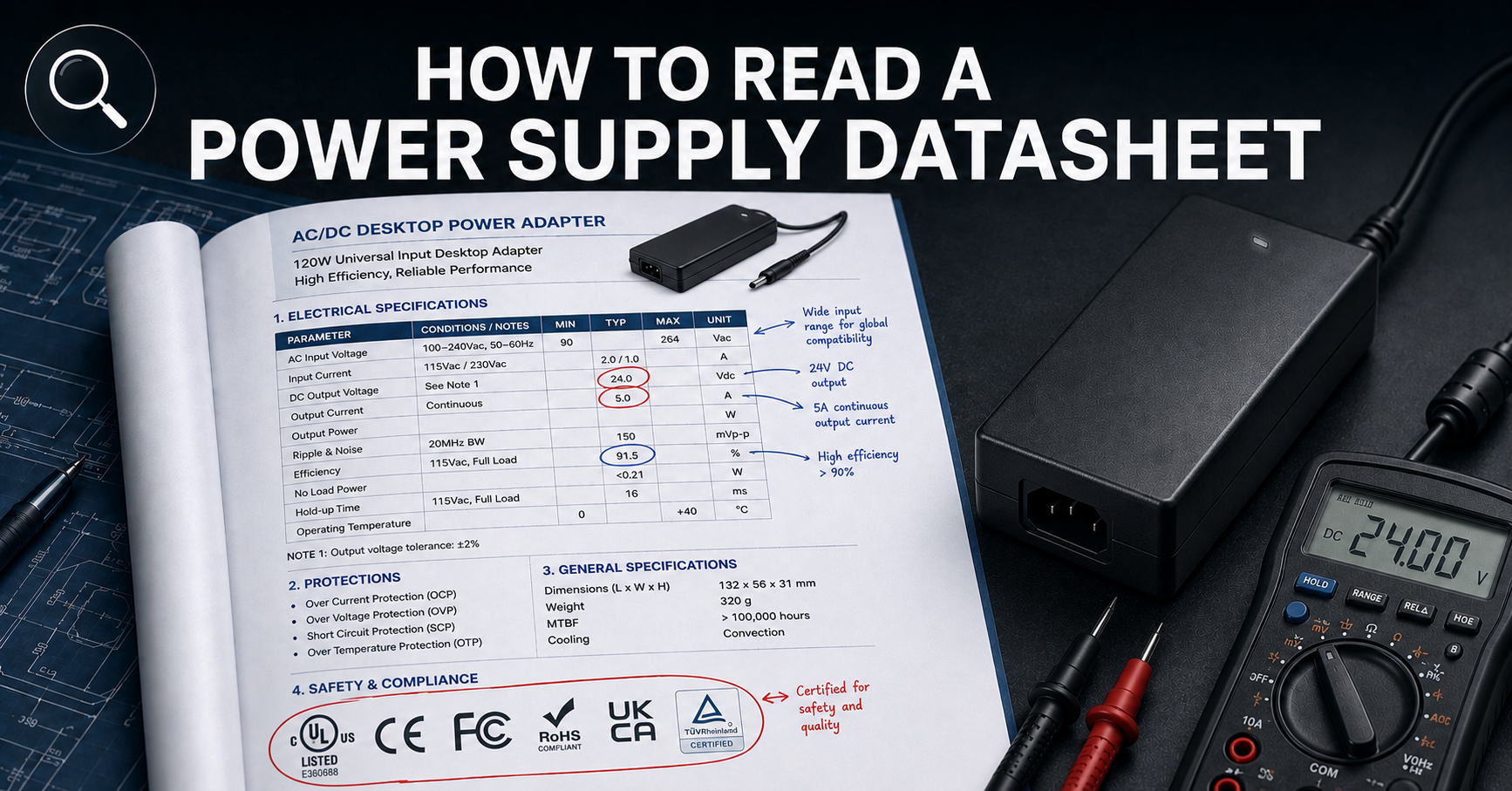
How to Read a Power Supply Datasheet
Learn how to evaluate connector specifications in a datasheet — current ratings, derating curves, certification verification.
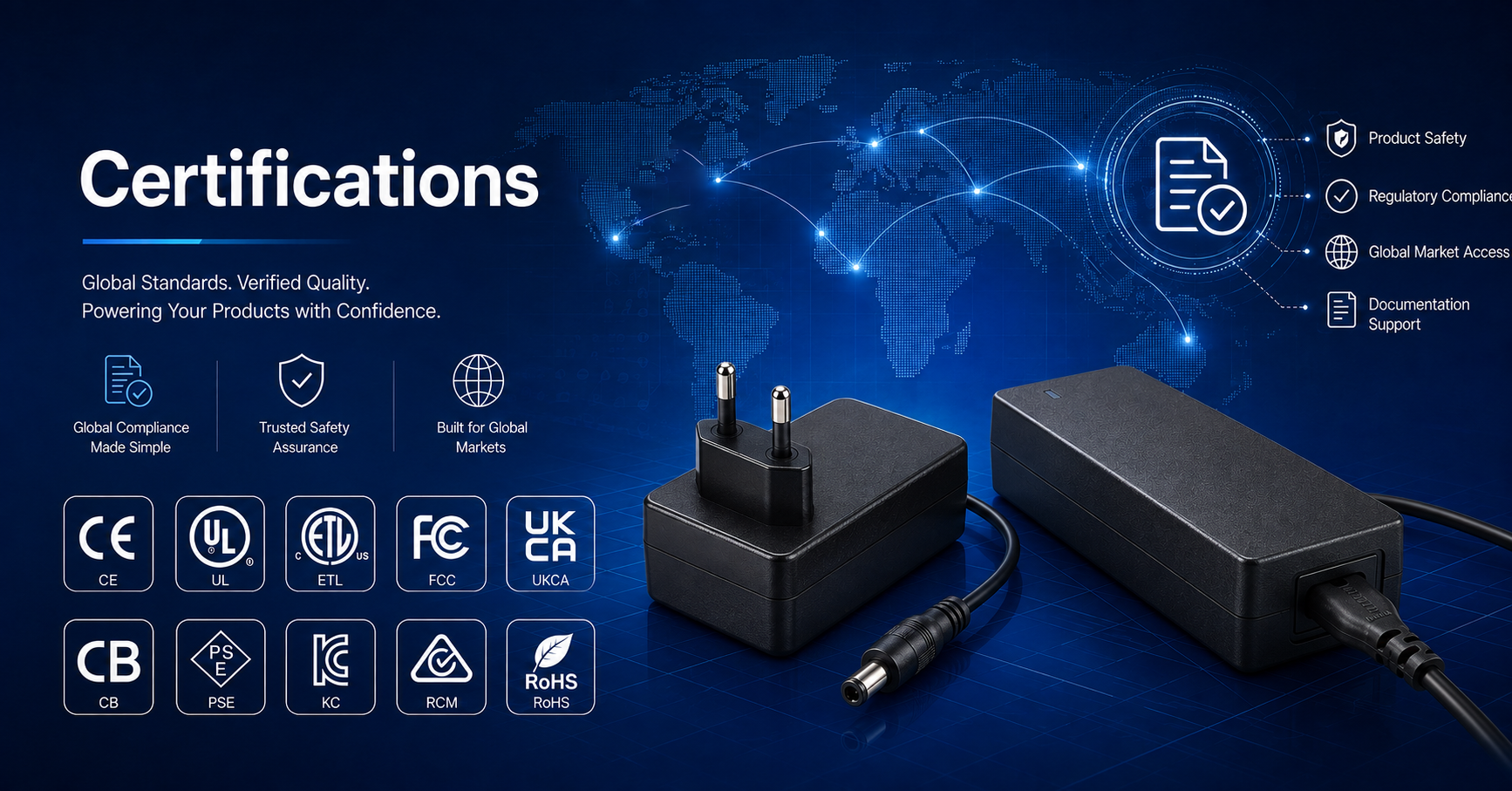
✅ Related Certifications
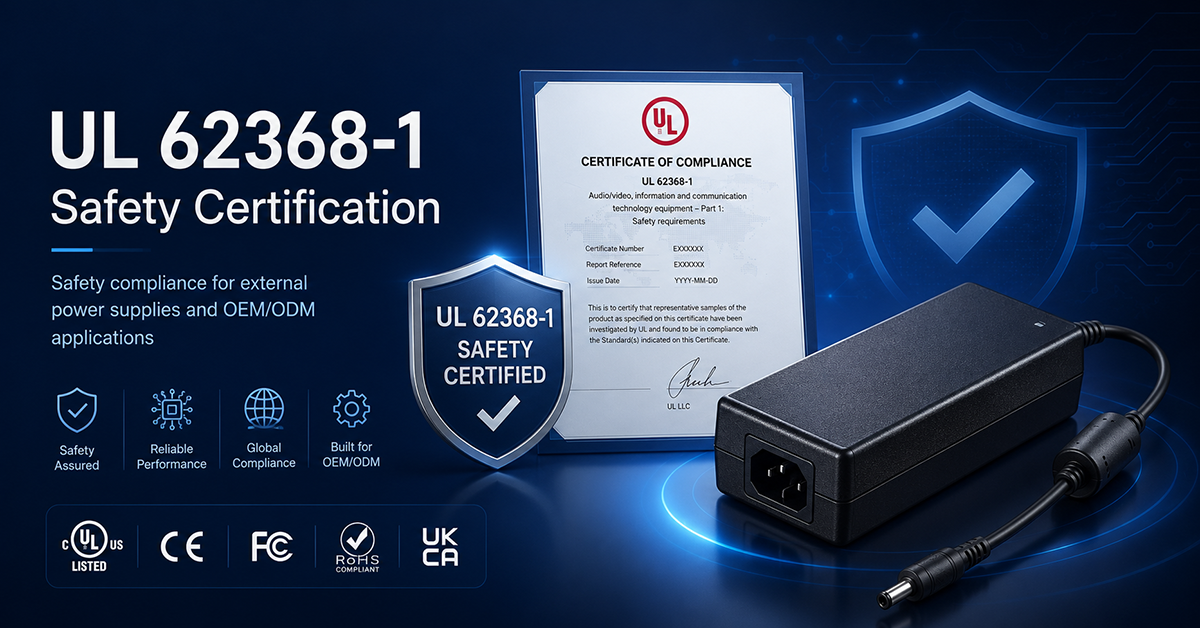
UL 62368-1 Safety Certification
Safety standard covering connector creepage/clearance, temperature rise, and strain relief requirements for IT/AV equipment power adapters.