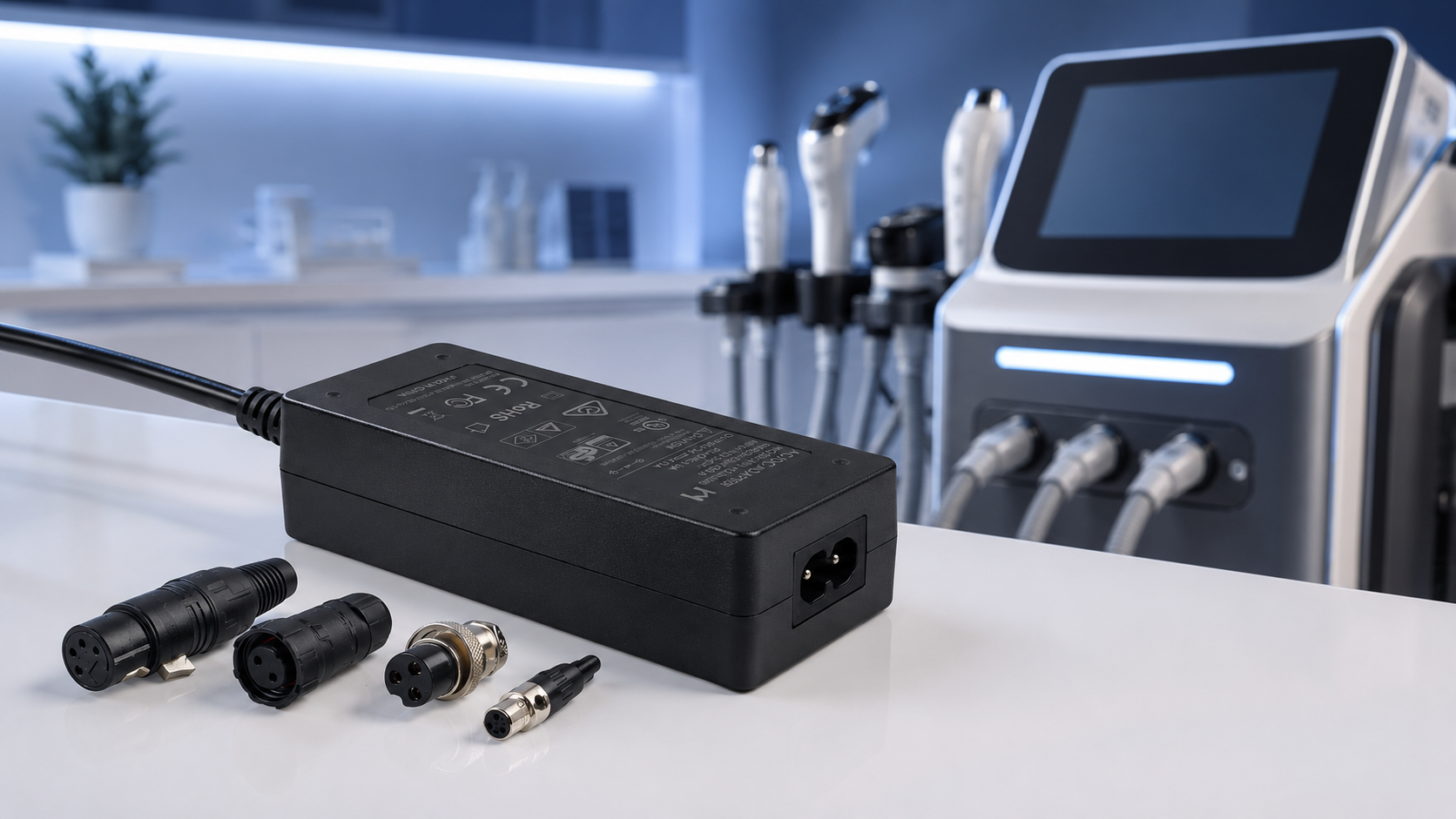
Professional beauty equipment — IPL hair removal systems, RF skin tightening machines, LED therapy panels, and microcurrent devices — depends on AC/DC power conversion that is far more demanding than consumer electronics. These devices operate in commercial environments (clinics, salons, spas) where power stability, connector reliability, thermal performance, and certification readiness are system-level decisions made at the design stage — not last-minute add-ons.
This guide takes an engineering perspective on selecting AC/DC power adapters for professional beauty equipment: form factor, voltage, input and efficiency requirements, connector standards, output quality, safety compliance, and what OEM customization actually involves.
Key Takeaways
- Desktop adapters suit benchtop devices; interchangeable plug adapters consolidate global SKUs into one design.
- 12V covers most RF, LED, and microcurrent devices; 12.6V matches 3S Li-ion battery systems; 24V serves higher-power IPL and multi-function platforms.
- Universal 100–240VAC input and Level VI / ErP efficiency are baseline expectations for globally distributed devices.
- Output ripple below 100mVp-p and regulation within ±5% directly affect IPL/RF treatment consistency.
- Identify target-market certifications early; the CB scheme streamlines multi-market approval.
Desktop vs Interchangeable: Choosing the Form Factor
For professional beauty equipment, two AC/DC adapter form factors dominate.
Desktop Adapters (brick-style)
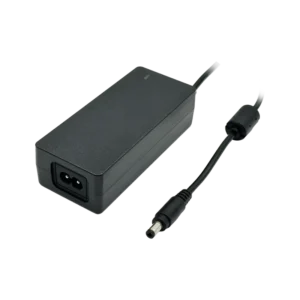
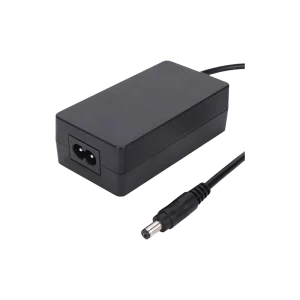
Desktop adapters are the most common choice for benchtop beauty equipment. They sit between the wall outlet and the device, connected by a DC cable, and scale comfortably beyond 60W — a practical advantage for higher-power IPL and multi-function platforms.
| Advantage | Consideration |
|---|---|
| Higher power capacity; desktop lines typically span 12W–300W | Extra desktop space required |
| Better thermal dissipation under continuous clinic use | Cable management needed |
| Industry-standard DC barrel output options | May need strain relief for devices moved between rooms |
| Easy to replace or upgrade without opening the device | — |
Interchangeable Wall Plug Adapters
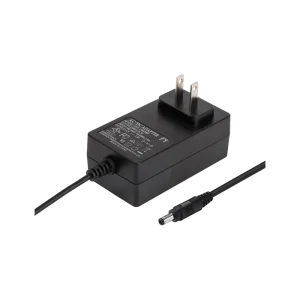
Interchangeable adapters feature detachable AC prongs, allowing a single power supply unit to be used in multiple markets by swapping the plug head — one SKU for global distribution.
| Advantage | Consideration |
|---|---|
| One SKU across markets — reduced inventory complexity | Compact wall-plug interchangeable designs typically cap around 65W |
| Plug heads swapped per destination market | Verify mechanical retention of the plug head over repeated swaps |
| Simplified logistics for multi-market launch | — |
Selection guide:
| If your device is… | Recommended form factor |
|---|---|
| A desktop IPL or RF machine | Desktop adapter (12V–24V, 60W class and above as required) |
| A portable / handheld treatment device | Desktop adapter or interchangeable (12V, ≤60W) |
| Sold globally with a single power supply design | Interchangeable with multi-plug kit |
| A device requiring >60W | Desktop adapter (confirm power ceiling against the device’s peak draw) |
Related reading: Wall Plug vs Desktop Power Adapter →
Voltage Selection: 12V, 12.6V, or 24V?
The operating voltage of professional beauty equipment varies by device type:
| Voltage | Typical Applications | Notes |
|---|---|---|
| 12V DC | RF beauty devices, LED therapy panels, microcurrent machines, facial treatment equipment | Most common — wide availability of standard adapters and connector options |
| 12.6V DC | Battery-powered / rechargeable beauty devices | Matches 3S Li-ion full-charge voltage (3 × 4.2V) |
| 24V DC | Higher-power IPL systems, multi-function aesthetic platforms, professional treatment consoles | Used where system power requirements exceed 12V platform capacity |
Engineering principle: Select the minimum voltage that meets your device’s power requirement — then verify the device’s actual input specification, including peak current draw, rather than assuming from device category. Higher-voltage systems may require additional insulation and safety margin, and can narrow the range of available adapter platforms.
For rechargeable beauty devices, charger selection involves additional parameters (charging current profile, termination voltage, protection). See our dedicated guide: Battery Charger Selection for Rechargeable Beauty Devices →
Universal Input, Efficiency, and Energy Regulations
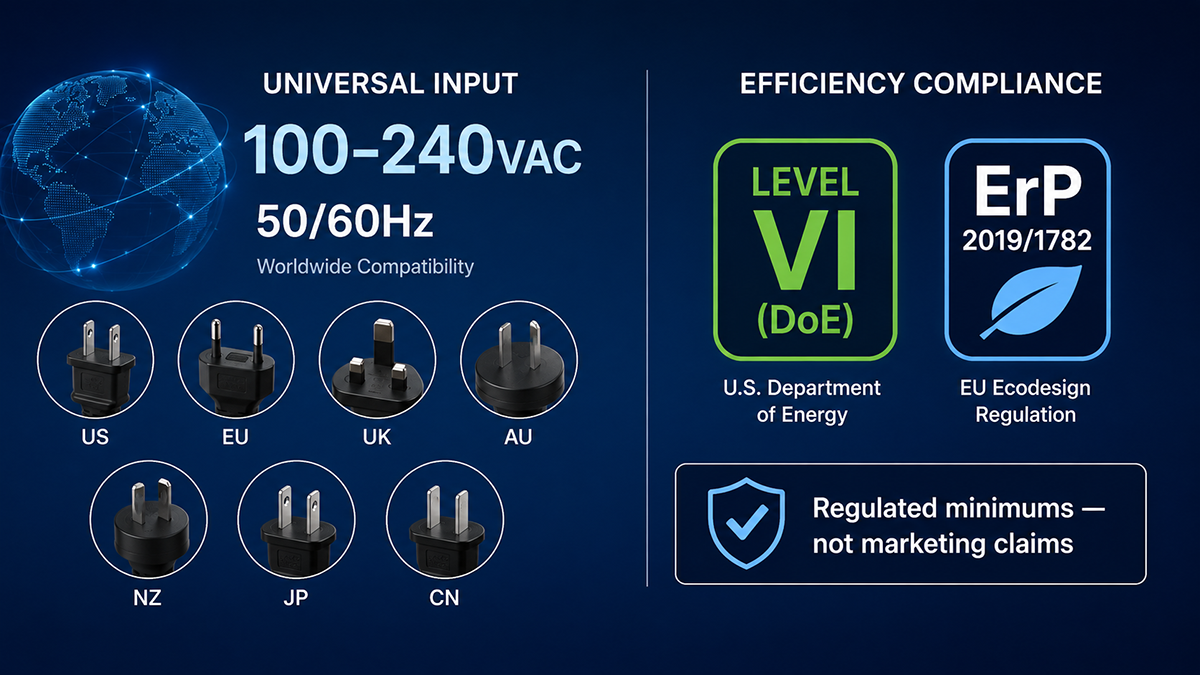
Beauty equipment distributed across multiple markets needs an adapter that accepts the full mains range:
- Input voltage: 100–240VAC, 50/60Hz — the universal input standard for global products. Confirm the adapter’s input range matches every destination market before finalizing the SKU.
- Efficiency: North American distribution typically requires DoE Level VI efficiency; EU distribution requires compliance with ErP 2019/1782. These are regulated minimums, not marketing claims — a non-compliant adapter can block market access even when safety certification is in place.
- Standby power: Check no-load power consumption limits for the target markets; energy regulations set caps that vary by region.
Efficiency requirements affect form factor too — higher-power desktop designs have more room for the conversion circuitry needed to meet Level VI at 24V/60W+. See Power Supply Efficiency Ratings → for a deeper breakdown.
Connector Standards and Mechanical Retention
The DC output connector is a critical interface point — it carries power, and in professional equipment it is often the first component to fail in the field. Common connector standards for beauty equipment include:
- 5.5×2.1mm DC barrel — Industry standard for ≤60W adapters. Widely available, cost-effective, easy to source replacements.
- 5.5×2.5mm DC barrel — Same outer diameter, larger center pin. May be mechanically compatible with 2.1mm sockets in some cases, but polarity and fit must be verified on the actual device.
- 4-pin Mini-DIN — Used in devices requiring multiple voltage rails or signal feedback.
- Custom latching connectors — Preferred for devices subject to movement or vibration during operation (mobile carts, handheld stations).
Connector selection checklist:
- Confirm center pin polarity (center positive is standard for most adapters)
- Verify mechanical retention — loose connectors cause intermittent power loss that is notoriously hard to diagnose in the field
- Test insertion/removal durability against the device’s expected service life (beauty devices are plugged and unplugged far more often than fixed installations)
- Consider locking connectors for equipment that moves during operation
- Document the connector choice in the device’s service manual — field replacement depends on it
For a complete treatment of DC connector types, see The Complete OEM Guide to DC Power Connector Types →
Output Quality: Regulation, Ripple, and Transient Response
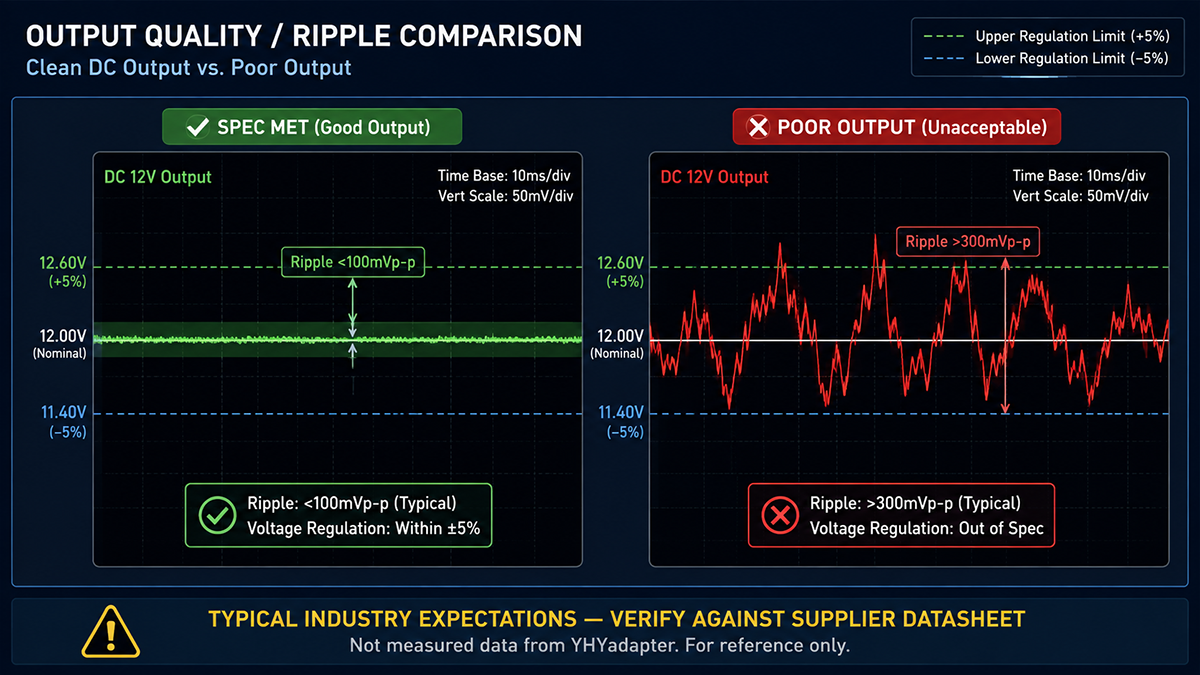
Professional beauty equipment — particularly IPL and RF devices — requires clean, stable DC power. The values below represent common expectations in professional-grade adapter specifications; always request the manufacturer’s actual specification and verify it against your device’s requirements.
| Parameter | Typical Requirement | Risk If Not Met |
|---|---|---|
| Output Voltage Regulation | ±5% or better | Device calibration drift, inconsistent treatment output |
| Ripple & Noise | <100mVp-p | Interference with control electronics, inconsistent RF/IPL firing |
| Load Regulation | <3% from no-load to full-load | Treatment variability between idle and peak power states |
| Transient Response | Recovery within 1ms | Device reset during sudden power demand |
Recommendation for OEMs: when evaluating adapters, request the ripple and noise specification measured at both light and full load, plus load regulation data. These parameters directly affect treatment consistency in IPL, RF, and microcurrent devices — and they are the parameters most often missing from abbreviated datasheets.
Protections and Reliability in Commercial Use
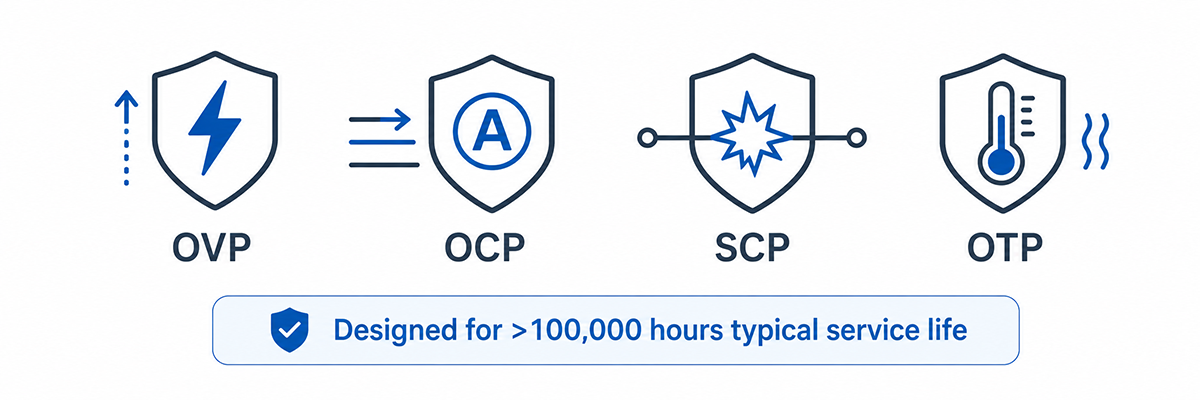
Beauty equipment runs long duty cycles in commercial environments. Standard protection features on professional-grade adapters include:
- Over-voltage protection (OVP) — protects the device if the adapter’s output fails high
- Over-current protection (OCP) — limits output under fault or shorted loads
- Short-circuit protection (SCP) — protects both adapter and device wiring
- Over-temperature protection (OTP) — critical for enclosed clinic cabinetry and warm environments
Reliability matters as much as protection: quality power adapters are designed for a typical service life exceeding 100,000 hours, using components rated for long-term operation. When comparing suppliers, ask how MTBF was estimated and under what conditions — an MTBF figure without test or analysis conditions is not comparable.
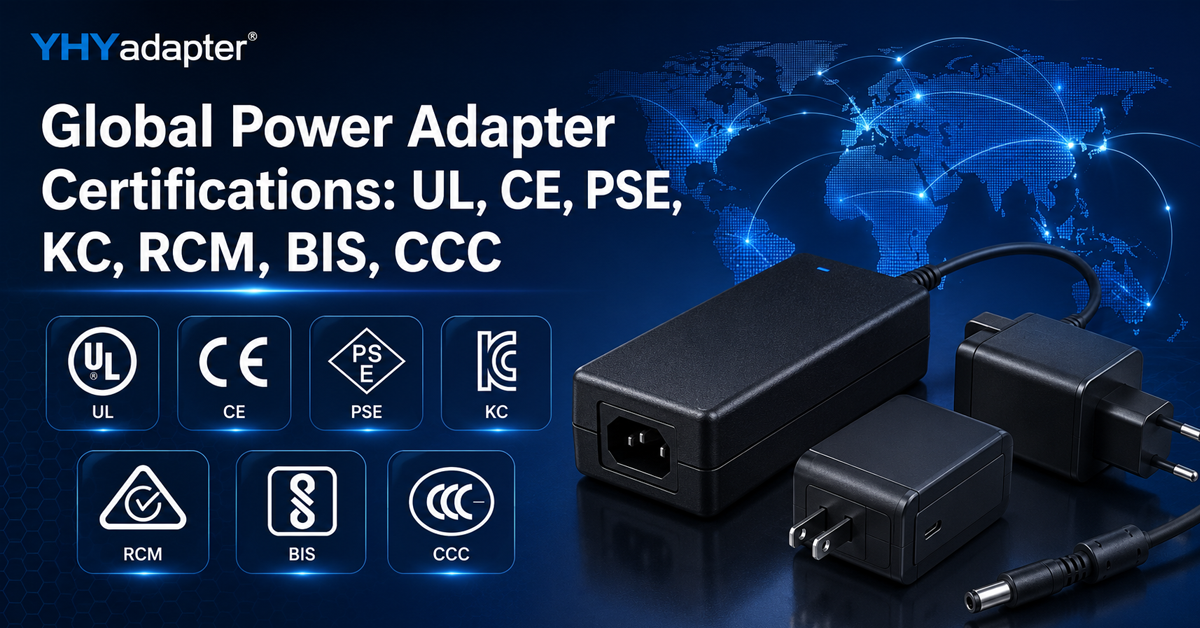
Safety Standards and Compliance by Market
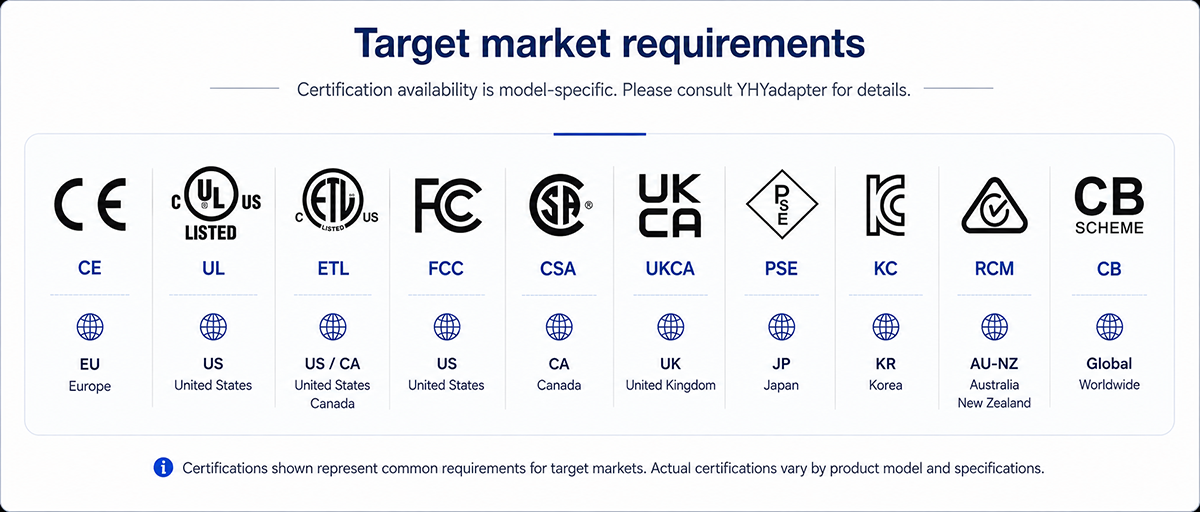
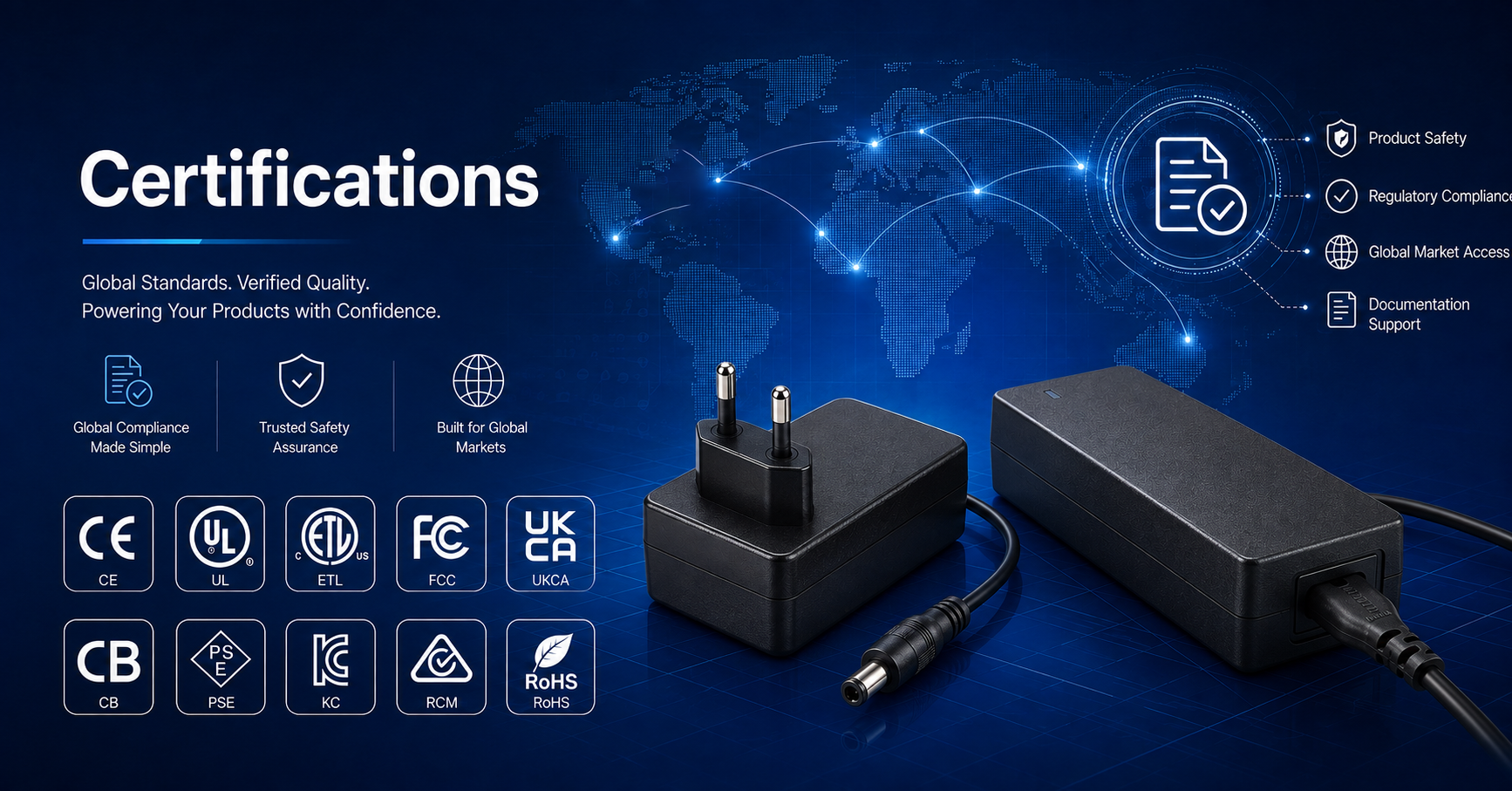
Power adapters for professional beauty equipment must meet the applicable safety and EMC requirements for each destination market. Plan for this at the specification stage — retrofitting compliance later is expensive.
| Market | Certification | Standard Reference |
|---|---|---|
| USA | UL / ETL listing | UL 62368-1; FCC Part 15 (EMC) — mandatory |
| Canada | CSA | CSA 62368-1 |
| European Union | CE | EN 62368-1 (LVD) + EN 55032 / EN 55035 (EMC) |
| United Kingdom | UKCA | BS EN 62368-1 |
| Japan | PSE | DENAN Law — Diamond mark for specified products; applicability depends on product classification |
| South Korea | KC | KC 62368-1 (safety + EMC) |
| Australia / NZ | RCM | AS/NZS 62368-1 + EMC |
| Global | CB | CB 62368-1 — facilitates national certifications via the IECEE scheme |
Key compliance principles:
- A certified adapter supports the end-product certification pathway, but final acceptance depends on the end-product construction, application, target market, and certification program. Component compliance never automatically certifies the end device.
- Certification availability is model-specific. Confirm the certification marks carried by the actual adapter model for your target markets — do not assume universal coverage.
- The CB scheme is particularly useful for beauty equipment OEMs planning multi-market launches, as test results can be leveraged across participating national certification bodies.
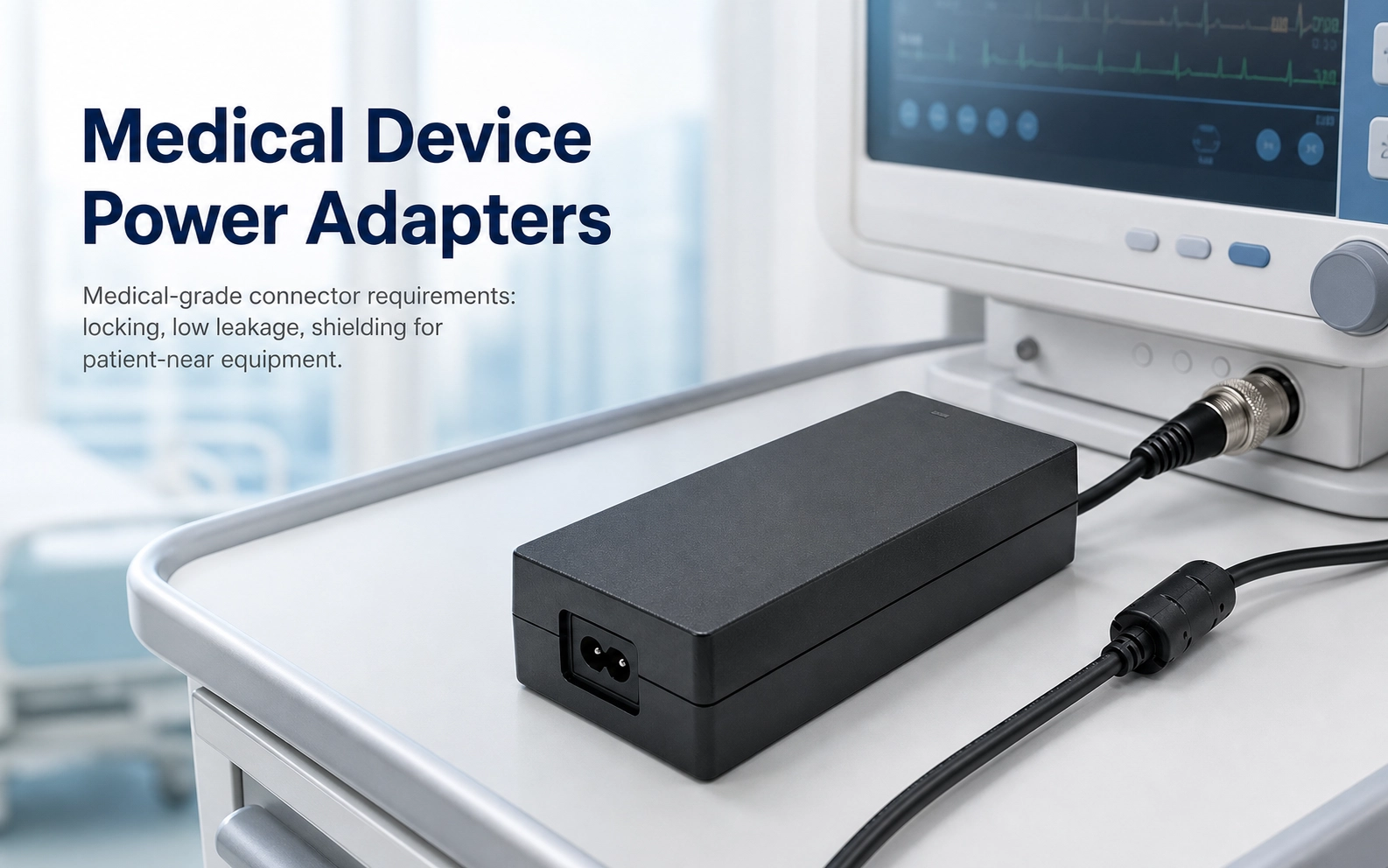
See also: Understanding Medical & Aesthetic Power Supply Certifications →
Medical Aesthetic Equipment: IEC 60601-1 Considerations
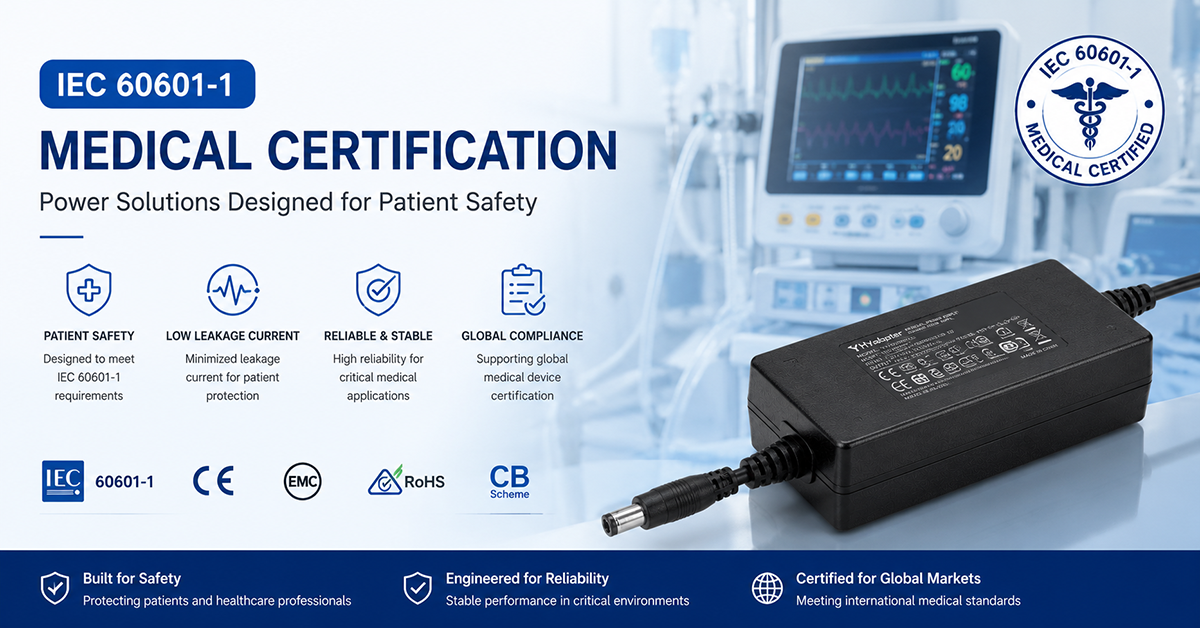
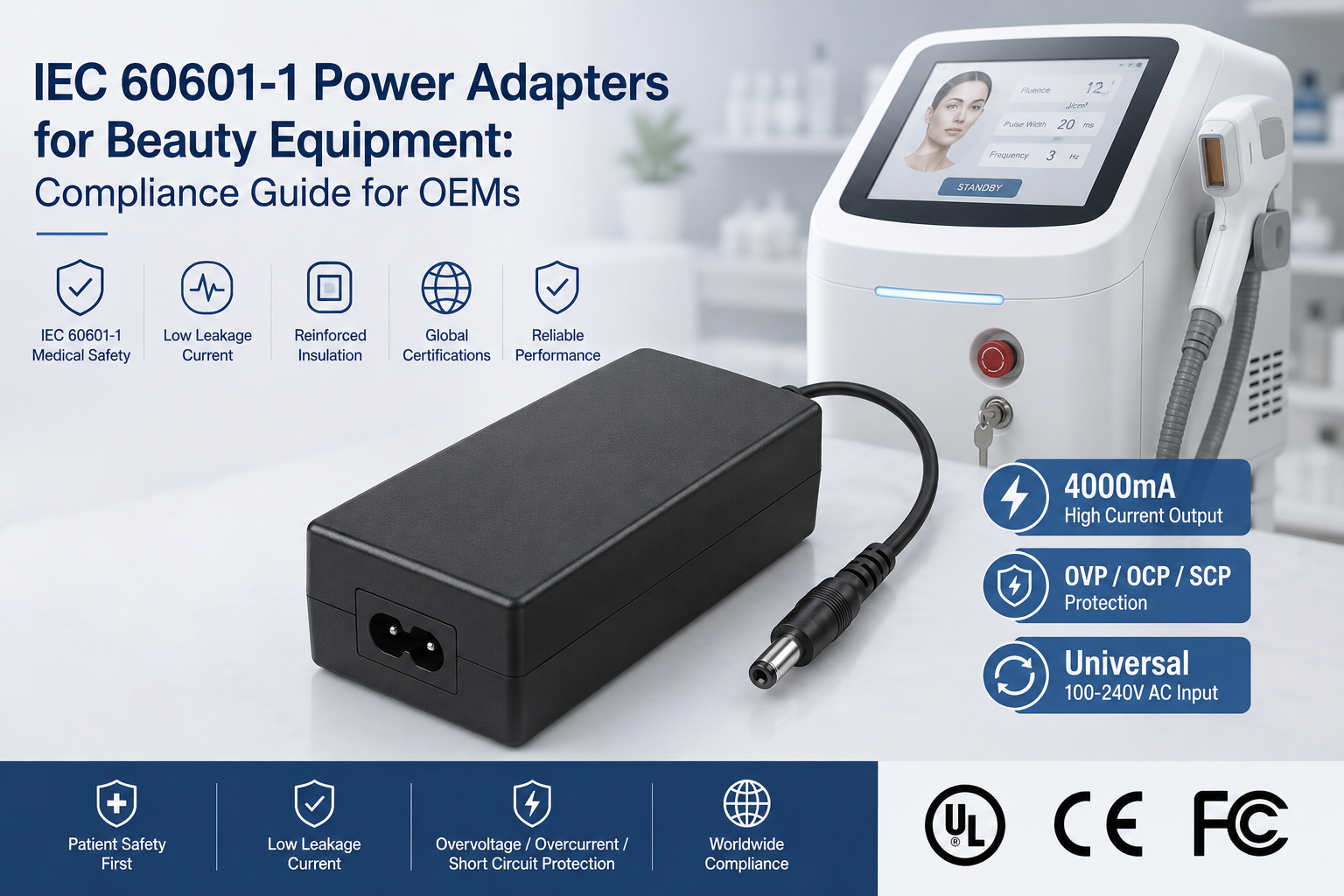
Some beauty device OEMs pursue IEC 60601-1 certification for their end products — particularly for medical aesthetic devices (IPL, diode laser, RF, skin rejuvenation), which represent the largest customer segment for IEC 60601-1 certified power adapters.
If your device requires IEC 60601-1 compliance, evaluate the AC/DC adapter as part of the medical electrical system:
- Adapters designed to meet IEC 60601-1 requirements are available by model — confirm the applicable edition and the adapter’s role in system-level testing.
- System-level testing by the end-device manufacturer is required. A certified adapter does not make the end product compliant.
- Leakage current requirements are system-level parameters — the adapter’s contribution must be verified within the complete device, not assumed from the adapter datasheet alone.
- Distinguish clearly between non-medical beauty equipment and medical (IEC 60601-1) products in your internal documentation — the classification determines the entire compliance pathway.
Dedicated guidance: IEC 60601-1 Power Adapters for Beauty Equipment → and How to Choose a Power Adapter for Medical Aesthetic Devices →
OEM Customization: What Is Standard vs What Requires Engineering
Professional beauty equipment OEMs frequently require customization. It helps to know which requests are standard OEM/ODM capability and which require engineering evaluation:
| Customization | Category | Availability |
|---|---|---|
| Cable length, gauge, strain relief, connector termination | Standard customization | Confirmed OEM/ODM capability |
| Connector type and polarity options | Standard customization | Confirmed, subject to platform |
| Labeling, branding, model number, packaging | Standard customization | Confirmed OEM/ODM capability |
| Output voltage / current fine-tuning | Engineering modification | Subject to platform availability and engineering evaluation per project |
| New output platforms or new certification scope | New platform development | Project scope — NRE, MOQ, and certification timeline apply |
YHYadapter’s OEM process:
- Requirements discussion (voltage, current, connector, certifications)
- Sample preparation and approval
- Pilot run and quality verification
- Volume production with QC documentation
Typical lead times for custom adapters: 25–35 days for samples, 30–45 days for production orders, depending on complexity and certification requirements. Confirm current lead times with the engineering team when planning your launch schedule. (OEM & ODM Solutions →)
Selection Summary and Specification Checklist
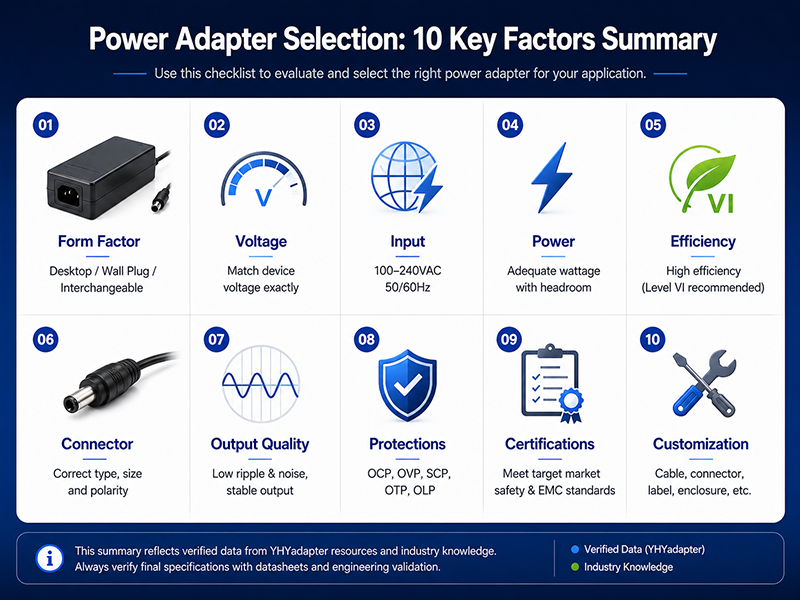
| Factor | Consideration |
|---|---|
| Form Factor | Desktop for benchtop devices; interchangeable for global SKU consolidation |
| Voltage | 12V for most devices; 12.6V for battery systems; 24V for higher-power platforms |
| Input | Universal 100–240VAC, 50/60Hz for multi-market distribution |
| Power | 60W class covers most professional beauty equipment; desktop lines scale higher |
| Efficiency | Level VI (DoE) / ErP 2019/1782 as required by destination markets |
| Connector | 5.5×2.1mm DC barrel for standard applications; custom latching connectors for mobile designs |
| Output Quality | Ripple <100mVp-p; regulation within ±5%; request full-load data |
| Protections | OVP, OCP, SCP, OTP as baseline |
| Certifications | Identify target markets early; CB scheme streamlines multi-market approval |
| Customization | Standard: cable/connector/labeling. Engineering-evaluated: voltage/current changes |
OEM specification worksheet — collect before contacting suppliers:
- Device input voltage and peak current draw
- Form factor (desktop / interchangeable / integrated)
- Connector type, pin size, polarity
- Duty cycle and ambient temperature of the installation environment
- Target markets and required certifications
- Efficiency and standby-power requirements for those markets
- Sample and production timeline requirements
FAQ
Q: What voltage do most professional beauty devices use?
A: 12V DC is the most common, covering most RF, LED, and microcurrent devices. 12.6V is used for rechargeable (3S Li-ion) battery systems, and 24V for higher-power IPL and multi-function platforms.
Q: Desktop or interchangeable — which is better for a beauty device?
A: It depends on power and distribution model. Desktop adapters offer higher power capacity and better thermal performance for benchtop devices. Interchangeable adapters consolidate global distribution into one SKU with swappable plug heads — typically at a lower compact-form power ceiling.
Q: Do beauty devices need medical-certified (IEC 60601-1) adapters?
A: Only if the end product is classified and marketed as medical aesthetic equipment. Adapters designed to meet IEC 60601-1 are available by model, but the end device still requires system-level testing — component compliance alone does not certify the end product.
Q: What is the standard DC connector for beauty equipment?
A: The 5.5×2.1mm DC barrel is the industry standard for ≤60W adapters. Always verify polarity (center positive is standard) and mechanical retention; mobile or vibrating equipment may benefit from latching connectors.
Q: Can YHYadapter customize adapters for a beauty equipment OEM project?
A: Cable length, connector termination, labeling, and packaging are standard OEM/ODM capability. Output voltage or current adjustments are evaluated per project against platform availability and engineering feasibility.
CTA Section
Looking for AC/DC power adapters for your beauty equipment project?
YHYadapter manufactures desktop and interchangeable adapters suitable for professional beauty equipment OEMs, with standard and customizable options — including 12V and 24V outputs, universal input, and certification support by model. Contact our engineering team to discuss your power requirements, connector preferences, and certification needs.
Related Resources
🔌 Related Products
🏭 Related Applications
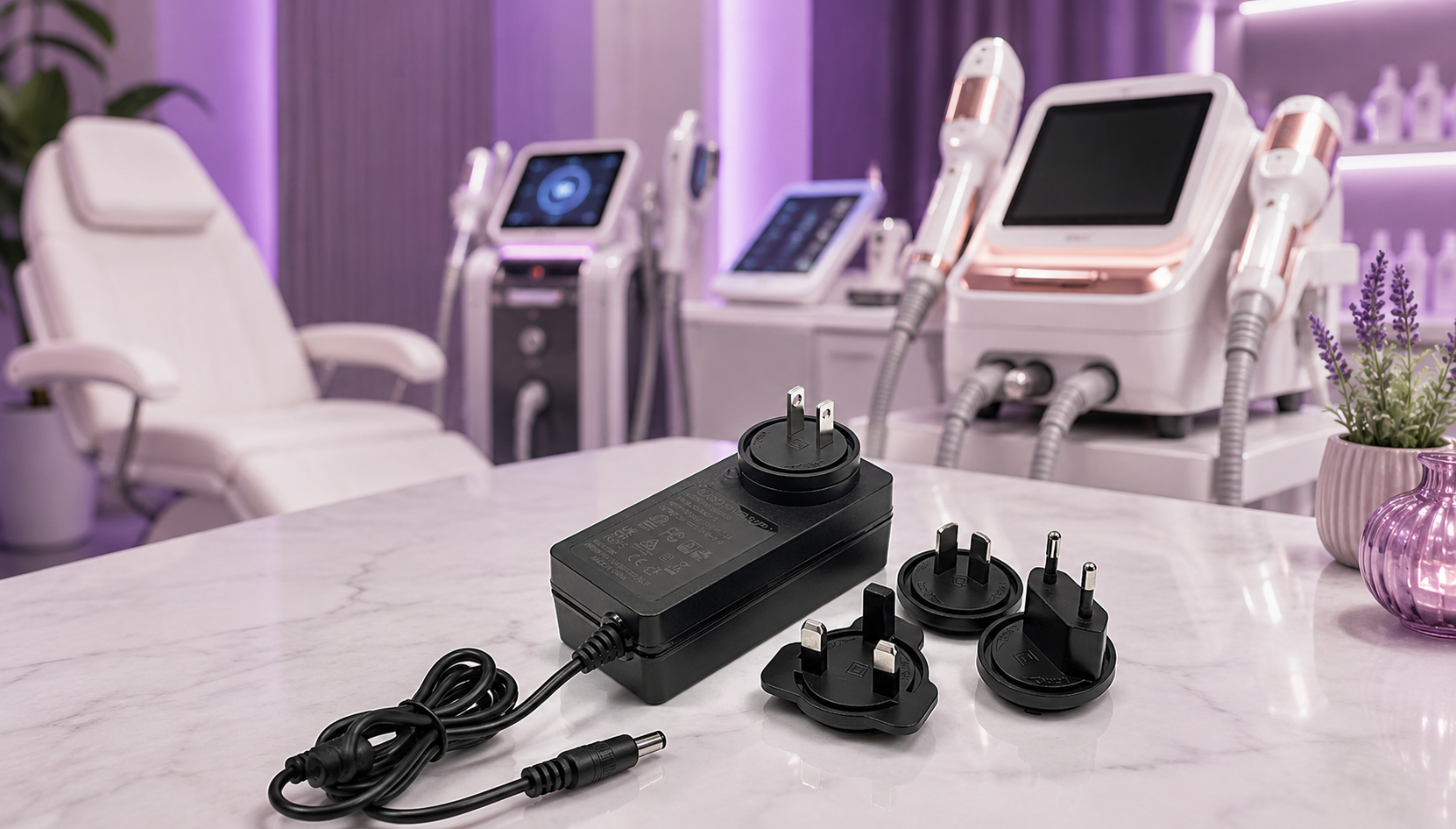
Beauty Equipment Power Supplies
Power adapter requirements for IPL, RF, and laser beauty devices — key datasheet parameters for pulsed-load applications.
📖 Related Guides
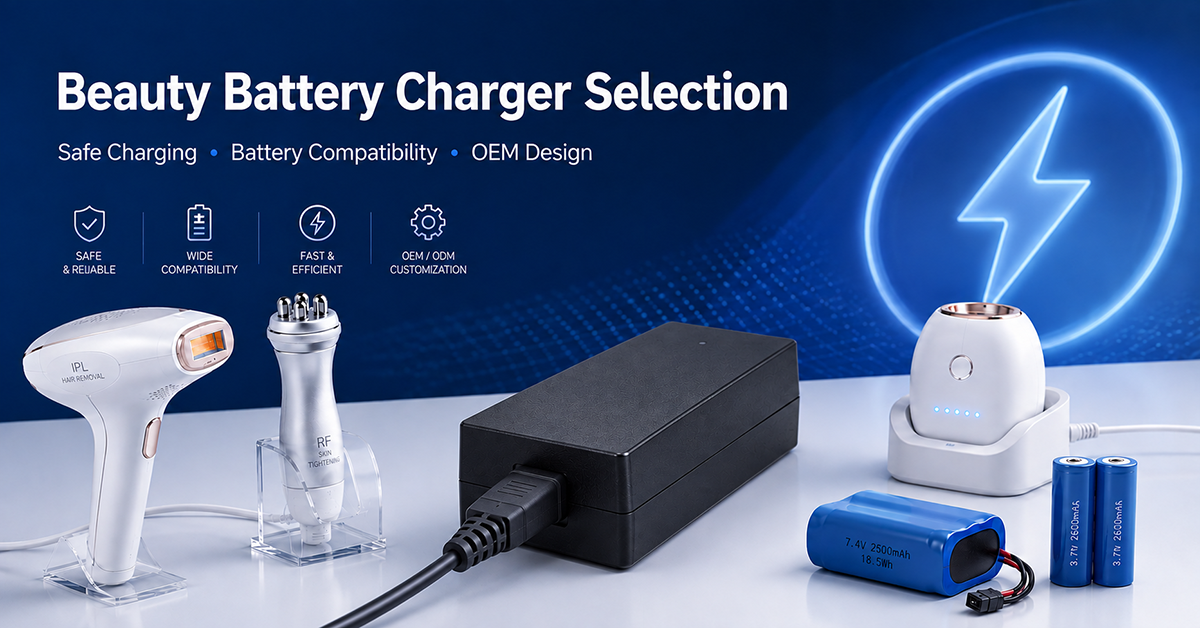
Beauty Battery Charger Selection
Companion charging solutions for rechargeable beauty devices
✅ Related Certifications