
Energy storage systems (ESS) are subject to a complex framework of safety, performance, and transport regulations that vary by market, application, and battery chemistry. The AC/DC power supply or charger used in an ESS must meet applicable standards for safety and EMC, while the complete ESS (battery, BMS, enclosure) is subject to additional product-specific standards. Transport regulations govern how lithium batteries are shipped, affecting every OEM that moves batteries or ESS products between locations.
This guide covers the certification requirements for energy storage power supplies and battery systems: product safety standards, EMC requirements, transport regulations, and practical certification planning for ESS OEMs.
YHYadapter product positioning: YHYadapter provides regulated constant-voltage AC/DC power adapters. Dedicated battery chargers with ESS-specific certifications (UL 1973, IEC 62619 integration) are available from specialized battery charger manufacturers. The certification information in this guide provides industry reference for OEMs designing ESS power architecture.
Product Safety Standards by Market
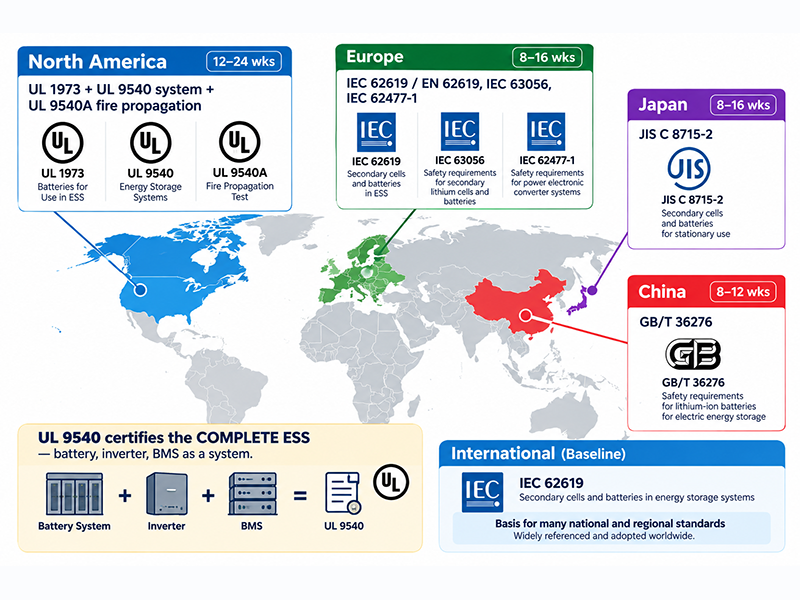
Energy storage systems are covered by product-specific safety standards that address the unique risks of battery systems: thermal runaway, fire, gas emission, and electrical hazards.
| Market | Standard | Scope | Typical Timeline |
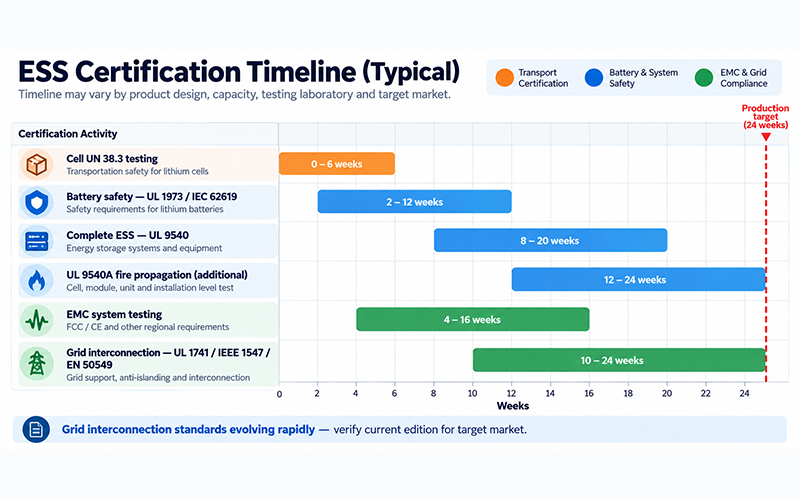
| USA | UL 1973 | Batteries for stationary ESS | 12–20 wks |
| USA | UL 9540 | Complete ESS (battery + inverter + controls) | 16–24 wks |
| USA | UL 9540A | Thermal runaway fire propagation testing | 8–16 wks (additional) |
| EU | IEC 62619 / EN 62619 | Secondary lithium cells for industrial applications | 8–16 wks |
| EU | IEC 63056 / EN 63056 | Secondary lithium cells for ESS | 8–16 wks |
| EU | IEC 62477-1 | Power electronic converter systems for ESS | 8–12 wks |
| International | IEC 62619 | Industrial lithium battery safety | Basis for many national standards |
| Japan | JIS C 8715-2 | Secondary lithium cells for industrial applications | 8–16 wks |
| China | GB/T 36276 | Lithium-ion battery for ESS | 8–12 wks |
Available by model. Certification availability depends on product model, configuration, application requirements, and destination market.
Key Standards Detail:
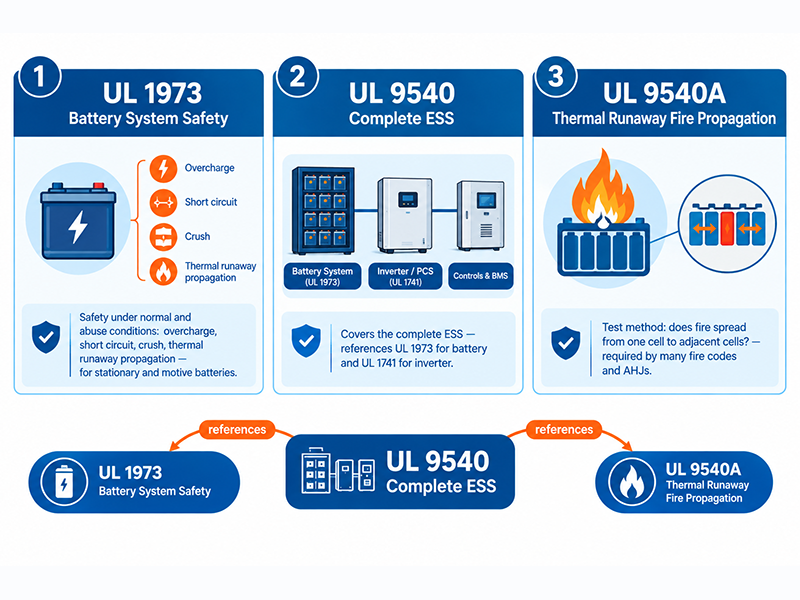
UL 1973 (USA): Safety standard for batteries for use in stationary and motive power applications. Covers lithium and other battery chemistries used in ESS. Requires testing for electrical, mechanical, and thermal abuse conditions including overcharge, short circuit, crush, and thermal runaway propagation.
UL 9540 (USA): Standard for the complete ESS, including the battery system, inverter/charger, and controls. UL 9540 references UL 1973 for the battery subsystem and UL 1741 for the inverter. UL 9540 certification covers the complete system.
UL 9540A (USA): Test method for evaluating thermal runaway fire propagation in battery systems. Required by many fire codes and AHJs (Authorities Having Jurisdiction) for ESS installations in buildings.
IEC 62619 (International/EU): Safety requirements for secondary lithium cells and batteries for use in industrial applications, including ESS. Addresses electrical, mechanical, and thermal abuse conditions.
IEC 62477-1 (International/EU): Safety requirements for power electronic converter systems and equipment—relevant for the inverter/charger subsystem of an ESS.
Why This Matters
- UL 9540 certifies the complete ESS system, not just individual components. The charger/inverter, battery, and BMS must all comply as a system.
- UL 9540A thermal runaway propagation testing is increasingly required by local fire codes for ESS installations in occupied buildings.
- IEC 62619 is the most widely recognized international safety standard for industrial lithium batteries. Certification to IEC 62619 facilitates acceptance in multiple markets.
What OEMs Should Do Now
- Determine which safety standards apply to your ESS product in each target market. UL 1973 + UL 9540 for US; IEC 62619 for EU and international.
- Plan for system-level certification (UL 9540 or equivalent) that covers the battery, charger, inverter, and BMS as an integrated system.
- If the ESS will be installed in occupied buildings, verify whether UL 9540A thermal runaway propagation testing is required by local fire codes.
EMC and Grid Interconnection Standards
ESS equipment must meet EMC standards for emissions and immunity, and grid interconnection standards for the inverter/charger.
| Market | EMC Standard | Grid Interconnection Standard |
| USA | FCC Part 15 Subpart B | UL 1741 / IEEE 1547 |
| EU | EN 55032 / EN 55035 | EN 50549 (grid connection) |
| EU | EN 61000-3-2 (harmonics) / EN 61000-3-3 (flicker) | VDE-AR-N 4105 (Germany) |
| International | CISPR 32 / 35 | Varies by country |
UL 1741 (USA): Standard for inverters, converters, controllers, and interconnection system equipment for use with distributed energy resources. ESS inverters must comply with UL 1741 for grid interconnection.
IEEE 1547 (USA): Standard for interconnection and interoperability of distributed energy resources with associated electric power systems interfaces. Specifies power quality, islanding detection, and voltage/frequency ride-through requirements.
EN 50549 (EU): Requirements for generating plants connected to the distribution network. ESS inverters in the EU must comply with the applicable part (Part 1 for low voltage, Part 2 for medium voltage).
Why This Matters
- The ESS inverter/charger must meet both EMC standards (FCC Part 15, EN 55032) and grid interconnection standards (UL 1741, IEEE 1547, EN 50549) for legal installation.
- Grid interconnection standards are evolving rapidly as utilities adapt to high penetration of distributed energy resources. Verify the applicable edition for your target market.
- The charger/adapter’s EMC performance affects the ESS’s ability to pass system-level EMC certification.
What OEMs Should Do Now
- Identify the grid interconnection standard applicable to your inverter in each target market. Confirm the current edition and any local amendments.
- Plan for system-level EMC testing of the complete ESS (battery + inverter + charger + BMS). Individual component EMC compliance does not guarantee system compliance.
- For multi-market products, design the inverter to meet the most stringent grid interconnection requirements among the target markets.
Battery Transport Regulations
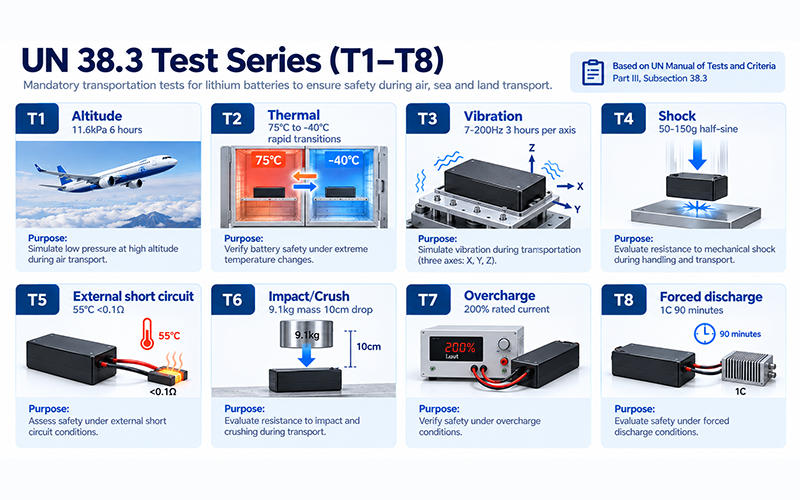
Lithium batteries are classified as dangerous goods for transport and must comply with international and national transport regulations.
| Regulation | Scope | Key Requirements |
| UN 38.3 | Transport of lithium cells and batteries | T1–T8 tests: altitude, thermal, vibration, shock, external short circuit, impact/crush, overcharge, forced discharge |
| IATA DGR | Air transport | UN 38.3 required; state of charge limits (≤30% for air); quantity limits per package |
| IMDG Code | Maritime transport | UN 38.3 required; packaging requirements; quantity limits |
| ADR | European road transport | UN 38.3 required; classification and labeling |
| 49 CFR (DOT) | US ground transport | UN 38.3 required; hazmat employee training |
UN 38.3 Test Summary:
| Test | Condition | Purpose |
| T1 — Altitude | 11.6kPa, 6 hours | Simulates air transport pressure |
| T2 — Thermal | 75°C to −40°C, rapid transitions | Thermal shock during transport |
| T3 — Vibration | 7–200Hz, 3 hours per axis | Transport vibration exposure |
| T4 — Shock | 50–150g, half-sine | Impact during handling |
| T5 — External short circuit | 55°C, <0.1Ω | Short circuit during transport |
| T6 — Impact/crush | 9.1kg mass, 10cm drop (cells) | Mechanical abuse |
| T7 — Overcharge (lithium) | 200% rated current | Charger failure during transport |
| T8 — Forced discharge | 1C, 90 minutes | Reverse current fault |
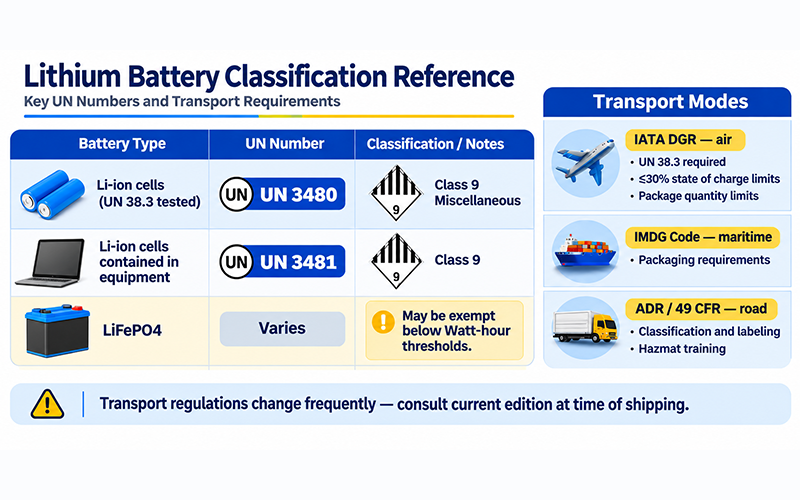
Transport Classification:
| Lithium Battery Type | UN Number | Transport Classification |
| Li-ion cells (UN 38.3 tested) | UN 3480 | Class 9 — Miscellaneous |
| Li-ion cells contained in equipment | UN 3481 | Class 9 — Miscellaneous |
| LiFePO4 (may be exempt if below certain thresholds) | Varies | Depends on Watt-hour rating |
Why This Matters
- UN 38.3 testing is mandatory for transporting lithium cells and batteries by any mode of transport. Without UN 38.3 certification, batteries cannot be legally shipped.
- Air transport of lithium batteries is increasingly restricted. Many airlines limit or prohibit lithium batteries above certain Watt-hour ratings.
- Transport regulations change frequently. The current edition of each regulation must be consulted at the time of shipping.
What OEMs Should Do Now
- Ensure all lithium cells and batteries used in the ESS are UN 38.3 tested and certified. Maintain the test summary for each cell model.
- For ESS products shipped with batteries installed, verify the transport classification and packaging requirements for the complete product.
- Stay current with transport regulation updates. Subscribe to IATA DGR updates for air transport changes.
Frequently Asked Questions
Does the AC/DC charger in an ESS need UL 1973 certification?
The charger is typically evaluated as part of the complete ESS system under UL 9540 (US) or as a component of the ESS evaluation rather than to UL 1973 directly. However, the charger’s safety (UL 62368-1 or equivalent) and its integration with the BMS and battery affect the ESS’s system-level certification.
What is the difference between UL 1973 and UL 9540A?
UL 1973 tests the battery system’s safety under normal and abuse conditions. UL 9540A specifically tests thermal runaway propagation—if one cell goes into thermal runaway, does the fire spread to adjacent cells? UL 9540A is a fire propagation test, while UL 1973 is a broader safety standard.
Do I need UN 38.3 for each individual battery module in an ESS?
UN 38.3 certification applies to the cell or battery design, not to each individual unit. A cell or battery model that has passed UN 38.3 testing is certified for transport. Each production unit does not need individual testing, but the manufacturer must maintain the test summary and ensure production cells are equivalent to the tested design.
Does a charger for a portable storage product need the same certification as a fixed ESS?
Not necessarily. Which requirements apply follows the product, its classification and the destination market. A portable accessory and a fixed installation can sit under different routes, so the applicable standard is confirmed per product and market rather than assumed from the category.
How do I confirm which certifications apply to a specific model?
Ask for the documentation that names the model and configuration, confirm the standard and edition, and confirm the market it covers. Availability is available by model, and a change to the configuration can move the product outside what was evaluated.
CONCLUSION
Energy storage certification involves multiple layers: product safety standards for the battery (UL 1973, IEC 62619) and complete ESS (UL 9540), EMC and grid interconnection standards (FCC Part 15, UL 1741, EN 50549), and transport regulations (UN 38.3). Certification planning should begin at the specification stage and account for the lead times of each applicable standard. System-level certification of the complete ESS is typically required, and individual component certifications must align with the system-level requirements.
Discuss Your Audio Equipment Power Requirements →
Related Resources
🔌 Related Products
🏭 Related Applications
Industrial Control Power Solutions
Power solutions for PLC, CNC, servo and automation equipment
📖 Related Guides
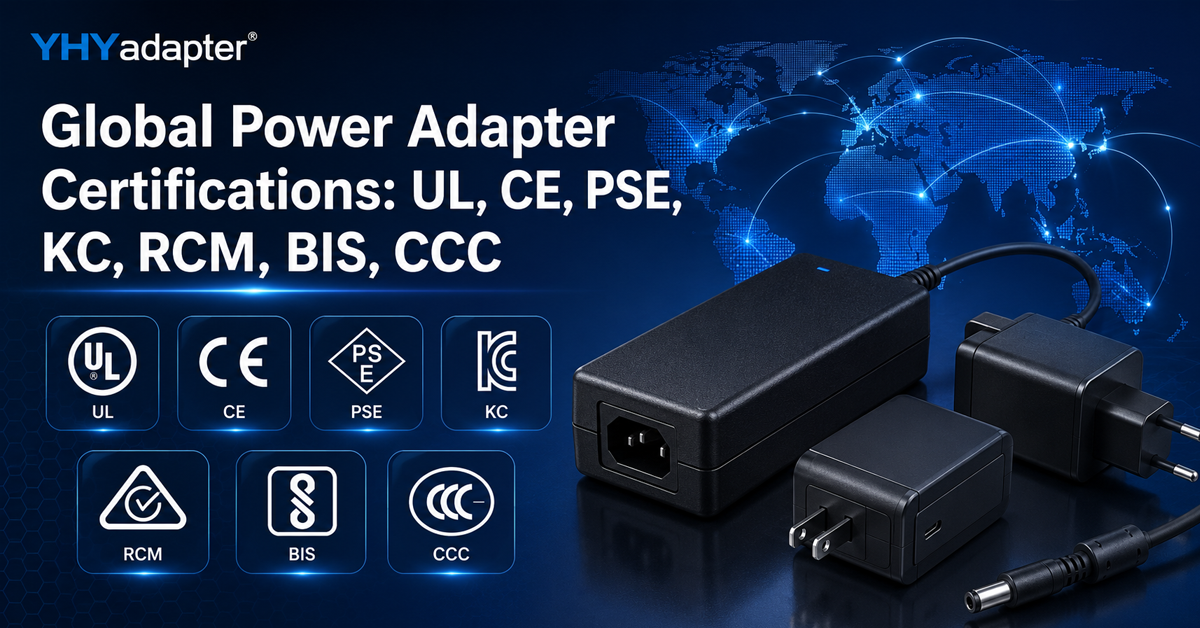
Global Certifications Guide
Global power adapter certification market guide (UL/CE/PSE/KC/RCM/BIS/CCC)
✅ Related Certifications
UL 62368-1 Safety Certification
Safety standard covering connector creepage/clearance, temperature rise, and strain relief requirements for IT/AV equipment power adapters.