YHYadapter product positioning: YHYadapter provides regulated constant-voltage (CV) AC/DC power adapters. LED controlgear certification (IEC 61347-1/-2-13) is available by model — the YHY-24002500 (24V/2.5A) carries IEC 61347-1/-2-13 certification (certificate CTC20231411SC01). Dedicated constant-current (CC) LED drivers from specialized manufacturers are discussed as industry architecture options.
LED lighting power supplies must carry the relevant safety, EMC, and energy-efficiency certifications for their target markets. The standards landscape for LED lighting differs significantly from general power adapters because LED drivers are classified as lighting controlgear and must meet lighting-specific product standards. Unlike general power adapters certified to UL 62368-1 or EN 62368-1, LED controlgear is evaluated to the IEC/EN 61347 series, with UL 1310 (Class 2) applicable in the US for limited-power units.
This guide covers the certification requirements for power supplies used in LED lighting applications, including safety standards, EMC requirements, energy-efficiency specifications, and practical compliance pathways for OEMs.
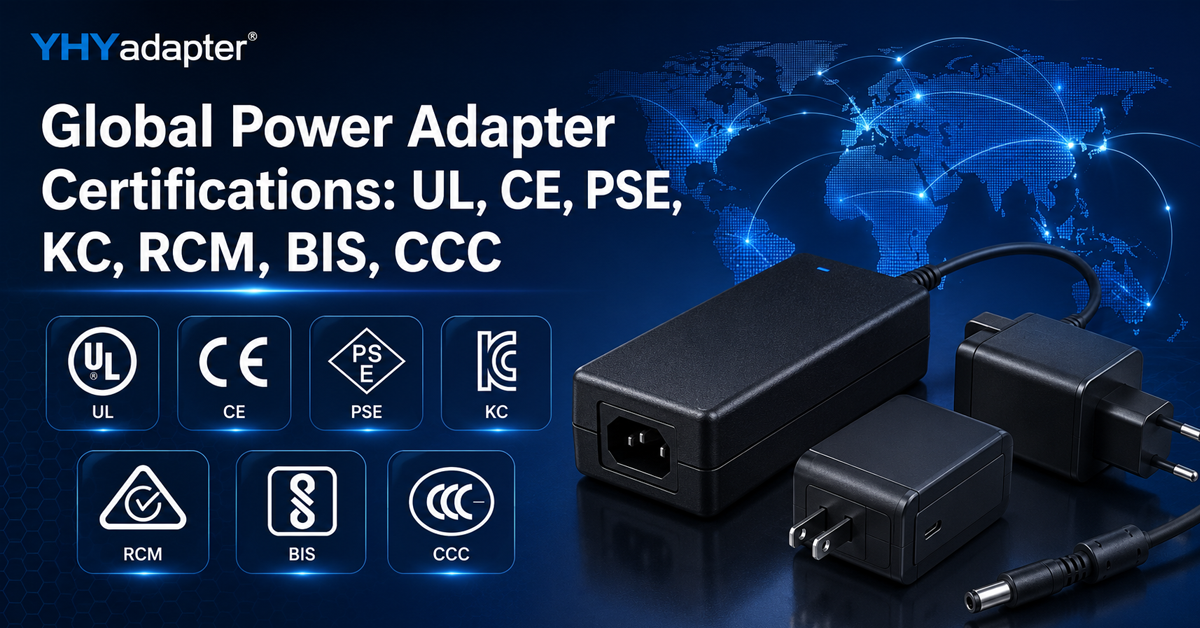
Safety Standards by Market
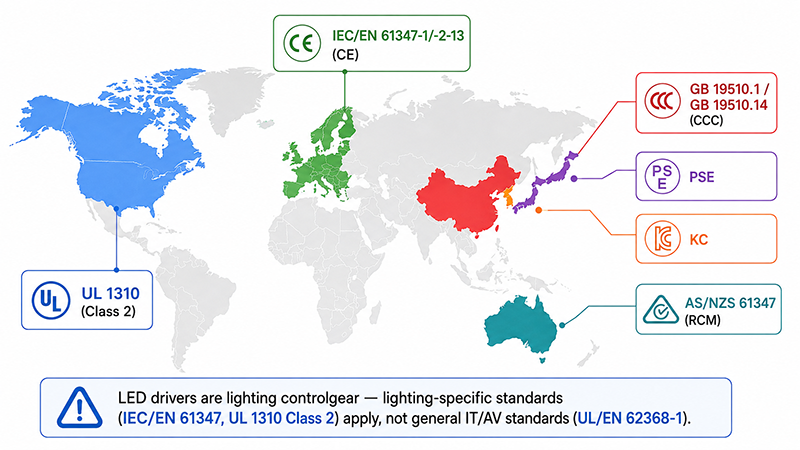
LED lighting power supplies are classified as lighting controlgear and must meet safety standards specific to lighting equipment. The applicable standard depends on the product type, output characteristics, and target market.
| Market | Safety Standard | Applies To | Typical Timeline |
|---|---|---|---|
| USA | IEC 61347-1/-2-13 (LED controlgear) / UL 1310 (Class 2) | LED controlgear safety (IEC 61347); limited-output power units ≤100VA, ≤30Vrms/42.4Vpk (UL 1310) | 8–14 wks |
| EU | EN 61347-2-13 | LED DC or AC supplied electronic controlgear | 2–6 wks (CE) |
| EU | EN 61347-1 | General requirements for lamp controlgear | 2–6 wks (CE) |
| China | CCC where in scope | GB 19510.1, GB 19510.14 (LED controlgear) | 4–6 wks |
| Japan | PSE depending on category | Appropriate PSE standard per product category | 4–9 wks |
| South Korea | KC safety + EMC | Applicable Korean lighting standards | 6–8 wks |
| Australia/NZ | RCM / EESS | AS/NZS 61347 series | 6–10 wks |
Key Standards Detail
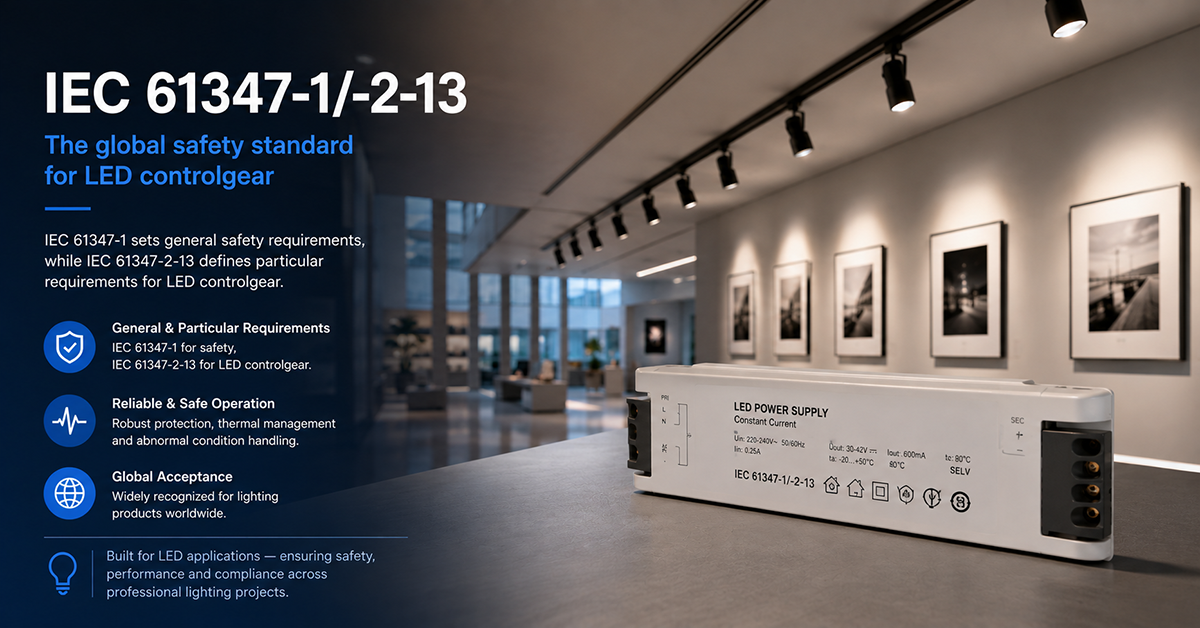
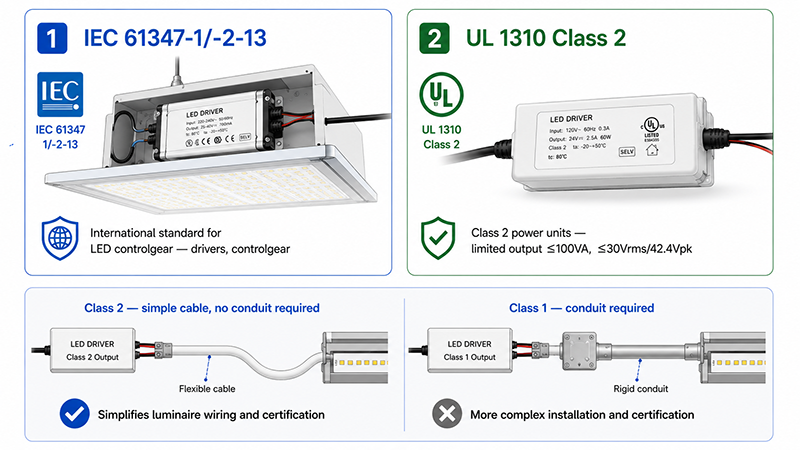
IEC/EN 61347-1/-2-13 (LED controlgear): The international and EU safety standard series for lamp controlgear. IEC 61347-1 covers general requirements; IEC 61347-2-13 is the product standard for LED DC or AC supplied electronic controlgear. It is distinct from the general-purpose standard EN 62368-1 and covers safety requirements specific to LED drive circuits, including output voltage, current limits, and protection features. YHYadapter’s YHY-24002500 (24V/2.5A) carries IEC 61347-1/-2-13 certification (certificate CTC20231411SC01).
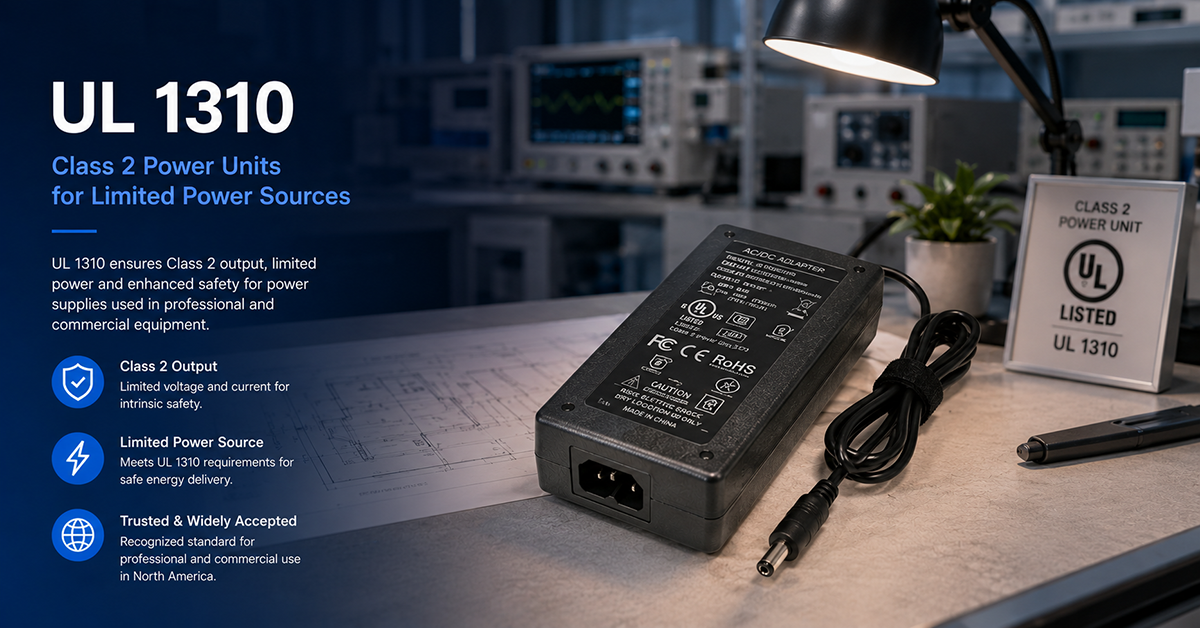
UL 1310 / Class 2 (USA): Class 2 power units have limited output power (≤100VA) and limited voltage (≤30Vrms or 42.4Vpk). Class 2 certification simplifies luminaire wiring because Class 2 circuits have fewer conduit and installation restrictions than Class 1 circuits. Many low-voltage LED drivers are certified as Class 2 power units.
EN 61347-2-13 (EU): The specific EU safety standard for LED controlgear. This is the product standard for LED drivers and is distinct from the general-purpose standard EN 62368-1. EN 61347-2-13 covers safety requirements specific to LED drive circuits, including output voltage, current limits, and protection features.
Why This Matters
- An LED driver certified to UL 62368-1 (IT/AV standard) may not be accepted for a lighting controlgear evaluation (IEC 61347-1/-2-13) or UL 1310 Class 2 listing. The product standard must match the end-product classification.
- Class 2 certification (UL 1310) in the US simplifies installation wiring and luminaire certification because Class 2 circuits have fewer restrictions than Class 1 circuits.
- The EN 61347 series is the applicable safety standard for LED drivers in EU markets. EN 62368-1 is for general power adapters, not for dedicated lighting controlgear.
OEM Actions
- Confirm the product standard that applies to your luminaire type in each target market. LED drivers typically require lighting-specific standards (IEC/EN 61347, UL 1310 Class 2) rather than general IT/AV standards.
- If designing for the US market, evaluate whether Class 2 (UL 1310) output characteristics are achievable—Class 2 simplifies luminaire certification and installation.
- Verify that the driver supplier holds the relevant certifications for your target markets before engaging in product development.
EMC Standards for LED Lighting
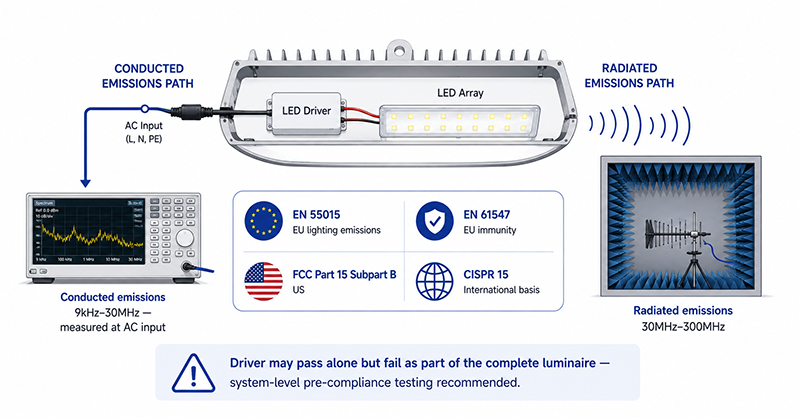
| Market | EMC Standard | Scope |
|---|---|---|
| USA | FCC Part 15 Subpart B | Radiated and conducted emissions for digital devices |
| EU | EN 55015 | Emission limits for lighting equipment |
| EU | EN 61547 | Immunity requirements for lighting equipment |
| China | GB/T 18595 | EMC requirements for lighting equipment |
| International | CISPR 15 | Basis for many national lighting EMC regulations |
EMC Compliance Path
EN 55015 (EU): This is the EMC emission standard specific to lighting equipment. It covers conducted emissions (9kHz–30MHz) and radiated emissions (30MHz–300MHz) from lighting products, including LED drivers. EN 55015 limits are different from EN 55032 (multimedia equipment), and LED drivers for EU lighting applications must comply with EN 55015.
FCC Part 15 (USA): LED drivers with digital control circuitry (PWM controllers, digital dimming, communication interfaces) fall under FCC Part 15 Subpart B. The driver and luminaire must comply as a system. The FCC does not have a lighting-specific emission standard; Part 15 Subpart B applies to all digital electronic products.
EMC Compliance Path:
The driver’s conducted and radiated emissions contribute to the total luminaire emissions. An adapter that passes emissions limits when tested alone may cause the complete luminaire to fail when connected. Pre-compliance testing of the driver + luminaire combination is recommended.
Available by model. An adapter carrying the relevant EMC certifications may support the end-product certification pathway. Final acceptance depends on the end-product construction, application, target market, and applicable certification program.
Why This Matters
- LED power supplies for EU lighting applications must comply with EN 55015 (lighting EMC), not EN 55032 (multimedia EMC). The standards have different limits and measurement methods.
- The driver’s certification does not extend to the complete luminaire. System-level EMC testing is required for the luminaire as a finished product.
- EMC compliance for LED luminaires with wireless control (Bluetooth mesh, Zigbee, Thread) requires additional testing for intentional radiators.
OEM Actions
- Verify that the driver supplier has EMC test data for the applicable lighting-specific standards (EN 55015, FCC Part 15).
- Plan for pre-compliance EMC testing of the complete luminaire (driver + LED array + housing + control wiring) early in the design cycle.
- If the luminaire includes wireless control, include both EMC and radio compliance in the certification plan.
Energy Efficiency Regulations
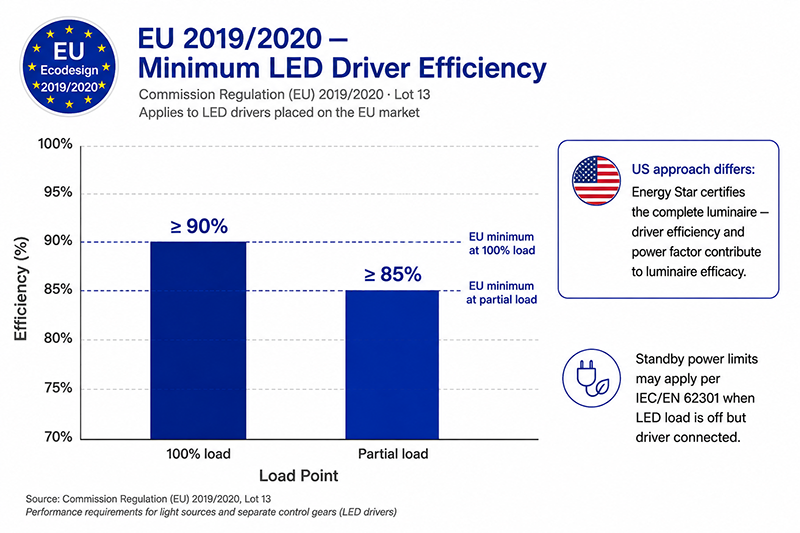
| Market | Regulation | Scope | Requirements |
|---|---|---|---|
| EU | EU 2019/2020 (Ecodesign for lighting) | External and internal LED drivers | Minimum efficiency at defined load points |
| USA | Energy Star (LED luminaires) | Complete luminaire, not just driver | Luminous efficacy and driver efficiency |
| USA | DoE efficiency standards | External power supplies (general) | Level VI efficiency per 10 CFR 430 |
| California | CEC Title 20 | External power supplies sold in California | Appliance efficiency regulations |
| Global | IEC/EN 62301 (standby power) | Standby power consumption | Standby power limits for applicable products |
EU Ecodesign (EU 2019/2020)
The EU Ecodesign regulation for lighting (EU 2019/2020) sets minimum efficiency requirements for LED drivers and other lighting controlgear. The requirements are specified in terms of minimum efficiency at full load and at defined partial load points. The specific limits depend on the driver’s rated output power. Verify the requirements against the applicable regulation edition and the driver’s power category.
Energy Star (USA)
Energy Star certification for LED luminaires requires the complete luminaire to meet efficacy and power quality requirements. While the luminaire is the certified entity, the driver’s efficiency and power factor contribute to the luminaire’s ability to meet Energy Star specifications.
Why This Matters
- Energy-efficiency regulations for LED drivers are typically specified at the product level (driver) in the EU and at the system level (luminaire) in the US. The applicable regulatory framework depends on the target market.
- Driver efficiency directly affects the luminaire’s ability to meet Energy Star or other efficiency certification requirements.
- Some markets have standby power limits that apply to the driver’s power consumption when the LED load is off but the driver is still connected to AC power.
OEM Actions
- Identify the energy-efficiency regulations that apply to your luminaire in each target market. Determine whether the driver must meet specific efficiency requirements or whether the luminaire is certified as a system.
- Request efficiency data at the applicable load points from the driver supplier. Verify that the driver meets the efficiency requirements for your target markets.
- Include the driver’s standby power consumption in the luminaire’s total standby power calculation.
Practical Certification Planning
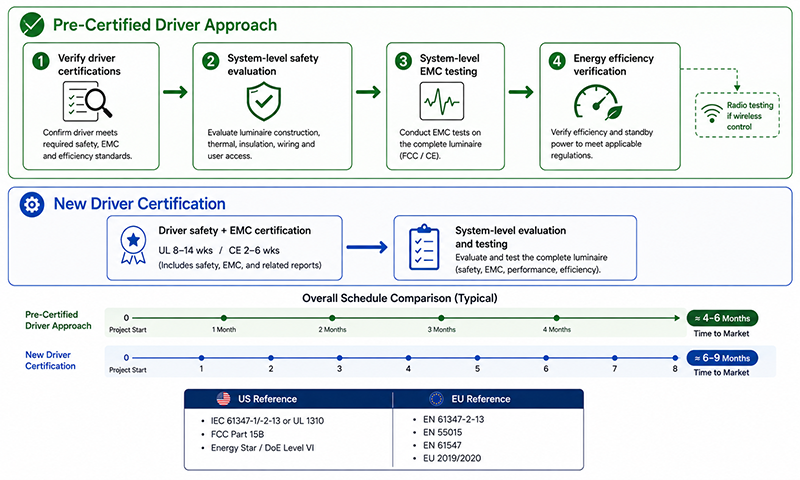
Pre-Certified Driver Approach
If the driver carries the required certifications for your target markets, the luminaire certification focuses on:
- System-level safety evaluation (driver integrated into luminaire)
- System-level EMC testing (driver + LED array + housing + wiring)
- Energy-efficiency verification (if applicable)
- Radio testing (if the luminaire has wireless control)
New Driver Certification
If a new driver certification is required, the timeline extends to include the driver’s safety and EMC certification, which typically takes 8–14 weeks for UL (US) or 2–6 weeks for CE (EU).
Key Standards for LED Lighting Power Supplies
| Component | US Standard | EU Standard |
|---|---|---|
| Safety | IEC 61347-1/-2-13 or UL 1310 (Class 2) | EN 61347-2-13 |
| EMC Emissions | FCC Part 15 Subpart B | EN 55015 |
| EMC Immunity | — | EN 61547 |
| Energy Efficiency | Energy Star / DoE Level VI | EU 2019/2020 |
| Radio (if applicable) | FCC Part 15C | RED 2014/53/EU |
Useful Links
Q: Does a UL 62368-1 certified power adapter qualify for use in an LED luminaire sold in the US?
A: UL 62368-1 is the safety standard for IT/AV equipment. For LED luminaires, lighting controlgear standards apply — IEC 61347-1/-2-13, with UL 1310 (Class 2) applicable to limited-power units in the US. A UL 62368-1 certified adapter may be accepted if the overall luminaire evaluation covers it, but the safest approach is to use a driver with lighting-specific certification such as IEC 61347-1/-2-13.
Q: What is the difference between Class 2 and non-Class 2 LED drivers in the US?
A: Class 2 drivers (UL 1310) have limited output power (≤100VA) and require simpler wiring methods—no conduit needed for Class 2 circuits in most US installations. Non-Class 2 drivers require Class 1 wiring (conduit). Class 2 drivers also simplify the luminaire’s UL listing process because the output wiring is less restricted.
Q: Do I need FCC certification for an LED driver used in a commercial luminaire?
A: In the US, FCC Part 15 Subpart B applies to any digital electronic product, including LED drivers with digital control circuitry (PWM controllers, digital dimming, communication interfaces). The driver must comply with FCC Part 15. The compliance path (SDoC or Certification) depends on the product type and whether it is marketed as a standalone device or as a component of a luminaire.
Conclusion
LED lighting power supply certification differs from general power adapter certification in several important ways. Safety standards are lighting-specific (IEC/EN 61347-2-13, with UL 1310 Class 2 for limited-power units in the US) rather than general IT/AV standards. EMC standards for EU markets are lighting-specific (EN 55015, EN 61547) rather than multimedia standards (EN 55032). Energy-efficiency regulations apply at the driver level in the EU and the luminaire level in the US. The certification strategy should be defined at the product specification stage, with the driver’s certifications verified against each target market’s requirements.
Related Resources
🔌 Related Products
🏭 Related Applications
Industrial Control Power Solutions
Power solutions for PLC, CNC, servo and automation equipment
📖 Related Guides
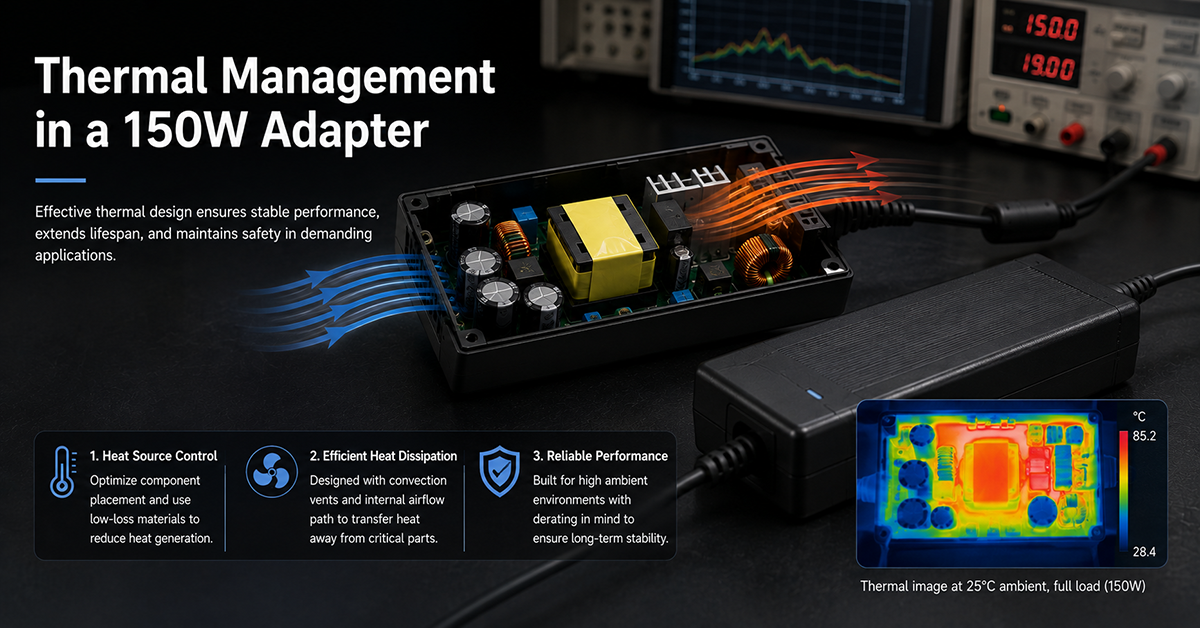
Thermal Management in a 150W Adapter
Fanless thermal management in a compact 150W adapter
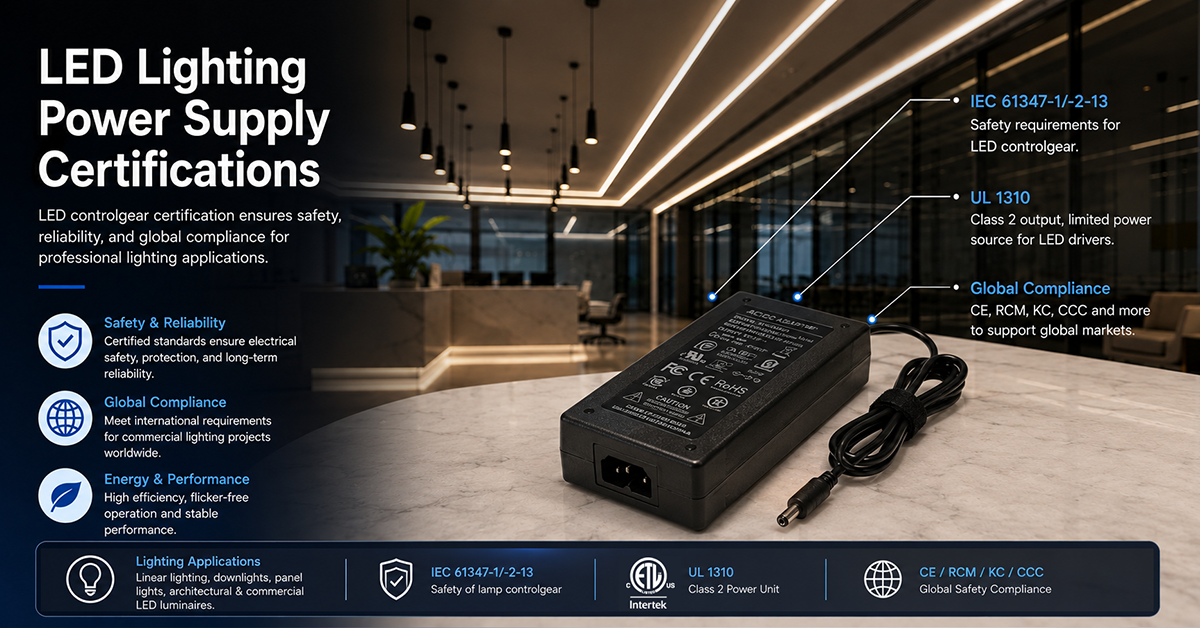
LED Lighting Power Supply Certifications
LED controlgear certification: IEC 61347-1/-2-13, UL 1310, global compliance
✅ Related Certifications