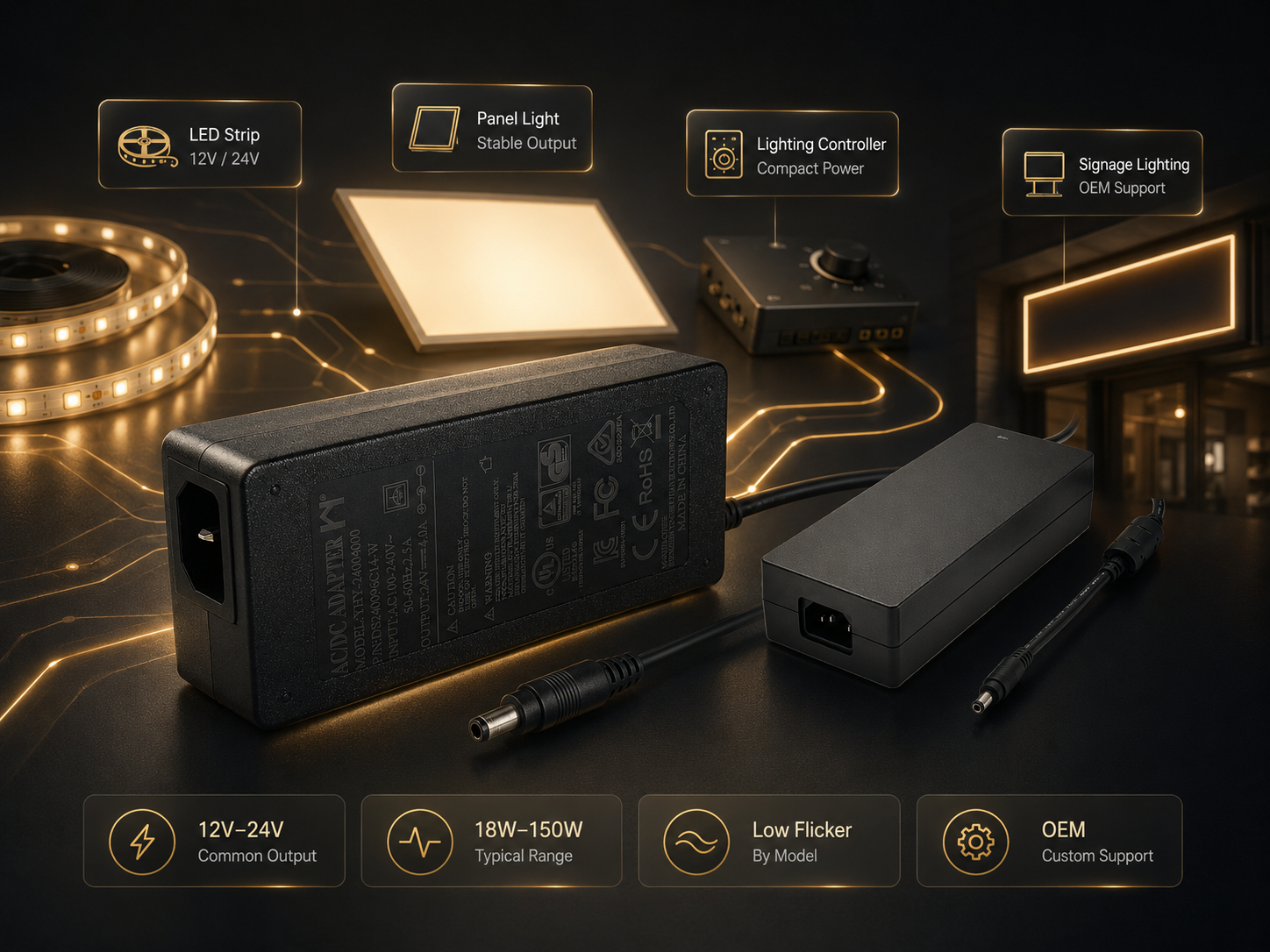
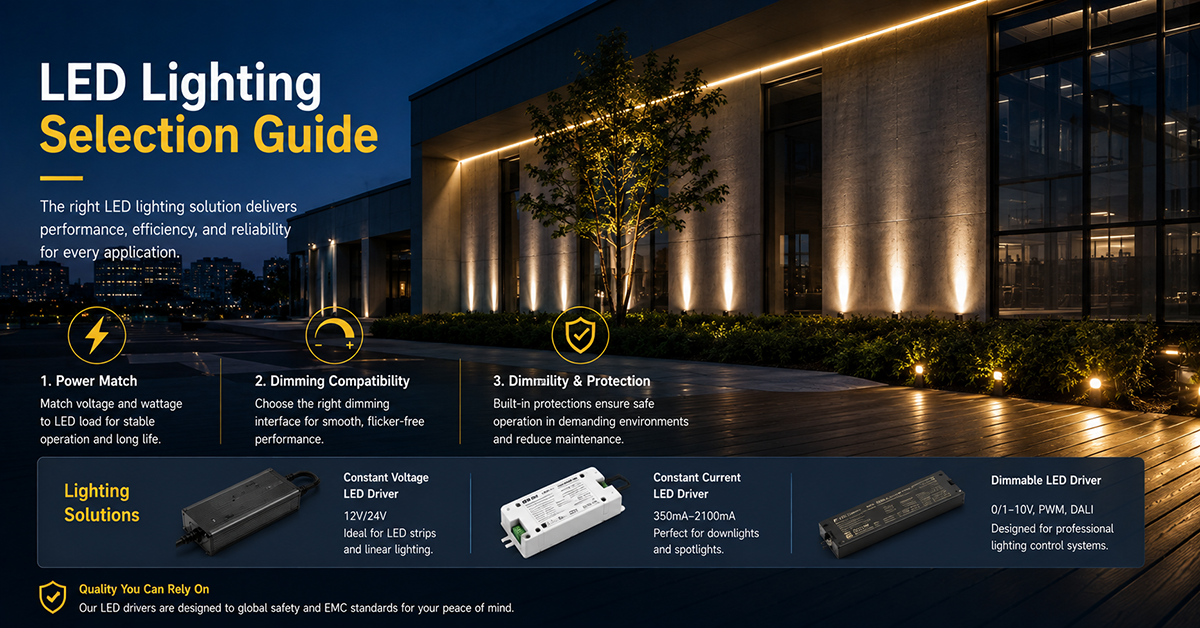
YHYadapter product positioning: YHYadapter provides regulated constant-voltage (CV) AC/DC power adapters (12V/24V desktop, wall plug and open frame platforms). These are suitable for LED lighting systems where a constant-voltage supply is the design choice (e.g., LED strip, signage, panel lighting with external CV drivers). For luminaire-integrated constant-current LED drivers with IP65/IP67 outdoor ratings, dedicated products from specialized lighting driver manufacturers are required. The outdoor design guidance in this guide serves as industry reference for OEMs planning outdoor LED installations.
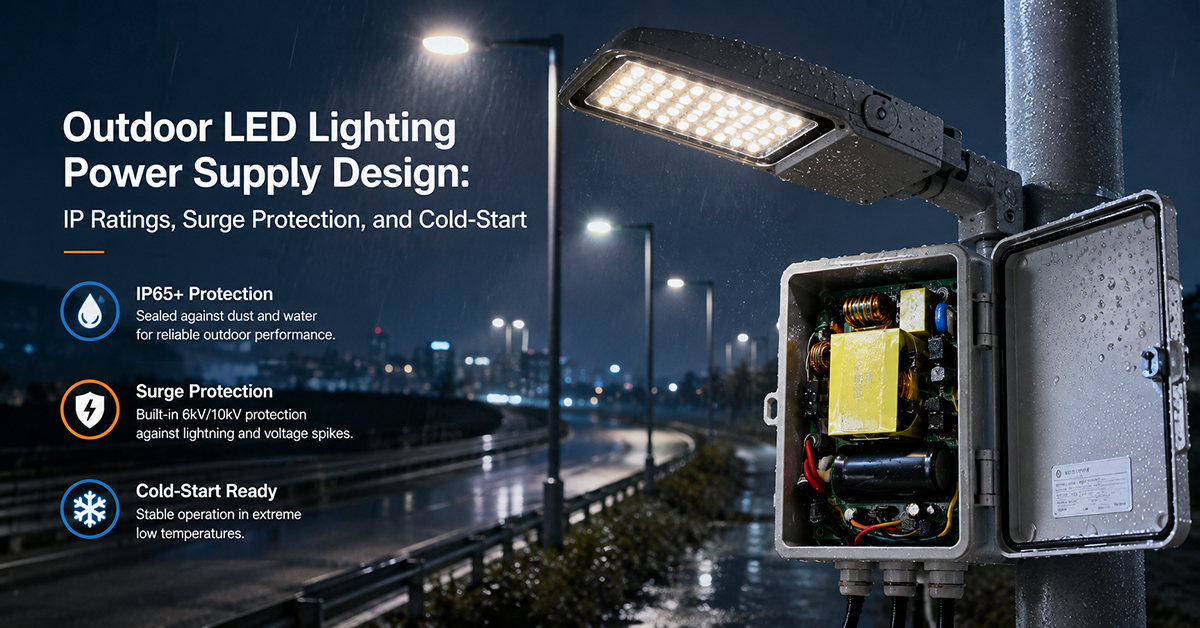
Outdoor LED lighting installations expose the power supply to environmental conditions that indoor drivers never encounter: rain, dust, temperature extremes, UV radiation, and electrical surges from lightning and utility grid switching. The power supply’s ability to operate reliably in these conditions directly affects the luminaire’s service life and maintenance costs. Unlike indoor drivers where thermal management and noise may be the primary concerns, outdoor drivers must prioritize ingress protection, surge immunity, and cold-start capability.
This guide covers the power supply design considerations specific to outdoor LED lighting: IP rating selection and installation, surge protection requirements per IEC 61000-4-5, cold-start performance in low-temperature climates, and the thermal challenges of enclosed outdoor luminaires.
IP Rating Selection for Outdoor LED Drivers
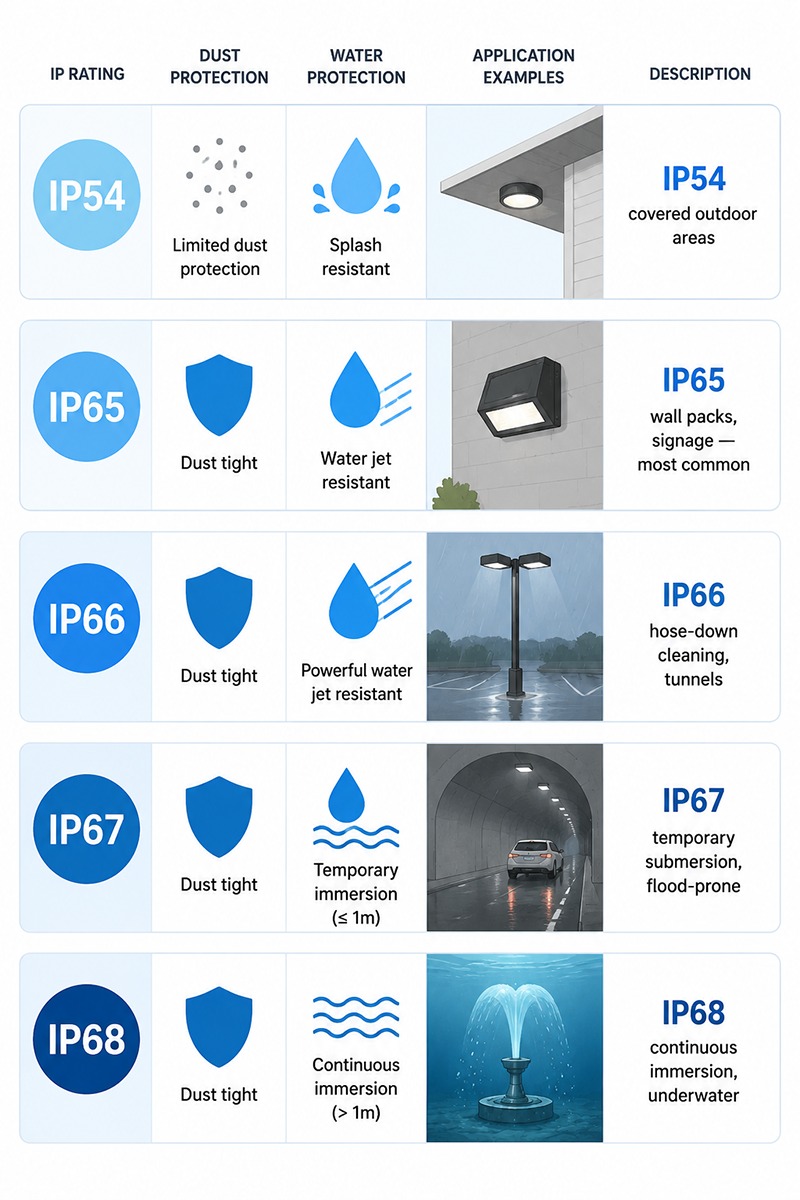
The Ingress Protection (IP) rating defines the driver’s resistance to solid objects (dust) and liquids (water). For outdoor LED lighting, the IP rating must match the installation environment.
IP Rating Reference
| IP Rating | Dust Protection | Water Protection | Typical Outdoor Applications |
|---|---|---|---|
| IP54 | Limited dust ingress | Splashing water from any direction | Covered outdoor areas, eaves, semi-protected |
| IP65 | Dust-tight | Water jets from any direction (6.3mm nozzle) | Wall packs, parking lot lights, signage |
| IP66 | Dust-tight | Powerful water jets (12.5mm nozzle) | Tunnel lighting, car washes, marine environments |
| IP67 | Dust-tight | Temporary immersion (1m depth, 30 min) | Fountain lighting, flood-prone areas, landscape |
| IP68 | Dust-tight | Continuous immersion (depth specified by manufacturer) | Underwater lighting, submersible applications |
Installation Considerations
- Using an IP65 driver but failing to seal the AC input cable entry at the luminaire
- Using an IP65 driver in an IP65 luminaire but leaving the wiring compartment unsealed
- Installing the driver in a position where water can pool around cable entries
- Using a non-IP-rated connector that bypasses the driver’s IP protection
Why This Matters
- An IP65 driver with an unsealed cable entry provides no more protection than an IP20 driver at the point of water ingress.
- Outdoor LED lighting with inadequate IP rating can fail within a single rainy season due to water ingress and corrosion.
- IP66 or higher is commonly specified for installations where the luminaire is subject to hose-down cleaning (parking garages, tunnels, food processing areas).
OEM Actions
- Select the driver IP rating based on the luminaire’s intended installation environment, not on a universal “IP65 for all outdoor” assumption.
- Specify sealing requirements for all cable entries (AC input, DC output, dimming control) in the luminaire assembly instructions.
- Verify the driver’s IP rating includes the cable entry method used in the luminaire. Some drivers are rated with specific cable glands.
Surge Protection Requirements
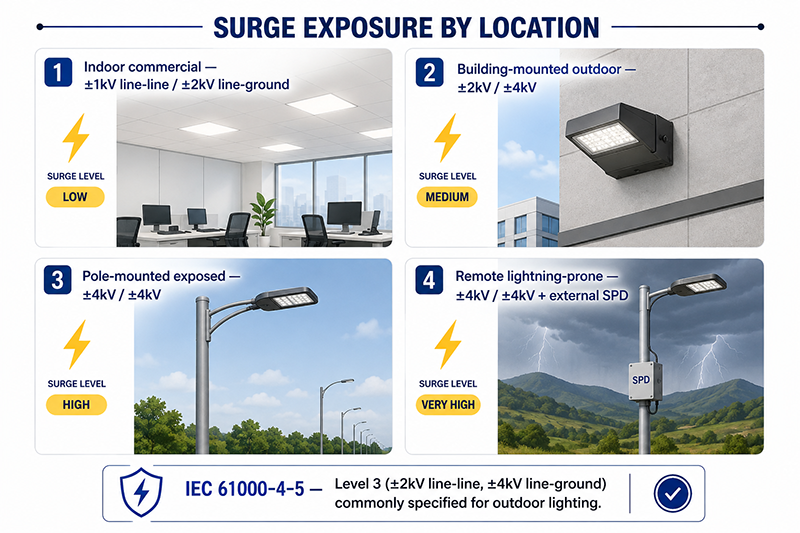
Surge Protection Levels
| Installation Category | Typical Surge Requirement (IEC 61000-4-5) | Example Applications |
|---|---|---|
| Indoor (commercial) | ±1kV line-to-line, ±2kV line-to-ground | Office lighting, retail |
| Outdoor (building-mounted) | ±2kV line-to-line, ±4kV line-to-ground | Wall packs, parking lot lights, signage |
| Outdoor (pole-mounted, exposed) | ±4kV line-to-line, ±4kV line-to-ground | Street lighting, parking lot poles, floodlights |
| Remote / lightning-prone | ±4kV line-to-line, ±4kV line-to-ground + external SPD | Rural lighting, exposed hilltop installations |
Surge Protection Methods
| Method | Description | Typical Location |
|---|---|---|
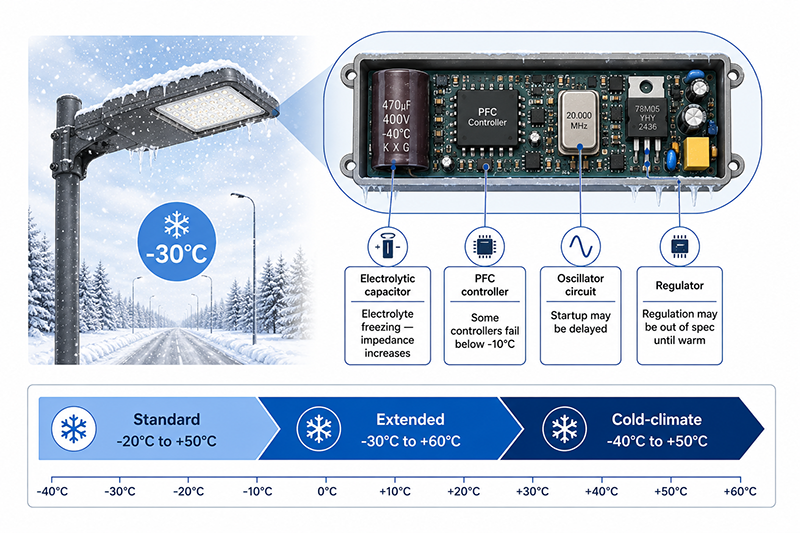
| Integrated MOV (metal oxide varistor) | Internal surge suppression across AC input | Inside driver; provides basic protection |
| External surge protective device (SPD) | Dedicated surge suppressor at the luminaire or distribution panel | External to driver; provides enhanced protection |
| Combined driver + SPD | Driver design with enhanced surge rating | Integrated; reduces installation cost |
| Additional series impedance | Inductance or resistance to limit surge current | Between AC source and driver |
Practical Surge Protection Strategy
For most outdoor LED lighting installations, a driver with integrated ±2kV/±4kV surge protection (per IEC 61000-4-5 Level 3) provides adequate protection. For lightning-prone areas or high-exposure installations (pole-mounted, exposed ridgelines), an external SPD at the luminaire or distribution panel is recommended.
Why This Matters
- A lightning-induced surge can destroy LED drivers that lack adequate surge protection, causing simultaneous failure of multiple luminaires in an installation.
- Surge protection requirements depend on the installation location, not just on the driver’s rated protection level. A driver with ±2kV protection may be adequate for a building-mounted wall pack but insufficient for a street light on an exposed pole.
- External SPDs add to installation cost but provide multi-strike protection that internal MOVs may not survive.
OEM Actions
- Determine the surge exposure level for the luminaire’s intended installation environment. Specify driver surge protection appropriate to the installation category.
- For lightning-prone installations, specify an external SPD or a driver with enhanced surge protection and include the SPD in the luminaire assembly.
- Verify the driver’s surge protection rating is tested per IEC 61000-4-5 with the applicable waveform (1.2/50µs voltage, 8/20µs current).
Cold-Start Performance
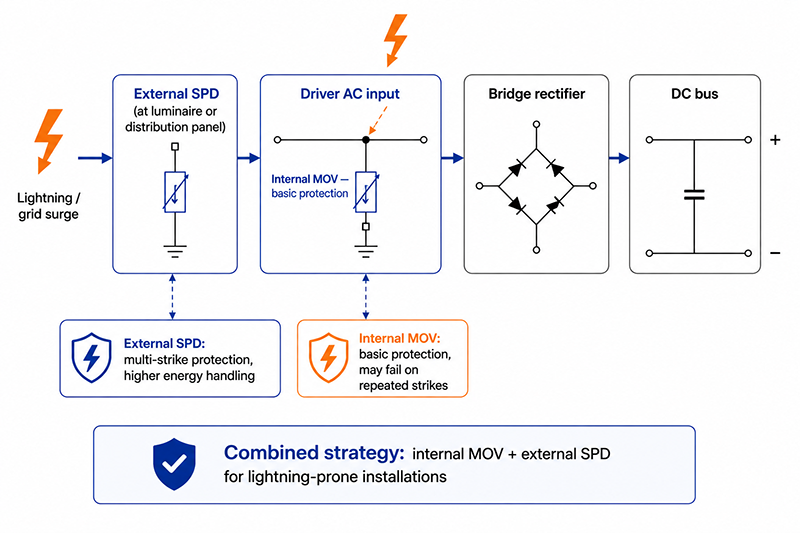
Cold-Start Challenges
| Challenge | Effect | Typical Limitation |
|---|---|---|
| Electrolyte freezing | Capacitor impedance increases, reducing filtering effectiveness | −20°C to −40°C depending on capacitor grade |
| PFC controller startup | Some PFC controllers fail to start below −10°C | Controller-specific minimum operating temperature |
| Oscillator startup | PWM controller startup may be delayed or fail at low temperature | Controller-specific minimum temperature |
| Output voltage regulation | Regulator feedback compensation may be affected | Regulation may be out of spec until warm |
Cold-Start Temperature Ratings
- Standard commercial: −20°C to +50°C
- Extended temperature: −30°C to +60°C
- Cold-climate: −40°C to +50°C
Verification
Cold-start capability should be verified by the OEM through thermal chamber testing rather than relying solely on datasheet specifications. A driver that starts at −30°C with a warm (room-temperature) AC source may not start at −30°C with a cold-soaked AC source.
Why This Matters
- A driver that fails to start at low temperature can leave outdoor lighting inoperative during winter conditions, creating safety and security issues.
- Cold-start failure is often temperature-sensitive: a driver may start at −20°C but fail at −25°C. The margin to the specified minimum should be verified.
- Some drivers may start at low temperature but operate with degraded performance (higher ripple, reduced output current) until internal temperature rises.
OEM Actions
- Determine the minimum expected ambient temperature for the luminaire’s installation location. Select a driver with a minimum operating temperature at least 10°C below the expected minimum.
- Verify cold-start capability through thermal chamber testing at the minimum specified temperature, with the driver cold-soaked for at least 2 hours before the test.
- For cold-climate installations, specify drivers rated for −40°C or with a preheat function, depending on the expected winter temperatures.
Thermal Management in Outdoor Luminaires
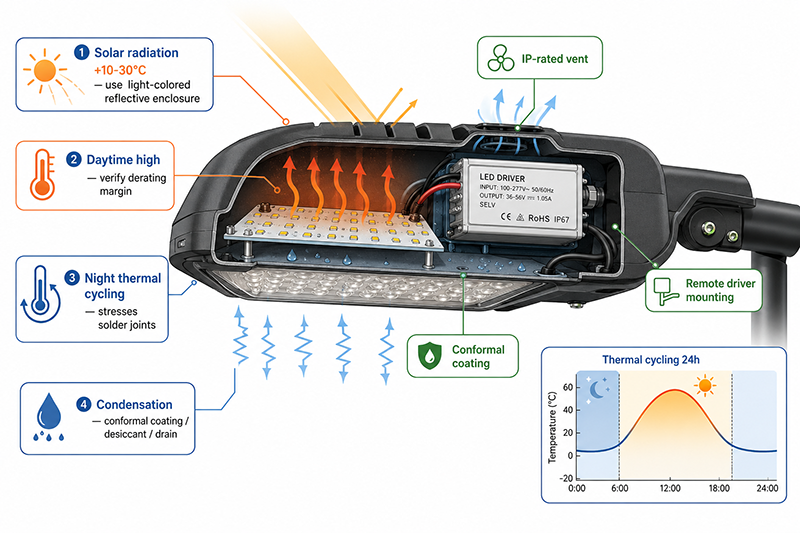
Thermal Conditions in Outdoor Luminaires
| Condition | Effect on Driver | Design Consideration |
|---|---|---|
| Solar radiation | Raises internal ambient temperature 10–30°C above external ambient | Light-colored enclosure; driver remote mounting |
| Daytime high temperature | Driver operating near or above derating threshold | Verify driver derating at expected internal ambient |
| Nighttime temperature swing | Thermal cycling stresses solder joints and components | Component selection for thermal cycling |
| Internal condensation | Moisture on PCB can cause corrosion and shorts | Conformal coating; condensation drain; sealed driver |
| Radiative cooling | Clear night sky can cool enclosure below ambient | Not typically a driver issue |
Thermal Mitigation Strategies for Outdoor Luminaires
| Strategy | Benefit | Implementation |
|---|---|---|
| Light-colored or reflective enclosure | Reduces solar heating by 5–15°C | Paint or material selection |
| Enclosure venting (with IP-rated vent) | Reduces internal temperature rise | Requires IP-rated vent; reduces condensation |
| Remote driver mounting | Driver operates at ambient temperature | Separate junction box or compartment |
| Thermal interface material | Improves heat transfer to enclosure | Thermal pad between driver and enclosure wall |
| Driver derating margin | Reliable operation at elevated temperature | Select driver with 20–30% power margin |
Why This Matters
- A dark-colored outdoor luminaire in direct sunlight can experience internal temperatures 20–40°C above the external ambient, potentially exceeding the driver’s maximum operating temperature.
- Thermal cycling (day/night temperature swings) stresses the driver’s solder joints and component interconnections. Drivers used in outdoor installations should have robust construction.
- Condensation inside outdoor luminaires can cause driver failure even if the driver’s IP rating is adequate. Desiccant packs, conformal coating, and condensation drains are preventive measures.
OEM Actions
- Measure or model the internal temperature of the luminaire under worst-case conditions: maximum external ambient temperature + solar radiation + LED heat + driver heat.
- Select a driver with adequate derating margin for the expected internal temperature. A driver rated for 50°C internal ambient should not be operated at 60°C internal ambient.
- Include condensation prevention in the luminaire design: sealed driver compartment with desiccant, conformal coating on the driver PCB, or a condensation drain.
Useful Links
Q: Is IP65 sufficient for all outdoor LED lighting?
A: IP65 is commonly specified for outdoor luminaires, but the appropriate rating depends on the installation environment. IP66 is recommended where the luminaire is subject to hose-down cleaning or heavy rain. IP67 is required for installations where temporary submersion is possible. Requirements depend on the specific installation location and applicable codes.
Q: Do I need external surge protection for outdoor LED lighting?
A: For building-mounted outdoor luminaires, a driver with integrated ±2kV/±4kV surge protection (IEC 61000-4-5 Level 3) may be sufficient. For pole-mounted or remote installations in lightning-prone areas, an external SPD at the luminaire or distribution panel is recommended.
Q: What is the minimum cold-start temperature I should specify for outdoor LED lighting?
A: The minimum start temperature should be at least 10°C below the expected lowest ambient temperature at the installation location. For most North American and European climates, −20°C is sufficient. For cold-climate regions (northern Canada, Scandinavia, northern China), −30°C or −40°C drivers should be specified.
Conclusion
Outdoor LED lighting power supply selection requires attention to three areas that are less critical in indoor applications: ingress protection, surge immunity, and cold-start capability. The IP rating must protect against the installation environment’s moisture and dust exposure. Surge protection should match the installation’s lightning and grid exposure level. Cold-start capability must be verified for the expected winter temperatures. Thermal management must account for solar heating in addition to self-heating. Each of these requirements should be evaluated against the specific installation environment rather than applied as a universal outdoor specification.
Related Resources
🔌 Related Products
🏭 Related Applications
Industrial Control Power Solutions
Power solutions for PLC, CNC, servo and automation equipment
📖 Related Guides
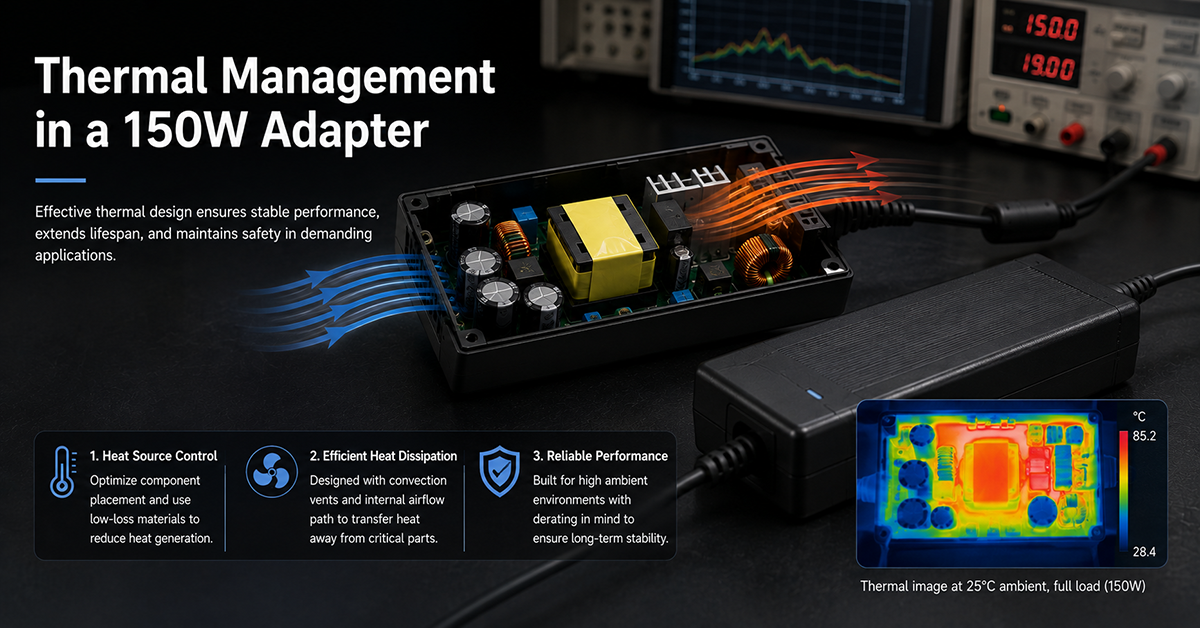
Thermal Management in a 150W Adapter
Fanless thermal management in a compact 150W adapter
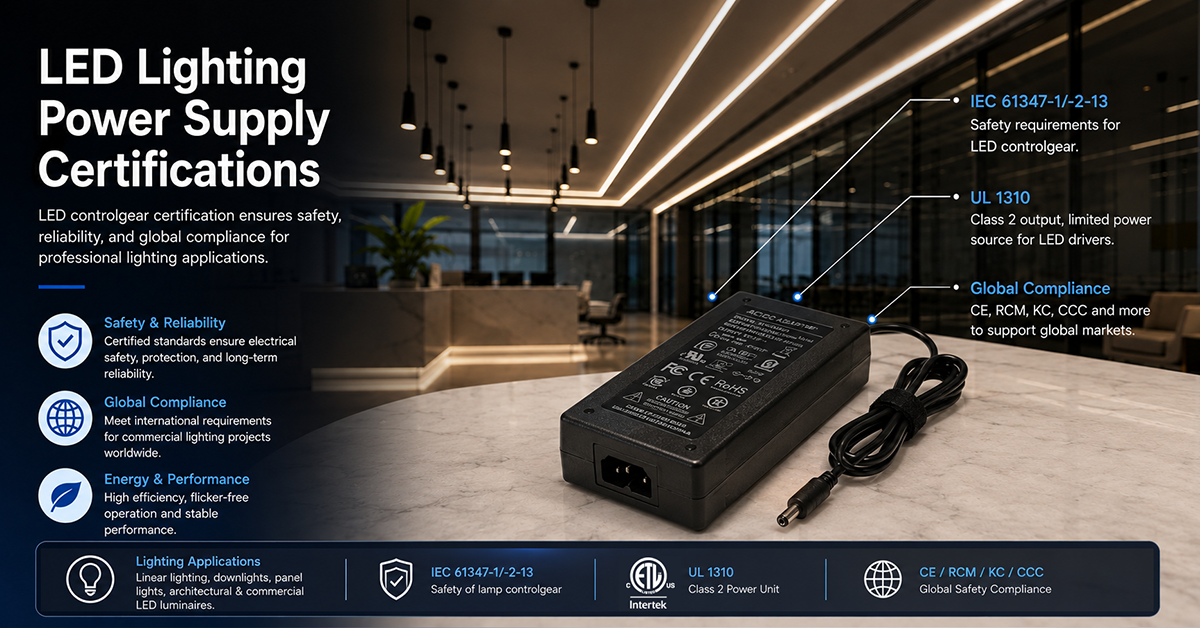
LED Lighting Power Supply Certifications
LED controlgear certification: IEC 61347-1/-2-13, UL 1310, global compliance
✅ Related Certifications