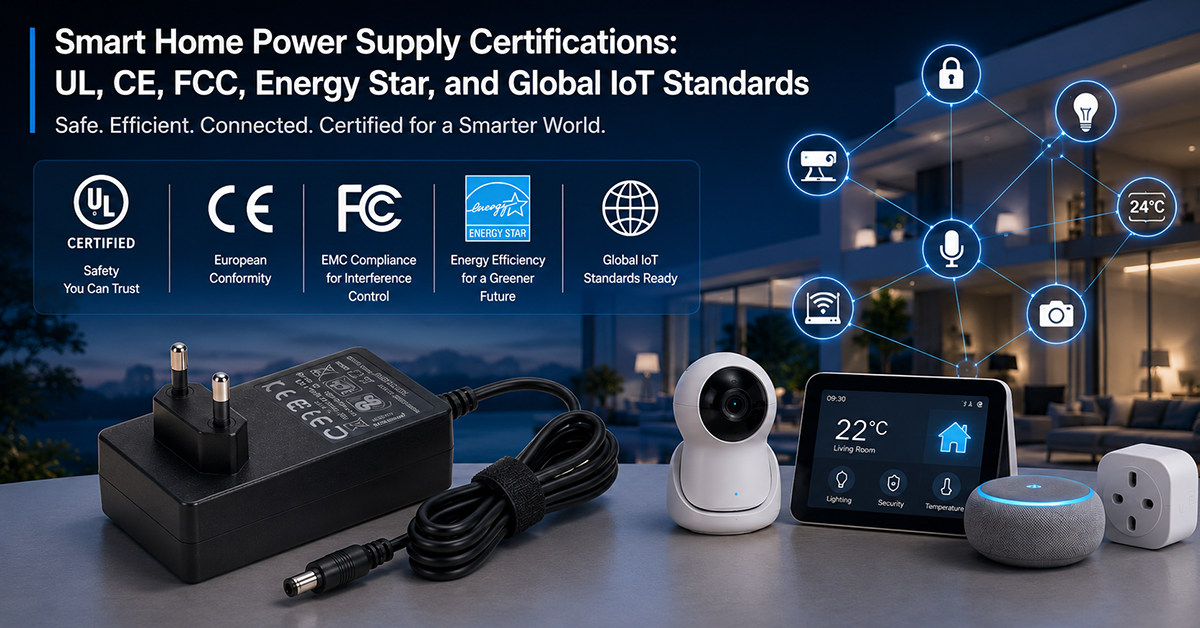
Smart home and IoT devices sold globally must comply with a range of safety, EMC, radio, and energy-efficiency regulations. The external power adapter attached to each device must carry the relevant certifications for each target market. Because smart home devices often include wireless connectivity, they face an additional layer of compliance requirements beyond safety and EMC, and the interactions between the power supply, wireless radios, and the rest of the device can affect system-level EMC and radio performance.
This guide covers the certification requirements for power supplies used in smart home and IoT devices, including safety standards, EMC requirements, energy-efficiency regulations, wireless compliance, and practical certification planning for OEMs.
Safety Standards for Smart Home Power Supplies
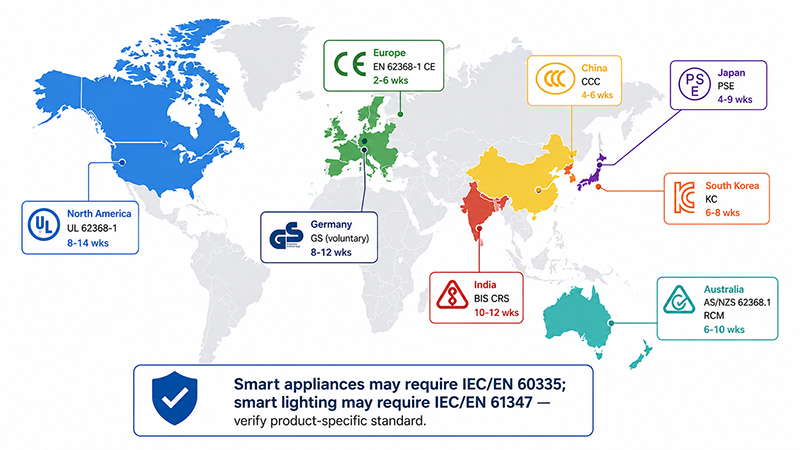
Smart home device power adapters are typically covered by IEC/UL/EN 62368-1, the safety standard for audio/video, information, and communication technology equipment. This standard applies to most smart home devices including smart speakers, cameras, hubs, sensors, and displays.
| Market | Safety Standard | Applicability | Typical Timeline |
|---|---|---|---|
| USA | UL 62368-1 (NRTL listing) | Smart home devices with AC mains connection | 8–14 wks |
| EU | EN 62368-1 (CE conformity) | Smart home devices sold in EU | 2–6 wks |
| Japan | PSE depending on product category | External power adapters are within scope | 4–9 wks |
| South Korea | KC safety | Smart home devices and adapters | 6–8 wks |
| Australia/NZ | AS/NZS 62368.1 (RCM/EESS) | Smart home devices and adapters | 6–10 wks |
| India | BIS CRS registration | External power adapters within scope | 10–12 wks |
| China | CCC where product falls within mandatory catalogue | External power adapters may be within scope | 4–6 wks |
| Germany | GS mark (voluntary) | Optional for EU-marketed products | 8–12 wks |
Products with Specific Standards
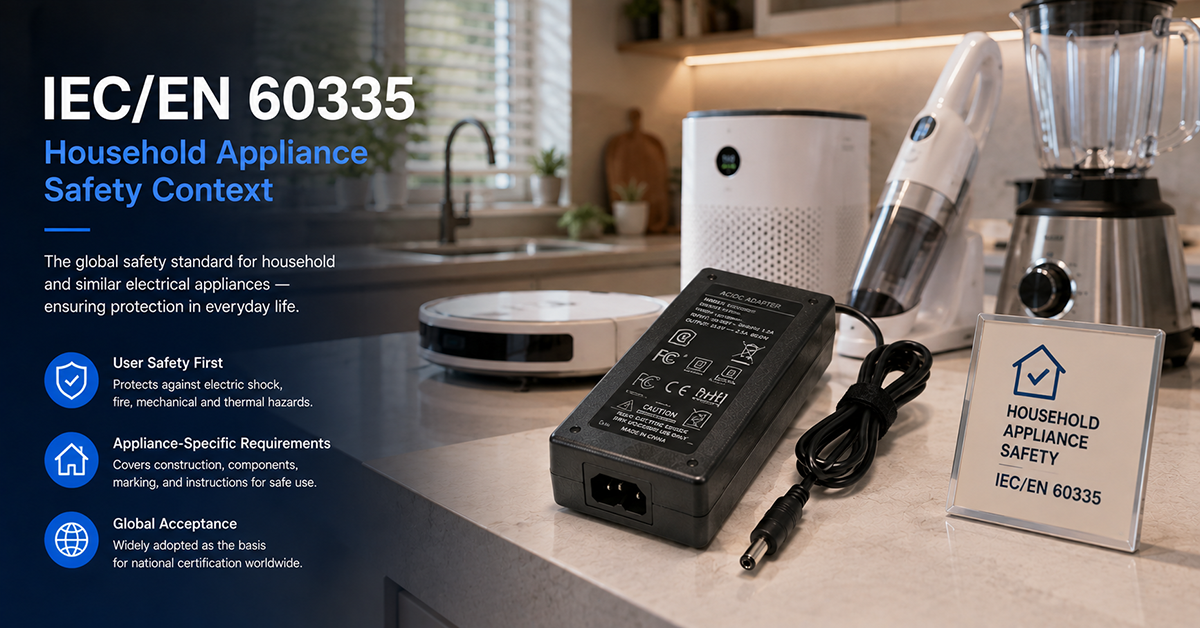
- Smart appliances (connected refrigerators, washing machines): May require IEC/EN 60335 (household appliances) in addition to or instead of 62368-1
- Smart lighting (connected bulbs, light strips): May require IEC/EN 61347 (lighting controlgear) or IEC/EN 62560 (self-ballasted LED lamps)
- Smart medical devices (connected health monitors): May require IEC 60601-1 (medical electrical equipment)
Why This Matters
- UL/EN 62368-1 covers most smart home devices, but smart appliances and smart lighting may fall under different product-specific standards.
- The adapter’s safety certification covers the adapter itself. The end product’s safety evaluation is a separate process.
- Products with wireless charging (smartphone charging pads, etc.) may have additional safety requirements for the wireless power transmitter.
What OEMs Should Do Now
- Identify the applicable safety standard for your device type in each target market. Verify that the candidate adapter carries the required certifications.
- For multi-function devices (e.g., a smart display that also controls appliances), verify which safety standard takes precedence.
- Work with your adapter supplier to select a model with the appropriate certifications for your target markets.
EMC and Wireless Compliance
EMC Standards
| Market | EMC Standard | Scope |
|---|---|---|
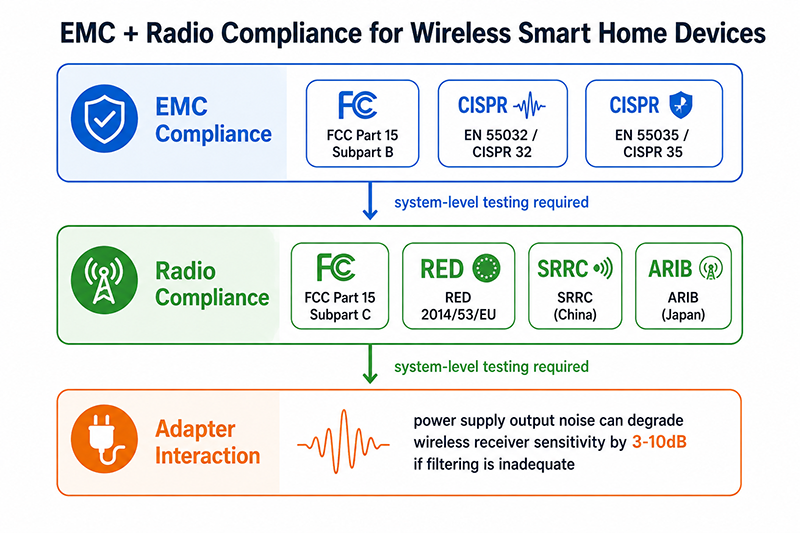
| USA | FCC Part 15 Subpart B | Emissions for digital devices |
| EU | EN 55032 / CISPR 32 | Emissions for multimedia equipment |
| EU | EN 55035 / CISPR 35 | Immunity for multimedia equipment |
| China | GB/T 9254 | Emissions and immunity for IT equipment |
| Korea | KC EMC | Applicable EMC standards |
| Australia/NZ | AS/NZS CISPR 32 | Emissions |
Radio (Wireless) Standards
| Market | Radio Standard | Scope |
|---|---|---|
| USA | FCC Part 15 Subpart C | Intentional radiators (Wi-Fi, BT, Zigbee, Z-Wave, Thread) |
| EU | RED 2014/53/EU (Radio Equipment Directive) | Radio equipment sold in EU; covers safety, EMC, and radio spectrum |
| Canada | RSS standards (Industry Canada) | Radio equipment sold in Canada |
| Japan | ARIB standards | Radio equipment sold in Japan |
| Korea | KC radio | Radio equipment sold in Korea |
| China | SRRC (State Radio Regulation) | Radio equipment sold in China |
| Australia/NZ | AS/NZS 4268 | Radio equipment |
Power Supply Interaction with Wireless Performance
The power supply’s output noise and grounding can affect wireless radio sensitivity. A poorly filtered adapter can introduce noise at frequencies that fall within the wireless bands, reducing receiver sensitivity. This interaction is system-dependent and should be verified during pre-compliance testing.
Why This Matters
- A smart home device with Wi-Fi, Bluetooth, or Thread must comply with both EMC standards (emissions and immunity) and radio standards for each target market.
- The power adapter’s output noise can degrade wireless receiver sensitivity by 3–10dB if filtering is inadequate, reducing the device’s effective wireless range.
- Radio certification in some markets (China SRRC, Japan ARIB) has longer lead times than EMC certification and should be planned early.
What OEMs Should Do Now
- Include both EMC and radio compliance in the certification plan. Radio certification timelines can be 8–16 weeks depending on the market.
- Test the complete device (adapter + product) for wireless performance with the production-intent adapter to verify that the adapter does not degrade radio sensitivity.
- For multi-market products, plan for radio certification in each target market. Some markets have mutual recognition, but radio testing is typically required per market.
Energy-Efficiency and Standby Regulations
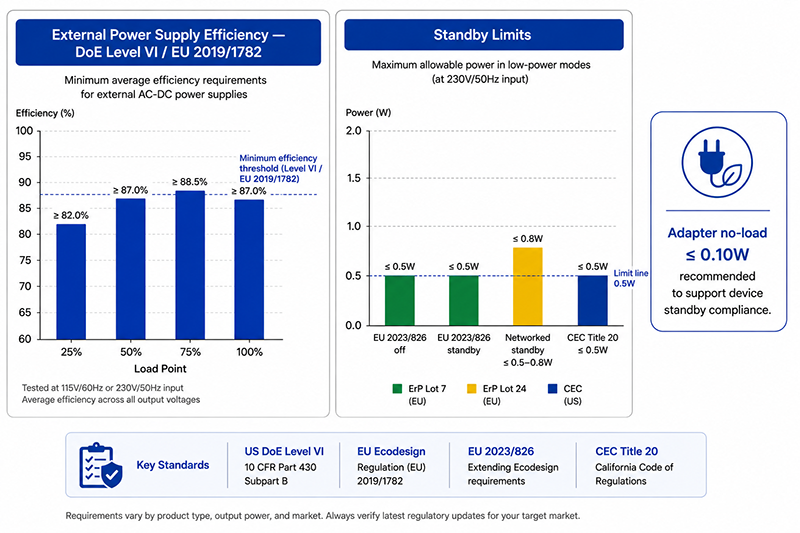
| Market | Regulation | Scope | Key Requirements |
|---|---|---|---|
| EU | EU 2023/826 (Ecodesign standby) | Standby and off-mode power for household equipment | ≤0.50W (off), ≤0.50W (standby), ≤0.50–0.80W (networked standby) from 2025 |
| EU | EU 2019/1782 (external power supplies) | External power supply efficiency | DoE Level VI equivalent minimum efficiency |
| USA | DoE Level VI / 10 CFR 430 | External power supply efficiency | Minimum efficiency at defined load points |
| USA | Energy Star | Smart home devices (various categories) | Voluntary; product-specific requirements |
| USA | CEC Title 20 | External power supplies (California) | Standby ≤0.50W |
| Global | IEC/EN 62301 | Standby power measurement | Test method standard |
External Power Supply Efficiency (DoE Level VI / EU 2019/1782)
External power supplies sold in the US and EU must meet minimum efficiency requirements. The requirements are specified as average efficiency at 25%, 50%, 75%, and 100% of rated load, and no-load power. The specific limits depend on the adapter’s rated output power.
Available by model. Verify that the adapter meets the applicable efficiency requirements for the target market.
Why This Matters
- An adapter that does not meet DoE Level VI or EU 2019/1782 efficiency requirements cannot be legally sold with new products in the US or EU.
- The adapter’s no-load power consumption contributes to the device’s standby power total. Meeting the 0.50W standby limit (EU 2023/826) requires a low-no-load adapter.
- Energy Star certification for the complete product (adapter + device) may be required or beneficial depending on the product category and target market.
What OEMs Should Do Now
- Verify that the adapter meets DoE Level VI (US) and EU 2019/1782 (EU) efficiency requirements for the target markets.
- Request no-load power data from the adapter supplier. Select adapters with ≤0.10W no-load where possible to support device standby compliance.
- Determine whether Energy Star certification is required or beneficial for your product category and include it in the certification plan.
Certification Planning for Smart Home OEMs
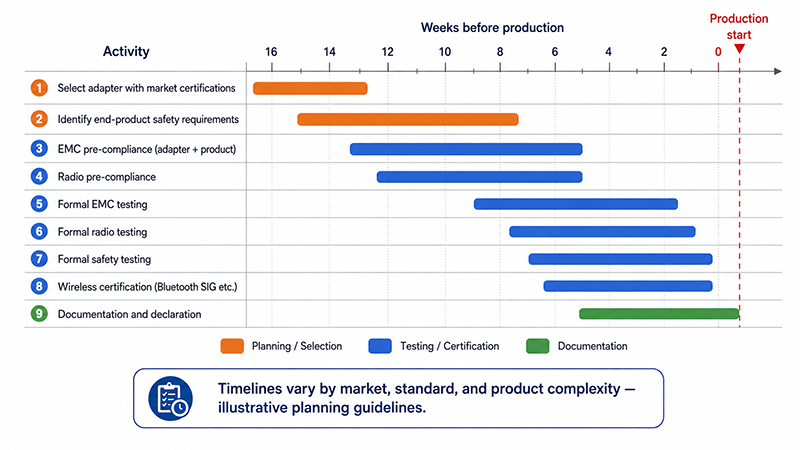
| Activity | Timeline (Weeks Before Production) | Notes |
|---|---|---|
| Select adapter with target market certifications | 12–16 wks | Verify safety, EMC, efficiency certifications |
| Identify end-product safety requirements | 12–16 wks | Determine applicable standard (62368-1, 60335, etc.) |
| EMC pre-compliance (adapter + product) | 10–14 wks | Test combined system |
| Radio pre-compliance | 10–14 wks | Verify wireless performance with adapter |
| Formal EMC testing | 6–10 wks | Submit for applicable standards |
| Formal radio testing | 6–10 wks | Submit for applicable radio standards (FCC, RED, etc.) |
| Formal safety testing | 6–10 wks | If required for the end product |
| Wireless certification (Bluetooth SIG, etc.) | 6–10 wks | If applicable |
| Documentation and declaration | 2–4 wks | Technical file, DoC, labeling |
Useful Links
Related article: Global Power Adapter Certifications →
Related article: Low Standby Power Design →
Q: Does my smart home device need FCC certification if it has Wi-Fi?
A: Yes. Wi-Fi is an intentional radiator and falls under FCC Part 15 Subpart C. The device must be FCC certified for the Wi-Fi transmitter. Additionally, the device (including the adapter) must comply with FCC Part 15 Subpart B for emissions. Both are required for legal sale in the US market.
Q: Can I use the same power adapter for products sold in the US and EU?
A: Yes, a universal input adapter (100–240VAC) can be used in both markets, provided it carries the applicable certifications (UL for US, CE for EU). The adapter must meet the efficiency requirements for each market (DoE Level VI for US, EU 2019/1782 for EU). Verify that the specific model has both certifications available.
Q: What is the Energy Star requirement for a smart home hub?
A: Energy Star requirements vary by product category. Smart home hubs may fall under the “Audio/Video” or “Network Equipment” category depending on their primary function. Verify the applicable Energy Star specification for the specific product type. Energy Star is voluntary in the US but required for some government and commercial projects.
Conclusion
Smart home device certification involves multiple regulatory layers: safety standards (UL/EN 62368-1 or applicable product-specific standard), EMC requirements (FCC Part 15, EN 55032), radio standards (FCC Part 15C, RED), and energy-efficiency regulations (DoE Level VI, EU 2019/1782, EU 2023/826). The external power adapter must carry the relevant certifications for each target market. Planning certification early in the product development cycle, including pre-compliance testing of the complete adapter + product system, is essential for avoiding late-stage certification delays.
Related Resources
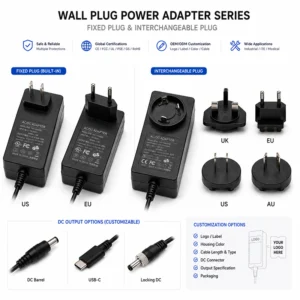
🔌 Related Products
🏭 Related Applications
Industrial Control Power Solutions
Power solutions for PLC, CNC, servo and automation equipment
📖 Related Guides
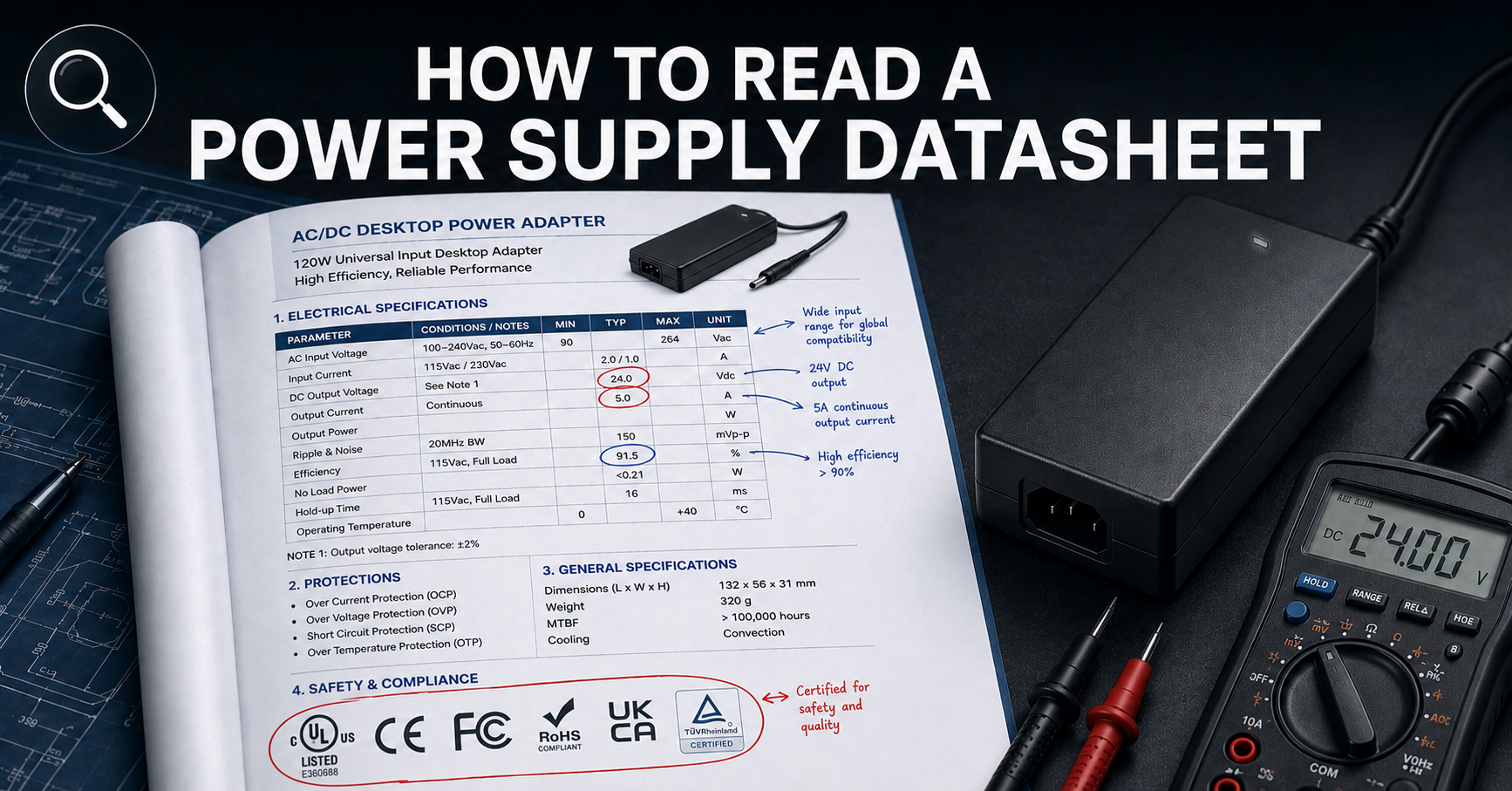
How to Read a Power Supply Datasheet
Learn how to evaluate connector specifications in a datasheet — current ratings, derating curves, certification verification.
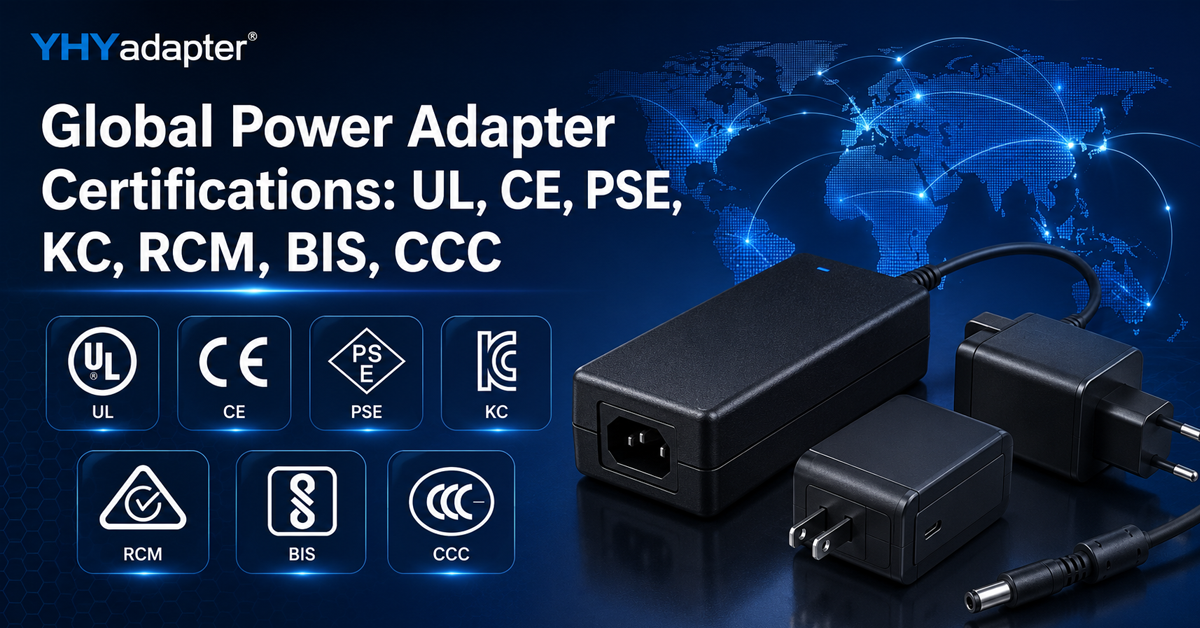
Global Certifications Guide
Global power adapter certification market guide (UL/CE/PSE/KC/RCM/BIS/CCC)
✅ Related Certifications
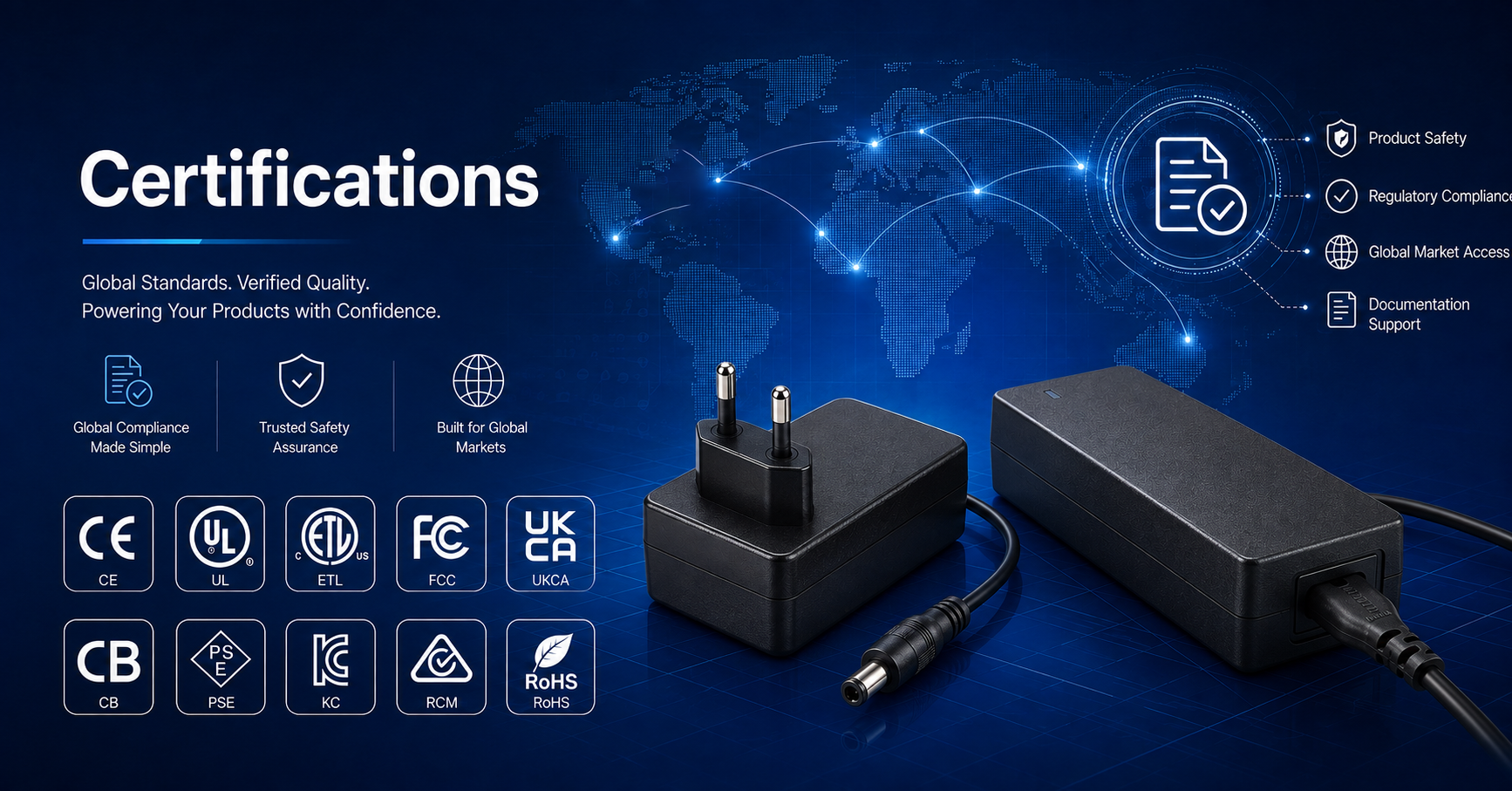
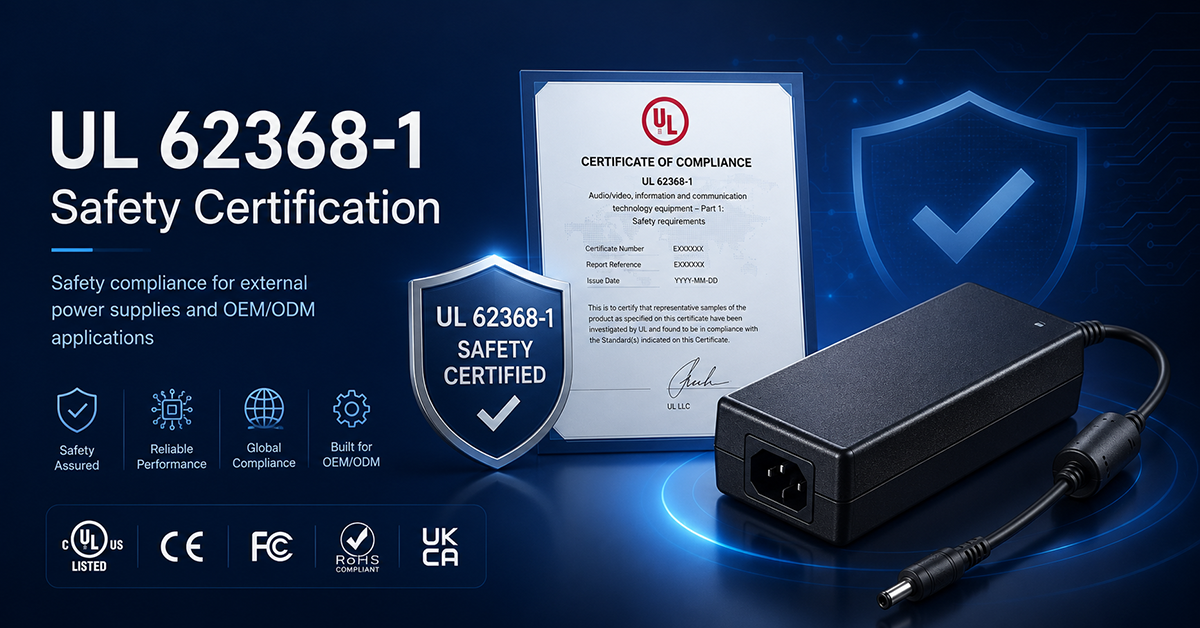
UL 62368-1 Safety Certification
Safety standard covering connector creepage/clearance, temperature rise, and strain relief requirements for IT/AV equipment power adapters.