
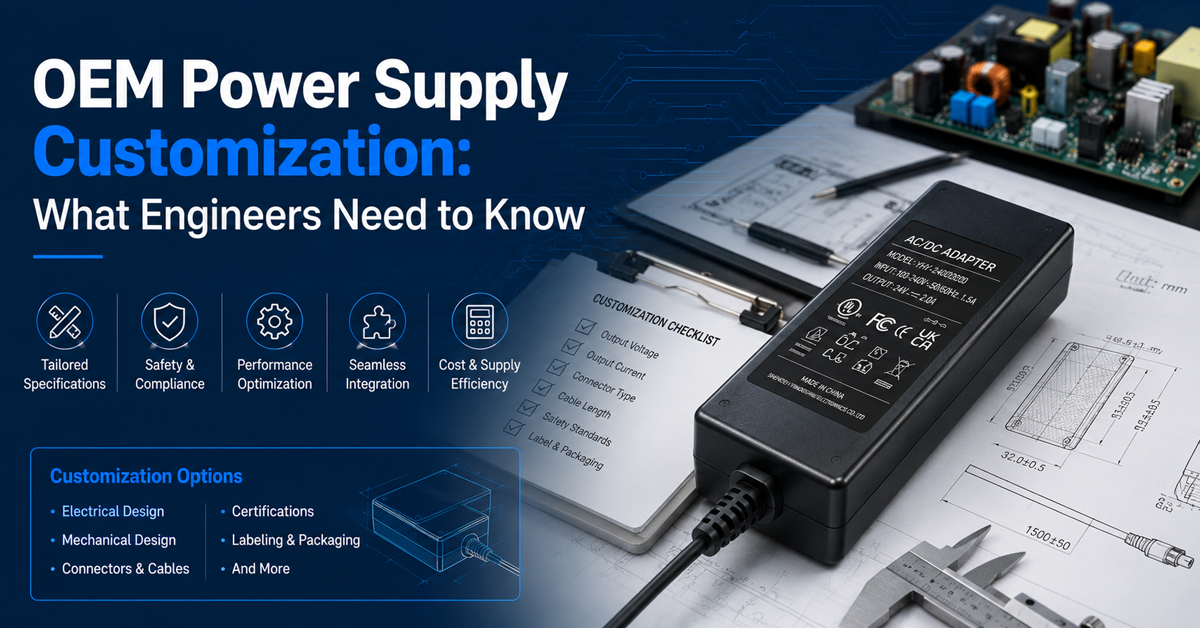
OEM product designers often find that standard catalog power adapters do not fully match their product’s voltage, connector, cable, or certification requirements. Customization bridges this gap — from minor adjustments like output cable length to full specification development of a new adapter design. However, customization decisions carry implications for cost, timeline, reliability, and certification that differ significantly from off-the-shelf procurement.
This guide covers the practical engineering aspects of OEM power supply customization: what can and cannot be customized, the engineering constraints that limit certain modifications, typical minimum order quantities (MOQs) and lead times, specification documentation best practices, and a framework for deciding when customization is justified versus when a standard off-the-shelf adapter is the better choice.
What Power Supply Parameters Can Be Customized?
Power Adapter Customization Capabilities
Power adapter customization can range from simple configuration changes based on an existing qualified platform to full OEM/ODM development involving electrical, mechanical, thermal, and compliance engineering.
The appropriate customization path depends on the required electrical specifications, mechanical configuration, target application, certification requirements, and compatibility with an existing power platform. Wherever possible, an established platform can be used to reduce development time, tooling investment, validation effort, and certification cost.
| Customization Level | Scope | Engineering Effort | Typical MOQ |
|---|---|---|---|
| Level 1 — Configuration Customization | Cable length and gauge, DC connector, AC plug, label, branding, packaging | Low — based on an existing qualified platform | 500–3,000 units |
| Level 2 — Specification Customization | Output voltage/current adjustment, standby power optimization, protection parameters, cable voltage-drop optimization | Moderate — electrical modification and verification required | 1,000–5,000 units |
| Level 3 — Full Custom Development | New enclosure, PCB or power platform, special output requirements, multiple outputs, charging profiles, application-specific functions | High — full engineering development and validation | Project-dependent |
MOQ ranges are indicative and depend on the selected platform, components, tooling requirements, certification scope, and annual project volume.
Customization Scope
| Category | Customization Options | Engineering Considerations |
|---|---|---|
| DC Output Cable | Cable length, AWG, insulation, color and strain relief | Current capacity, voltage drop, temperature rise and mechanical durability |
| DC Connector | Barrel, locking barrel, GX, XLR, terminal block, Molex/JST, USB-C and application-specific connectors | Current rating, polarity, pinout, locking requirements and mating compatibility |
| Output Voltage | Standard or application-specific output voltage | Available range depends on transformer design, feedback circuit, component ratings and platform capability |
| Output Current / Power | Current rating optimization within an existing platform or development of a higher-power platform | Thermal performance, transformer, rectification stage, switching devices and protection limits must be validated |
| AC Input | US, EU, UK, AU and interchangeable plug configurations; IEC inlet options for desktop adapters | Market-specific mechanical and safety requirements apply |
| Efficiency & Standby Power | Efficiency optimization and reduced no-load consumption | Target requirements depend on destination market, power rating and applicable energy-efficiency regulations |
| Protection Functions | OVP, OCP, OLP, SCP and OTP thresholds | Protection strategy can be optimized for the end equipment and operating environment |
| Enclosure & Mechanical | Dimensions, mounting features, cable exits, ventilation and application-specific housing | Tooling, thermal design, creepage/clearance and mechanical safety evaluation may be required |
| Branding & Labeling | OEM logo, model number, rating label, customer identification and applicable compliance markings | Regulatory marks may only be applied when the product and certification status permit their use |
| Packaging | Bulk, individual box, custom printed packaging, manuals and accessories | MOQ depends primarily on packaging materials and printing requirements |
| Application-Specific Design | Multiple outputs, charging profiles, specialized connectors, control functions and protection logic | May require new PCB/transformer design, firmware or control development and full validation |
| Certification | Market-specific safety, EMC, energy efficiency and application-specific compliance | Design changes may require certification update, extension testing or full type testing depending on their impact |
Engineering & Validation
Every customization project is evaluated against electrical, thermal, mechanical, EMC and safety requirements before production release. Changes that affect certified components, insulation systems, PCB layout, enclosure construction or critical electrical parameters may require additional testing or certification updates.
Why This Matters
- Surface-level customizations (cable, label, connector) have minimal impact on base cost but significantly improve product integration.
- Full custom designs require 8–16 weeks of engineering development and MOQs of 5,000–10,000 units minimum.
- Unclear specification documentation is the primary cause of customization delays — a well-written spec saves 2–4 weeks in the development cycle.
What OEMs Should Do Now
- First evaluate whether a standard adapter with minor modifications (cable length, connector) can meet your requirements before requesting a full custom design.
- Prepare a written specification document before contacting potential manufacturers — document summarizes requirements more effectively than email threads.
- Indicate annual projected volume and initial order quantity to help the manufacturer determine whether a custom platform is economically viable.
Q: What is the typical MOQ for a custom output voltage within an existing platform?
A: 1,000–3,000 units for voltage adjustment within ±20% of the base platform. For voltages requiring a new transformer design, MOQ typically rises to 3,000–5,000 units.
Q: Can I change the AC plug type without changing the DC output specification?
A: Yes, for desktop adapters with IEC C14 inlet, the AC plug is determined by the detachable AC cord, not the adapter itself. For wall plug adapters, the AC plug type is integral to the adapter and requires either a different fixed-plug variant or an interchangeable plug design.
Useful Links
What Are the Engineering Constraints on Output Customization?
Output Voltage & Current Customization Within an Existing Platform
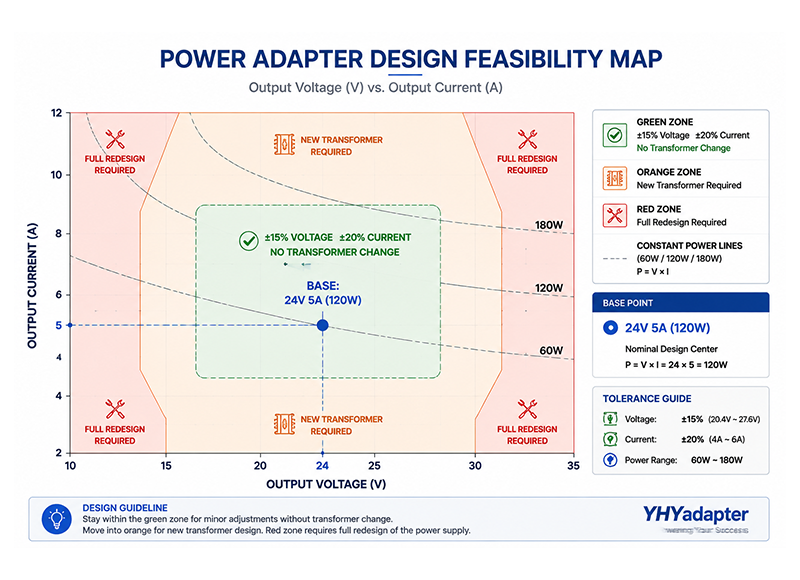
Customizing the output voltage or current of a power adapter does not depend on wattage alone. The available adjustment range is determined by the electrical architecture, component ratings, magnetic design, thermal margin, protection settings, and certification boundaries of the existing platform.
For OEM projects, relatively small output changes can often be implemented on an established platform, while larger voltage or current changes may require substantial redesign and revalidation.
Voltage Adjustment
Output voltage is typically regulated through the secondary-side feedback and control network. Moderate voltage adjustments may be possible without changing the fundamental power architecture when the existing design provides sufficient operating margin.
For many established platforms, an adjustment of approximately ±10–15% from the nominal output voltage may be achievable through changes to the feedback network and related control components.
However, the actual allowable range is platform-dependent and must be verified against:
- Transformer turns ratio and operating range
- Output rectifier or synchronous rectification stage
- Output capacitor voltage rating
- Feedback and loop compensation
- Over-voltage protection thresholds
- Efficiency and thermal performance
- Regulation, ripple, and transient response
- Safety and certification limits
Larger voltage changes may require modifications to the transformer, secondary-side components, protection circuitry, or other parts of the power stage.
Engineering guideline: ±10–15% can be used as an initial feasibility reference, not as a guaranteed customization range.
Current Adjustment
Output current capability is determined by the complete power path rather than a single component.
Key constraints include:
- Transformer winding and magnetic design
- Primary switching devices
- Secondary rectification or synchronous rectification
- Current-sense and protection circuitry
- PCB copper thickness and current paths
- Output capacitors
- DC cable gauge
- Connector current rating
- Enclosure and thermal design
- Overall component derating
A moderate current adjustment may be possible when sufficient design margin exists. Significant current increases, however, can require changes to the magnetic components, rectification stage, PCB layout, wiring, connectors, protection thresholds, and thermal design.
For this reason, a fixed rule such as “20% higher current requires a transformer or FET change” should not be applied universally. Each configuration should be evaluated against the validated capability of the specific platform.
Voltage, Current, and Power Are Interdependent
Maintaining approximately the same output power does not mean two voltage/current combinations can use the same electrical design without modification.
Consider a 120W platform:
| Output Configuration | Output Power | Relative Engineering Impact |
|---|---|---|
| 24V / 5A | 120W | Base configuration |
| 28V / 4.3A | ≈120W | Potentially feasible within the same platform, subject to engineering validation |
| 12V / 10A | 120W | May require substantial secondary-side redesign despite identical output power |
Moving from 24V / 5A to approximately 28V / 4.3A keeps the output power close to 120W while reducing output current. If the transformer, feedback network, output components, protection circuitry, and voltage ratings provide sufficient margin, the configuration may be achievable within the same platform.
By contrast, moving from 24V / 5A to 12V / 10A maintains the same 120W output power but doubles the secondary-side current.
This can significantly affect:
- Transformer secondary winding
- Rectification losses
- PCB current density
- Output filtering
- Cable gauge
- Connector rating
- Thermal performance
- Current protection settings
As a result, a 12V / 10A design may require a substantially different secondary power stage or a platform specifically designed for high-current, low-voltage operation.
Engineering Principle
Same wattage does not necessarily mean the same power platform.
Output voltage, current, topology, thermal performance, magnetic design, mechanical configuration, and regulatory requirements must be evaluated together when determining whether an existing platform can support a custom output specification.
The final customization range should therefore be confirmed through engineering evaluation and validation, rather than determined solely by a fixed percentage change in voltage or current.
Why This Matters
- Requesting a voltage outside the platform’s capability requires a new transformer design, adding $3,000–8,000 in NRE (non-recurring engineering) costs and 4–8 weeks to the timeline.
- Modifying current output upward by more than 20% may change the thermal profile, requiring enclosure modifications or adding a heatsink — which affects size and certification.
- A well-scoped customization request that stays within the platform’s design margins can be delivered in 4–6 weeks with no NRE cost.
What OEMs Should Do Now
- Determine your actual voltage tolerance requirement: if you can accept 24V ±5% from a 24V standard model, customization may not be needed. If you require a specific non-standard voltage (e.g., 28V), specify the exact voltage and tolerance.
- Provide the full operating current range, not just the maximum. Peak versus continuous current affects thermal design.
- Ask the manufacturer which platforms offer the widest customization headroom — some platforms are designed with extra margin to accommodate OEM adjustments.
Q: What is the typical NRE cost for a custom output voltage requiring a new transformer?
A: $3,000–$8,000 for the engineering design, prototyping, and qualification of a new transformer. This cost is typically amortized across the MOQ or charged as a one-time tooling fee.
Q: How does a custom output voltage affect certification?
A: Any change to the output voltage, current, or transformer is a certification-relevant change. The custom configuration must be added to the existing certification or separately certified. Some certification bodies allow covering multiple output configurations under a single family certificate.
Useful Links
What Connector and Cable Customization Options Are Available?
DC Output Cable & Connector Customization
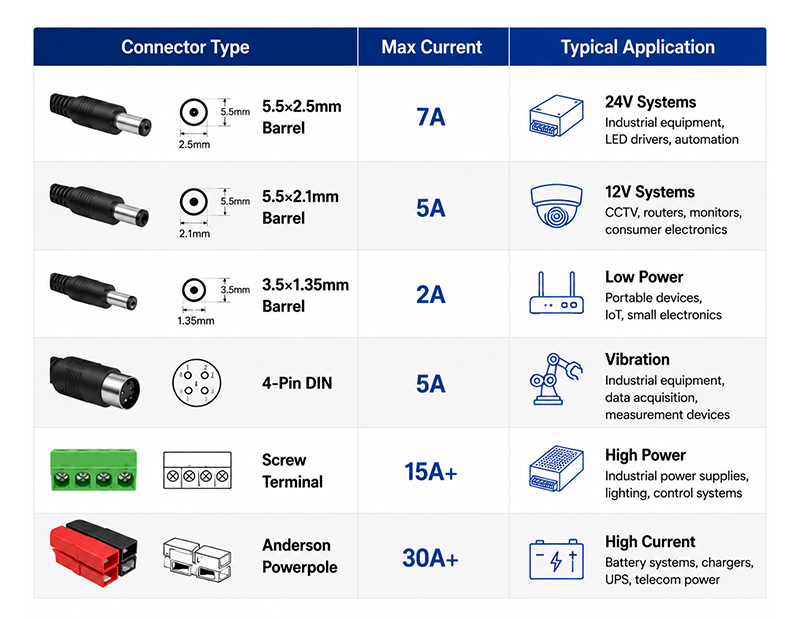
The DC output interface is one of the most commonly customized elements of an OEM power adapter. Connector type, cable length, wire gauge, and termination should be selected according to the end equipment, output current, installation environment, and mechanical requirements.
| Customization | Common Options | Key Considerations |
|---|---|---|
| DC Connector | 5.5×2.1mm, 5.5×2.5mm, 4.0×1.7mm, 3.5×1.35mm, locking connectors, GX, XLR, terminal blocks, Molex/JST, USB-C | Current rating, polarity, contact resistance, locking and mating compatibility |
| Polarity / Pinout | Center positive, center negative, customer-defined pinout | Must match the end equipment and be clearly defined in the specification |
| Cable Gauge | 24–16 AWG, depending on application | Output current, cable length, voltage drop and temperature rise |
| Cable Length | Typically 0.3–3.0m; other lengths available by project | Longer cables may require larger conductors or voltage-drop compensation |
| Cable Construction | Round, flat, shielded, high-flex | Installation space, flexibility, mechanical durability and EMC requirements |
| Jacket Material | PVC, TPE, silicone and application-specific materials | Flexibility, temperature, durability and environmental requirements |
| Termination | DC plug, locking connector, bare wire, stripped/tinned wire, terminal or customer-specified connector | Assembly method, current capacity and mechanical reliability |
Engineering Note
Connector size alone does not determine current capability. The complete output interface—including the plug and mating jack, cable gauge, cable length, contact resistance, and allowable temperature rise—should be evaluated as a system.
For higher-current, vibration-prone, industrial, or frequently connected equipment, locking connectors or application-specific interfaces may provide better reliability than standard barrel connectors.
Custom cable assemblies, lengths, terminations, and connector configurations can be developed according to project requirements. MOQ and cost depend on the cable construction, connector, materials, certification requirements, and production volume.
Why This Matters
- Selecting a non-standard connector (anything other than 5.5×2.5mm barrel) locks the customer into custom adapters, potentially limiting alternative sourcing options.
- Cable gauge must be matched to the output current: 22 AWG is suitable for up to 2A, 20 AWG for up to 3.5A, 18 AWG for up to 5A, and 16 AWG for up to 7A.
- Shielded cables add $0.30–1.00 per unit but can reduce conducted emissions at the system level, potentially simplifying end-product EMC testing.
What OEMs Should Do Now
- Specify the exact connector type, pin dimensions, and polarity in your custom adapter specification. Include a dimension drawing or manufacturer part number for the mating connector on your product.
- If using a barrel connector above 5A continuous, specify a locking connector or use a screw terminal instead — barrel connectors above 5A risk heating at the connection point.
- Request cable retention testing data (pull force, bending cycles) for the connector-cable assembly used in the custom adapter, particularly if the cable will be frequently handled.
Q: What is the minimum cable length available for a custom adapter?
A: 0.3m (30cm) is the practical minimum for most manufacturers, as cables shorter than this cannot be properly strain-relieved inside the adapter enclosure. For ultra-short requirements, consider a connector-mount design without a cable.
Q: Can I provide my own connector for the manufacturer to terminate?
A: In most cases, yes. The manufacturer can terminate customer-supplied connectors, but the connector must be compatible with the manufacturer’s soldering or crimping process. Provide at least 50 samples for process qualification.
Useful Links
Discuss your OEM power adapter requirements with our engineering team. We can evaluate your specifications and provide a customization feasibility assessment within 3 business days.
How Does Customization Affect Certification and Compliance?
Certification Impact of Power Adapter Customization
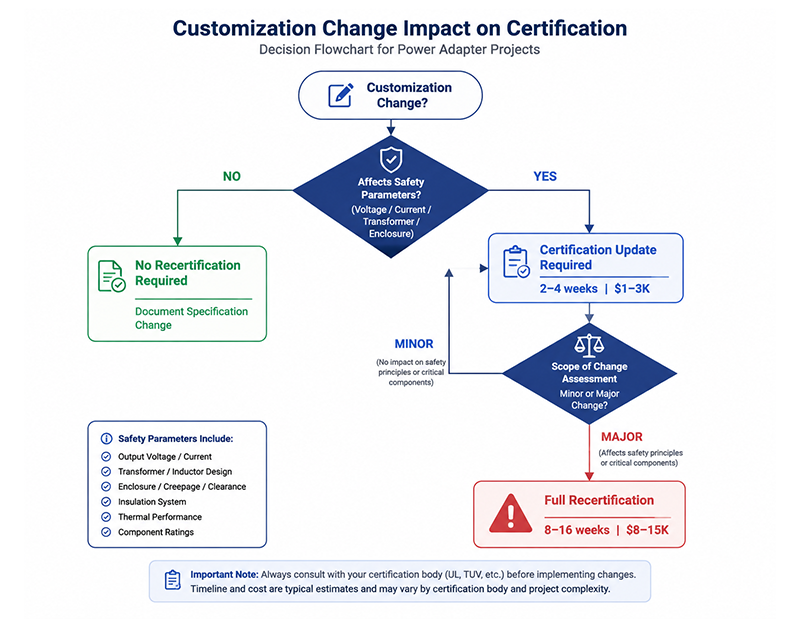
Any modification to a certified power adapter may affect its existing safety approvals. Changes to output ratings, connectors, cables, enclosure construction, or safety-critical components should therefore be reviewed against the original certification file before production.
Typical Certification Impact
| Customization | Typical Impact | Certification Consideration |
|---|---|---|
| Branding / Packaging | Low | Usually limited impact when the certified construction and required regulatory information remain unchanged |
| Cable Length / Color | Low–Moderate | May be acceptable within an approved construction, but cable specification, voltage drop, temperature rise, and EMC should be reviewed |
| DC Connector | Moderate | Connector rating, contact resistance, temperature rise, mechanical safety, and approved component status may require evaluation |
| Output Voltage / Current | Moderate–High | Changes outside the certified ratings may require report updates, additional testing, or a model extension |
| Enclosure | Moderate–High | Changes to material, dimensions, openings, insulation distances, or thermal behavior may require additional safety evaluation |
| Transformer / Critical Components | High | Changes to safety-critical components typically require certification-body review and may require additional testing |
Model Extension vs. Full Certification
Not every customization requires a completely new certification.
Where a modified product remains within the architecture and safety boundaries of an existing certified platform, the certification body may allow the new configuration to be added as a model variant, family extension, or report update, using applicable test data from the original model.
More substantial changes—such as a new power architecture, major output-rating change, insulation-system modification, or significant mechanical redesign—may require additional type testing or a new certification project.
Engineering Note
Certification impact is determined by the scope of the change and the existing certification file—not by a universal percentage threshold.
For planning purposes, a limited certification update may take approximately 2–4 weeks and cost USD 1,000–3,000, while a broader certification program may require USD 8,000–15,000 or more. Actual cost and lead time depend on the certification body, standard, target market, product architecture, and required testing.
Certification impact should be reviewed during the engineering feasibility stage, before tooling, samples, or mass-production materials are finalized.
Why This Matters
- Cost of customizing and recertifying an adapter can exceed $10,000 for a full specification change. This should be factored into the total project cost, not just the per-unit adapter price.
- Choosing a manufacturer that pre-certifies a range of output configurations (voltages, currents, connectors) within a product family reduces recertification cost and timeline for OEMs.
- Using a standard adapter with minor non-certified modifications in a certified end product may invalidate the end product’s compliance.
What OEMs Should Do Now
- At the specification stage, ask the manufacturer which certification variations are pre-covered within the product family — some families are certified at multiple voltage/current points.
- Budget for certification updates in your project plan: $2,000–5,000 per customization that touches safety-relevant parameters.
- If customization requirements are complex, evaluate whether a standard adapter used with a custom cable assembly (which does not affect the adapter’s certification) meets your needs.
Q: Does changing the output cable length require recertification?
A: Cable length changes of less than ±0.3m from the certified length typically do not require recertification under most safety standards, as the cable is considered a passive component. Larger changes may require EMC retesting. Always confirm with the certification body.
Q: Can the end product’s certification cover an uncertified custom adapter?
A: The end product’s safety certification can cover the complete system, including an uncertified adapter, but this shifts the full certification burden to the end product. In most cases, using a certified adapter component significantly simplifies end-product certification.
When Should Engineers Choose Standard vs Custom Power Adapters?
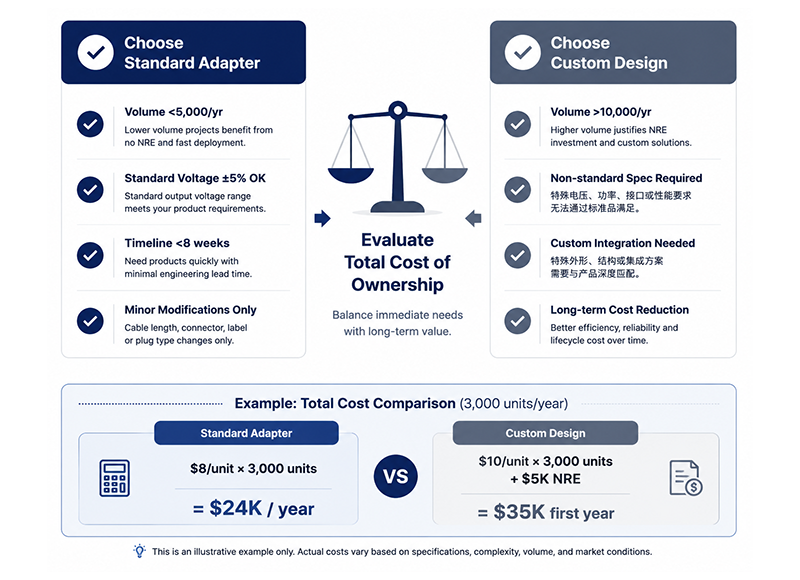
Standard vs. Custom Power Adapter: Which Should You Choose?
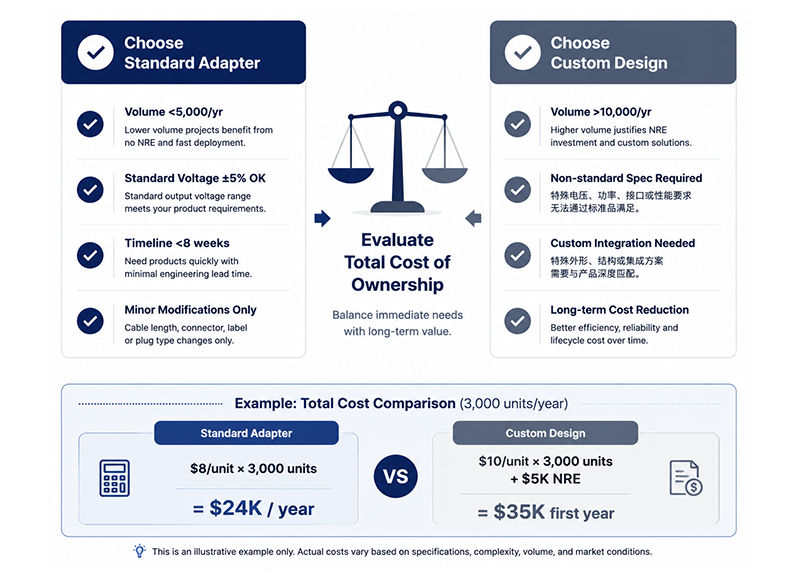
The choice between a standard power adapter and a custom solution depends on more than unit price. OEM teams should consider electrical requirements, annual volume, development timeline, mechanical integration, certification, and total lifecycle cost.
Decision Framework
| Factor | Standard Adapter | Custom Adapter |
|---|---|---|
| Annual Volume | Often preferred for low-to-medium volumes | Becomes more attractive as volume and program lifetime increase |
| Time to Market | Faster when a qualified platform already meets the requirements | Longer development cycle for engineering, validation, tooling, and certification |
| Electrical Requirements | Best when standard voltage, current, power, and protection characteristics are compatible | Preferred when the application requires non-standard electrical performance |
| Mechanical Integration | Suitable when standard enclosure and mounting are acceptable | Better for custom dimensions, mounting, cable exits, or equipment integration |
| Output Interface | Cable, connector, and label modifications may be sufficient | Suitable for specialized connectors, multiple outputs, or application-specific interfaces |
| Certification | Existing approvals can reduce market-entry time and compliance cost | New or modified certification may be required depending on the design |
| Upfront Cost | Lower engineering and NRE investment | Higher initial engineering, tooling, and compliance investment |
| Long-Term Cost | Attractive when standard products meet requirements without unnecessary complexity | Can reduce lifecycle cost when volume justifies design optimization |
Choose a Standard Platform When
A standard or lightly modified adapter is generally the better choice when:
- An existing platform already meets the required voltage, current, and power specifications
- Standard safety and EMC approvals cover the target markets
- The project requires a short development timeline
- Standard enclosure dimensions are compatible with the end equipment
- Only minor customization is needed, such as cable length, connector, label, or packaging
- Project volume does not justify substantial NRE, tooling, or new certification costs
Consider a Custom Design When
A dedicated custom solution becomes more appropriate when:
- No existing platform meets the electrical requirements
- Custom enclosure dimensions, mounting, or mechanical integration are required
- Specialized output characteristics or multiple outputs are needed
- Application-specific protection, control, or charging behavior is required
- Existing certifications do not cover the required product configuration or target market
- Long-term production volume can justify engineering, tooling, and certification investment
- Optimizing size, efficiency, thermal performance, reliability, or BOM cost creates meaningful lifecycle value
Example: Volume vs. Customization Economics
Consider an OEM project requiring approximately 100W of output power with a specialized DC connector.
If an existing qualified platform already meets the electrical requirements, customizing only the cable and connector may provide the most economical solution:
Existing Platform
Adapter + Custom Cable/Connector
→ Low NRE
→ Shorter Development
→ Existing Certification May Be Leveraged
Developing a dedicated electrical platform could involve:
Custom Platform
Engineering + Prototype + Validation + Certification + Tooling
→ Higher Upfront Investment
→ Longer Development
→ Potential Unit-Cost Optimization at Scale
At 3,000 units per year, the platform-based solution may provide a lower total cost if the standard electrical design already meets the application requirements.
At significantly higher cumulative volumes, a dedicated design may become more economical if reduced unit cost or improved product integration offsets the initial development investment.
Engineering Principle
Choose the lowest level of customization that fully satisfies the application requirements.
A qualified standard platform with targeted modifications is often the fastest and lowest-risk solution. Full custom development should be selected when it delivers clear technical, mechanical, compliance, or lifecycle-cost advantages that cannot be achieved with an existing platform.
Why This Matters
- Custom adapter development typically requires a minimum of 500–1,000 units per order to achieve economic viability.
- The NRE cost for a full custom design ($5,000–$20,000) is typically recovered within 3–12 months through lower per-unit cost at volumes above 10,000 units annually.
- Custom adapters reduce supply chain flexibility — once committed to a custom design, alternative sourcing becomes significantly more expensive and time-consuming.
What OEMs Should Do Now
- Calculate the total 3-year cost of ownership for both standard and custom approaches, including: per-unit cost × volume + NRE + certification costs + inventory carrying costs.
- If choosing customization, request samples of the custom configuration before committing to full production — verify voltage regulation, ripple, thermal performance, and connector fit.
- Include a secondary manufacturer qualification clause in the custom design agreement to ensure the design files (schematics, BOM, PCB layout) can be transferred if needed.
Q: What is the typical cost difference between a standard and custom adapter at equivalent specifications?
A: For the same electrical specification, a custom adapter typically costs 15–30% more than a standard model in the 1,000–5,000 unit range due to amortized NRE and lower production volume. Above 10,000 units annually, the premium typically drops to 5–15%.
Q: Can a manufacturer develop a custom adapter based on my existing competitor’s adapter specification?
A: Reverse-engineering a competitor’s adapter for a custom design is possible but not recommended. Better practice: provide the functional requirements (voltage, current, connector, size, certifications) and allow the manufacturer to propose an original design that meets those requirements.
Useful Links
Conclusion
Power adapter customization allows OEMs to align the power supply with the electrical, mechanical, and integration requirements of the end product. Depending on the project, customization may range from simple changes to cables, connectors, labeling, and packaging to specification modifications or full OEM/ODM development.
Where possible, starting from an existing qualified power platform can reduce development time, engineering risk, tooling investment, and certification effort. More substantial customization should be evaluated as a complete system, considering electrical performance, thermal design, reliability, mechanical integration, compliance, and production requirements.
The right solution is not necessarily the highest level of customization. For many OEM projects, a proven platform with targeted modifications provides the best balance of performance, time to market, compliance, and total lifecycle cost.
OEM Power Solutions from YHYadapter
YHYadapter supports OEM/ODM power supply projects across desktop power adapters, wall-mounted power adapters, interchangeable power adapters, battery chargers, PD chargers, and application-specific power solutions.
Customization options may include output voltage and current, DC cable and connector configuration, AC input options, enclosure and mechanical requirements, OEM labeling and packaging, protection parameters, and market-specific compliance support, depending on the selected platform and project requirements.
From platform selection and engineering evaluation to prototyping, validation, certification support, and mass production, YHYadapter works with OEM customers to develop power solutions that are practical to manufacture, reliable in operation, and appropriate for the intended application and target market.
Need a power adapter customized for your product?
Share your output specifications, connector requirements, target market, application, and expected volume with our engineering team to evaluate the most suitable standard, modified, or custom solution.
Related Resources
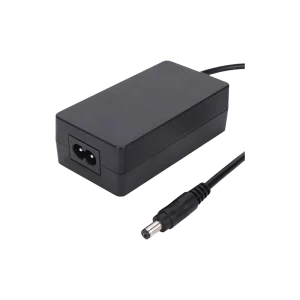
🔌 Related Products
🏭 Related Applications
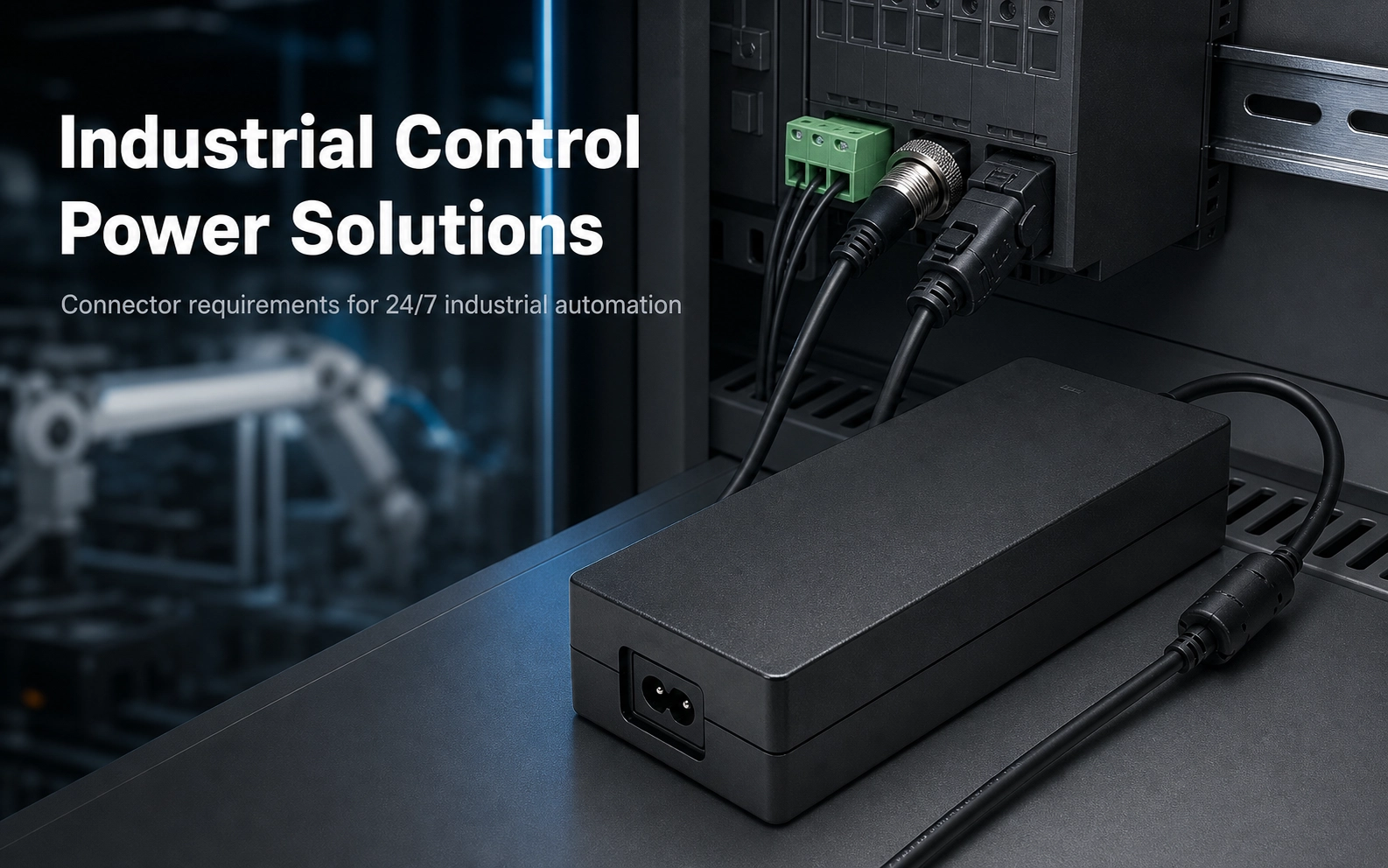
Industrial Control Power Solutions
Power solutions for PLC, CNC, servo and automation equipment

📖 Related Guides
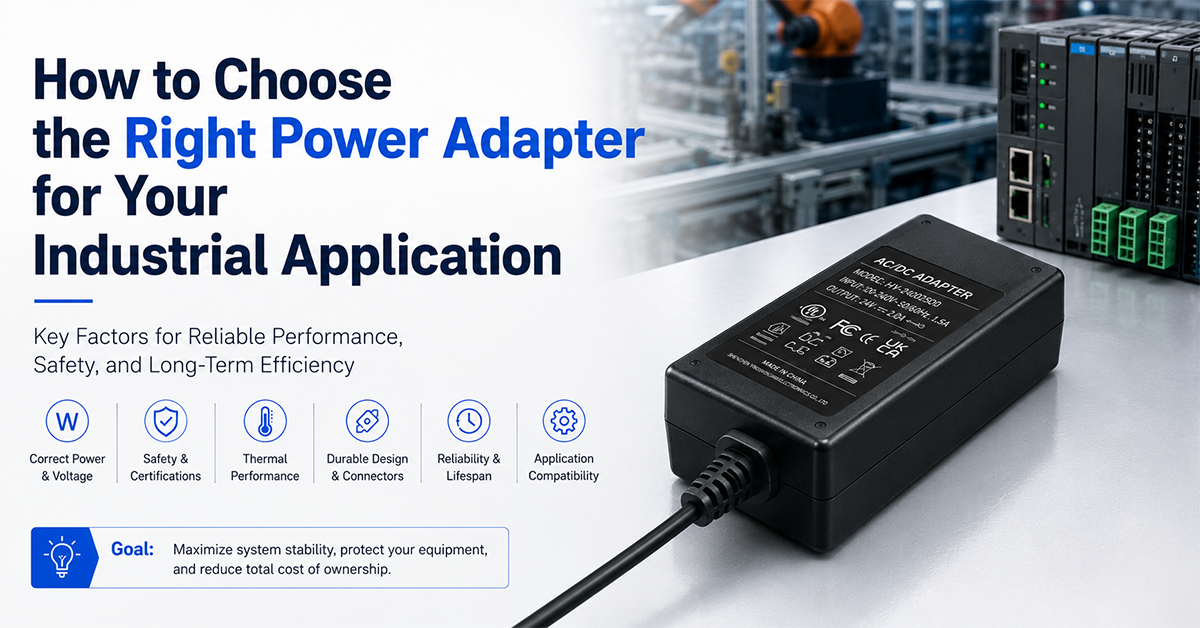
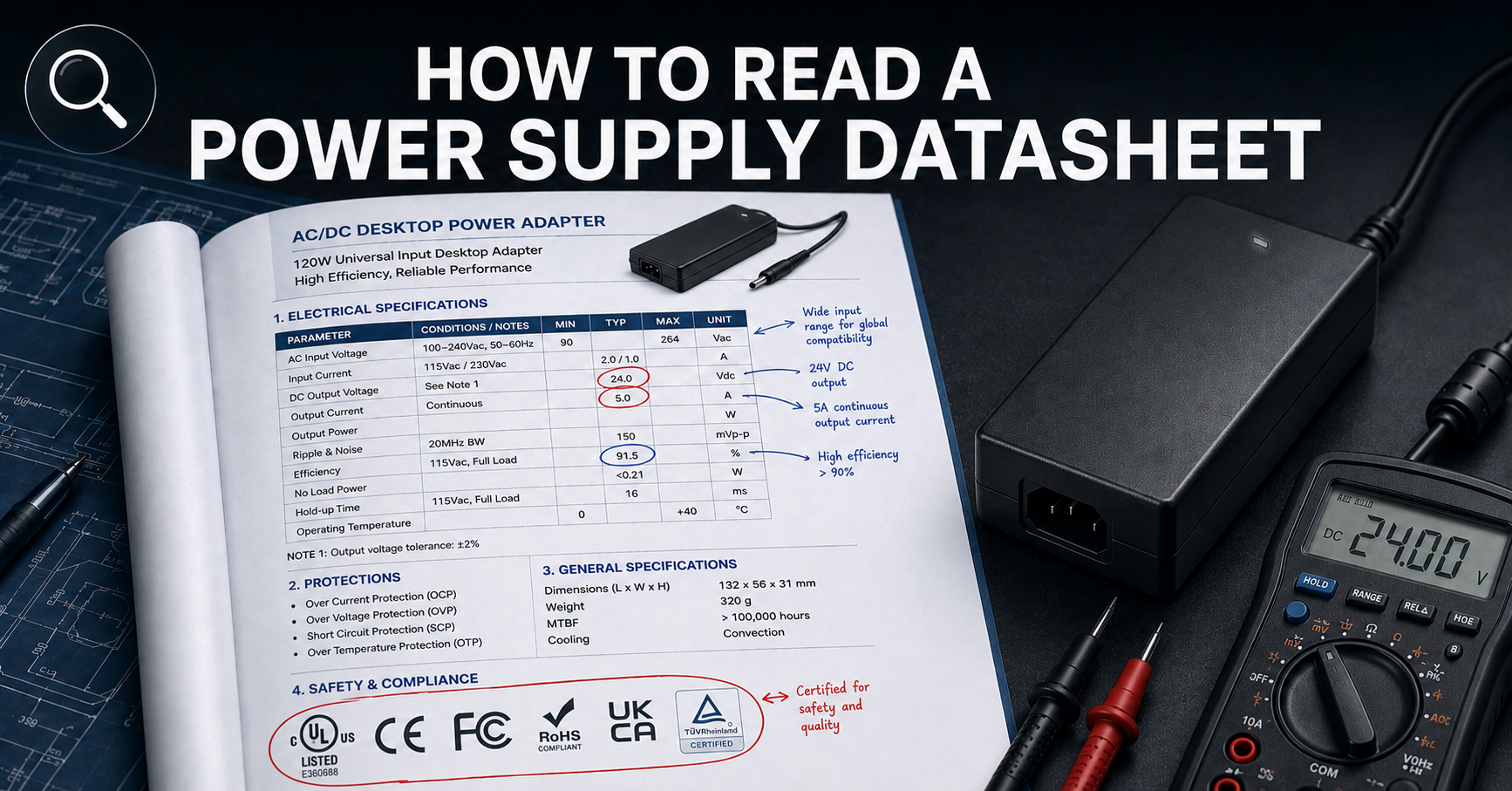
How to Read a Power Supply Datasheet
Learn how to evaluate connector specifications in a datasheet — current ratings, derating curves, certification verification.
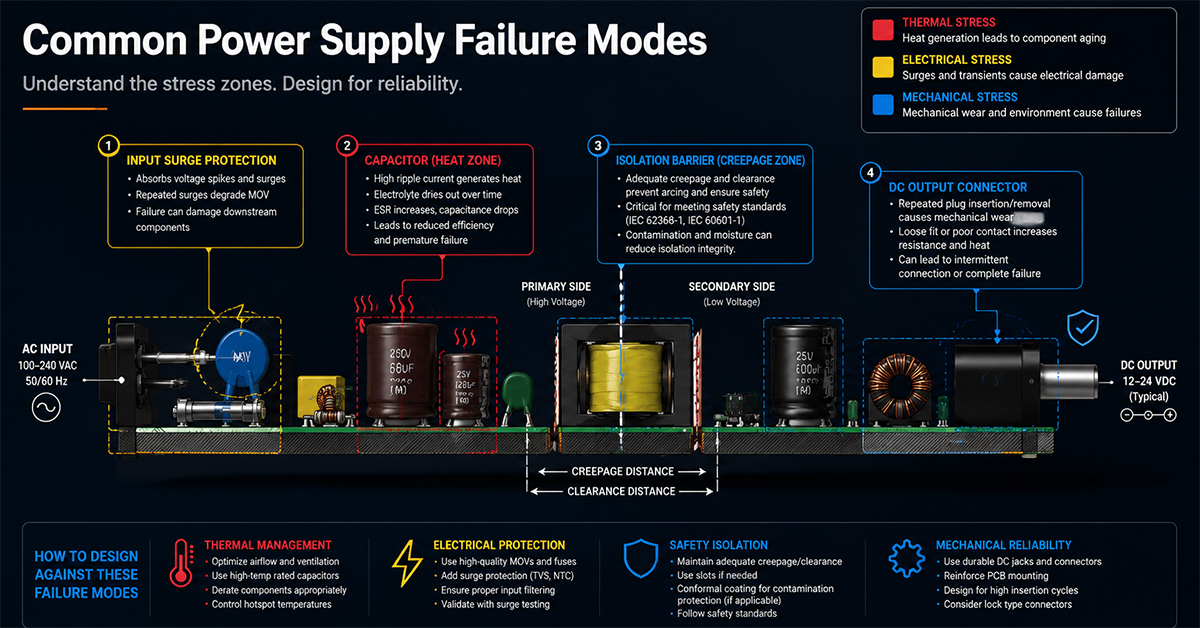
Common Power Supply Failure Modes
Common power supply failure modes and design countermeasures
✅ Related Certifications
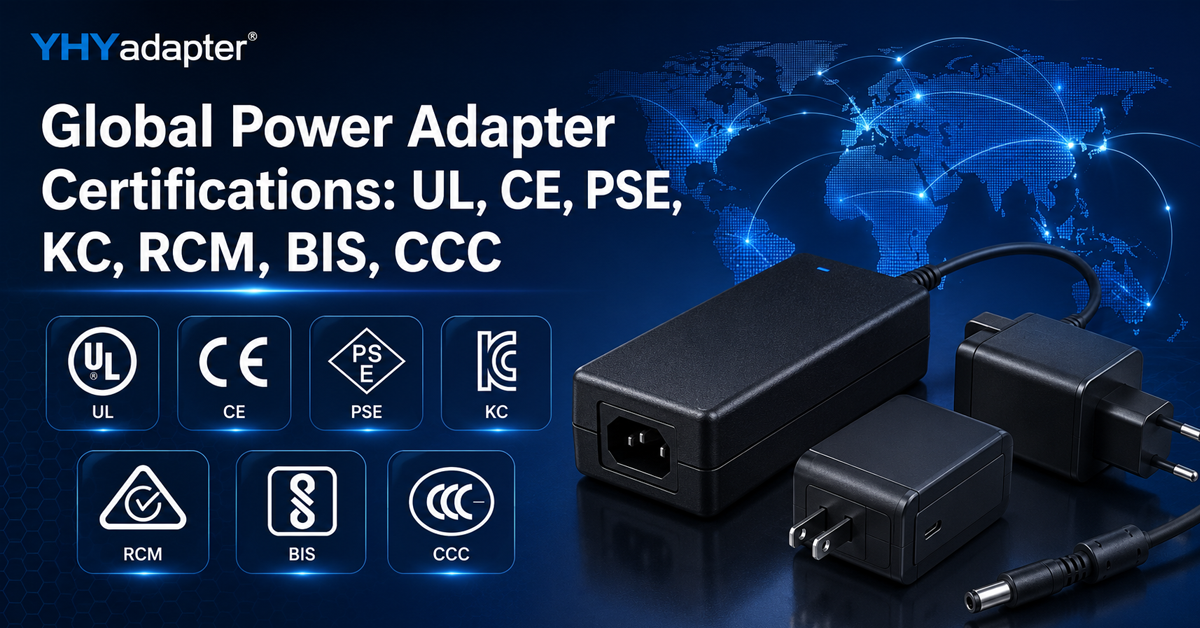
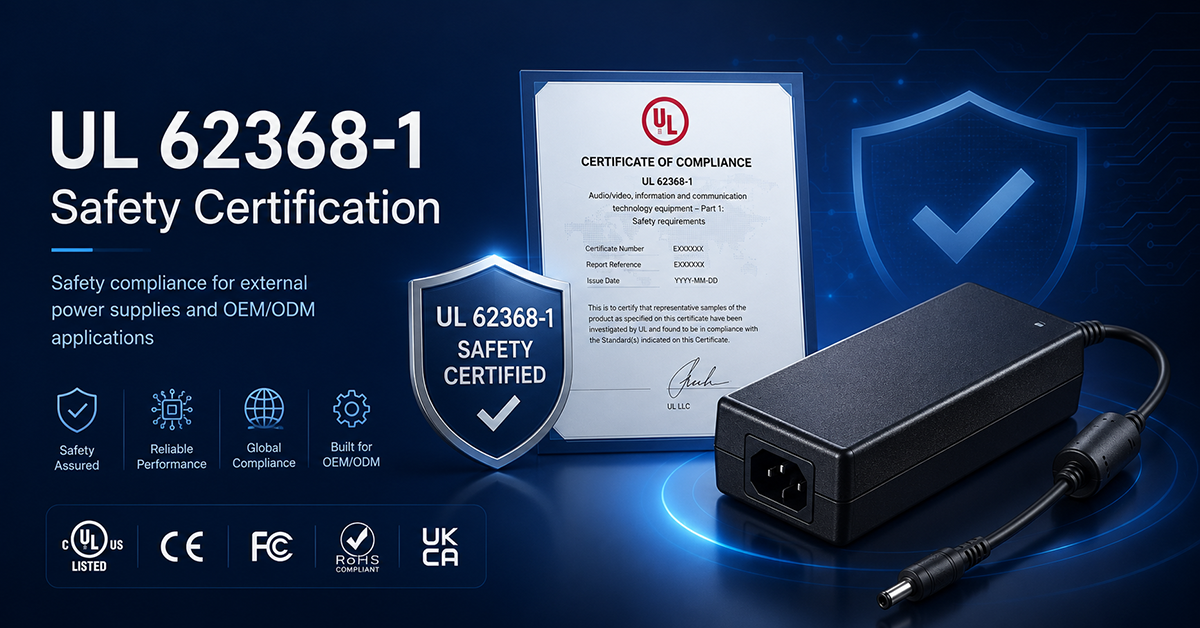
UL 62368-1 Safety Certification
Safety standard covering connector creepage/clearance, temperature rise, and strain relief requirements for IT/AV equipment power adapters.