
For professional audio equipment OEMs, the power supply is more than a component—it determines the noise floor, reliability, and regulatory compliance of the final product. A power supply with high output ripple or poor EMC performance can introduce audible artifacts into an audio signal path that may be difficult to fully correct with downstream filtering alone. Conversely, a well-selected power supply enables clean signal chains, consistent performance across production batches, and straightforward market certification.
This guide covers the power supply parameters that matter most to audio equipment design: noise and ripple specifications, EMC compliance for audio products, form factor selection for different equipment types, protection features, and certification pathways for global markets. The focus is on external AC/DC adapters—wall plug and desktop form factors—as used by audio equipment OEMs in commercial, professional, and consumer audio products.
What Output Ripple and Noise Specifications Matter for Audio Equipment?
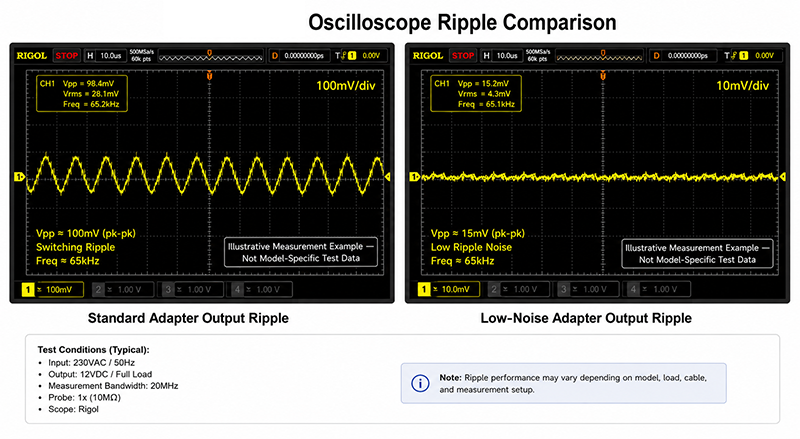
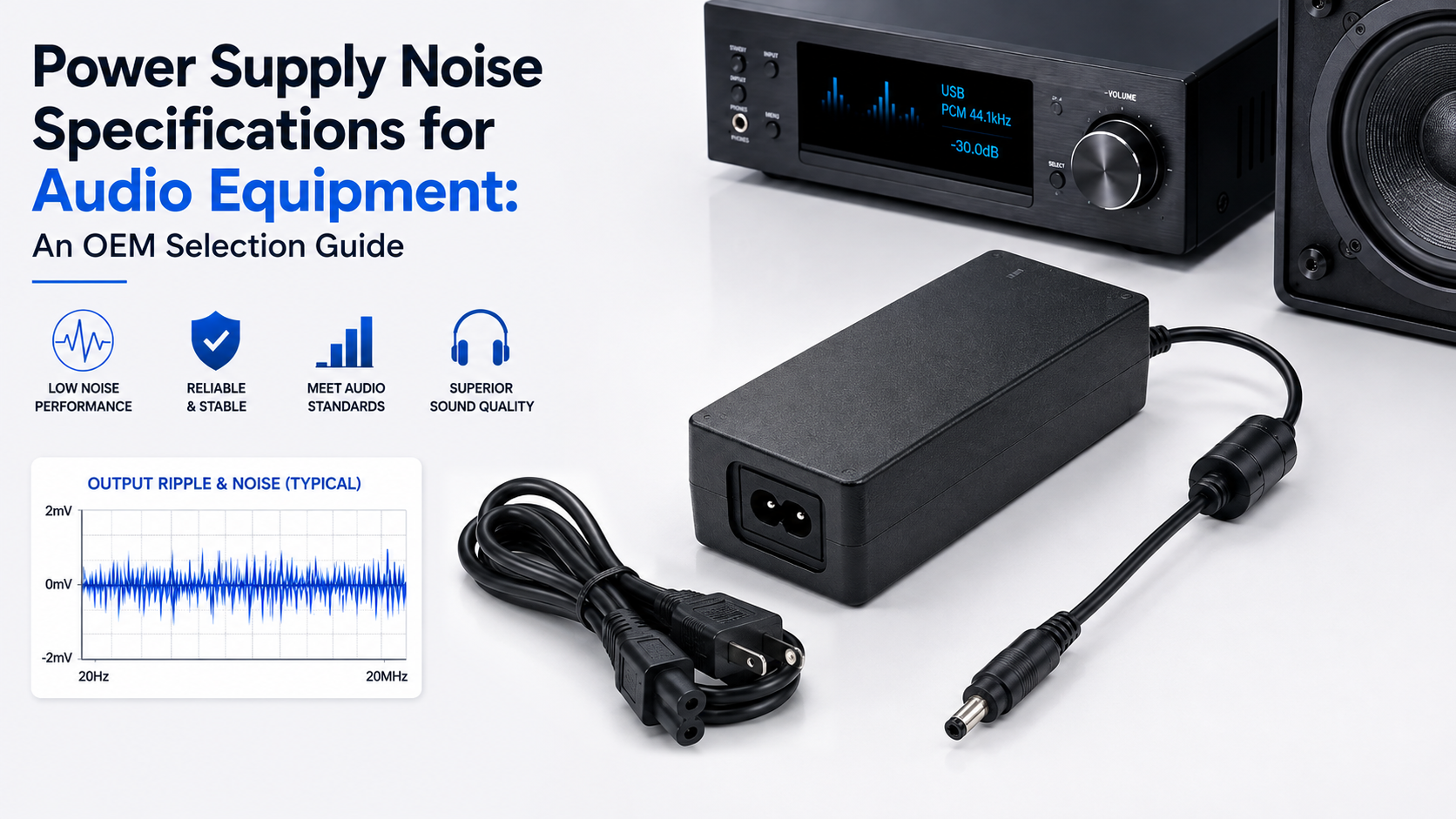
Audio circuits operate at signal levels measured in millivolts and microvolts. A microphone preamplifier may amplify a 2mV signal by 60dB, producing a 2V output. Power-supply ripple does not couple into the audio signal path in the same way as an input signal—its effect depends on the circuit’s power-supply rejection ratio (PSRR), regulator architecture, grounding, filtering, PCB layout, and the frequency content of the disturbance. For this reason, output ripple and noise specifications are among the most critical power supply parameters for audio applications.
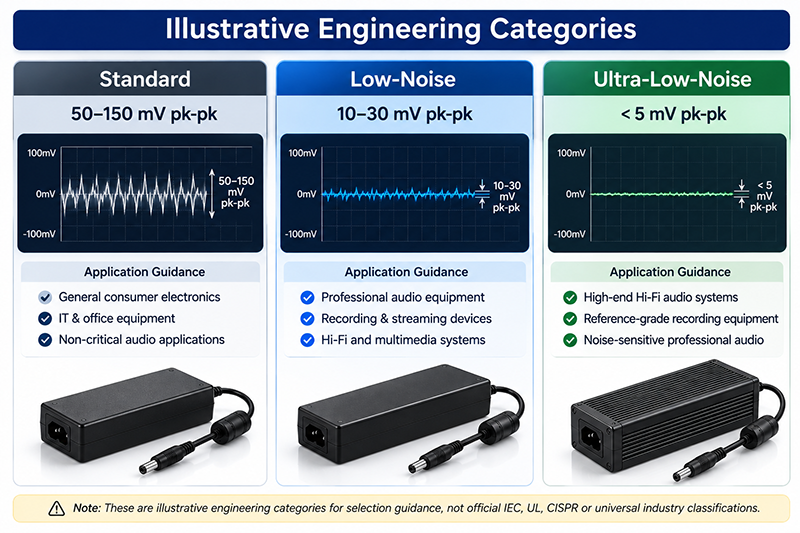
The following table shows illustrative engineering categories for ripple performance of external AC/DC adapters. These are guideline ranges for this guide, not IEC, UL, CISPR, or universal industry classifications.
| Category | Output Ripple & Noise (pk-pk) | Suitable For |
|---|---|---|
| Standard switching adapter | 50–150mV pk-pk | Digital audio gear, powered speakers (DSP stage), amplifier power stages |
| Low-noise switching adapter | 10–30mV pk-pk | Analog mixing consoles, studio interfaces, headphone amplifiers, effects processors |
| Ultra-low-noise / linear equivalent | <5mV pk-pk | Microphone preamplifiers, master clock generators, high-end reference monitors |
The switching frequency of the adapter’s internal converter is also relevant. A standard 65kHz–100kHz flyback converter produces switching noise at the fundamental frequency and its harmonics, which may fall within the audio band (20Hz–20kHz). Higher switching frequencies can move the fundamental switching component farther above the audible band, but overall noise performance still depends on topology, filtering, layout, grounding, common-mode behavior, cable configuration, and the end equipment’s PSRR.
Ripple is measured at the adapter’s DC output under full load using a 20MHz bandwidth oscilloscope with a 0.1µF ceramic capacitor and 10µF electrolytic capacitor in parallel at the probe tip per industry standard practice. OEMs evaluating adapters should request ripple data measured under their expected load conditions and with the actual DC cable length, as cable inductance can affect measured noise.
Why This Matters
- The effect of power-supply ripple on audio output is not a simple dB calculation from adapter ripple to noise floor—it depends on the circuit’s PSRR at the ripple frequency, the design of the regulator stage, and the audio signal path architecture. A qualitative approach is recommended: identify the noise sensitivity of each stage and select an adapter whose ripple characteristics are appropriate for that stage’s tolerance.
- Low-noise adapters (10–30mV pk-pk) suit many professional audio applications. Ultra-low-noise adapters are typically specified for the most sensitive signal-path stages.
- Switching frequency is one factor among many. Higher-frequency adapter designs can reduce in-band audio content, but topology, filtering, layout, and cable configuration all contribute to the final noise performance. Switching ripple (at the converter’s fundamental frequency) and mains hum (100Hz or 120Hz from rectification) are different noise mechanisms that should be evaluated separately.
What OEMs Should Do Now
- Identify which stage of your audio equipment uses the power supply: power amplifier stages can typically tolerate higher ripple, while analog signal stages may benefit from lower ripple depending on the circuit and PSRR design.
- Request ripple and noise test data from your power supply supplier, measured per industry-standard methods (20MHz bandwidth, with decoupling capacitors at probe tip, at 100% load).
- If your equipment uses a single external adapter to power both digital control and analog audio circuits, consider using a post-regulator (e.g., a low-noise LDO) on the analog rail to provide additional noise attenuation.
Q: Can a 48V power adapter directly charge a 24V battery system?
A: No. A battery requires a charging system designed for its chemistry, voltage, charging profile, current limits, protection requirements, and battery-management architecture. A 48V power supply should not be connected directly to a 24V battery.
Where battery backup is required, use a dedicated charger or appropriately designed DC-DC charging stage matched to the battery system.
Q: Is 48V always more efficient than 24V?
A: No. Higher distribution voltage can reduce cable and connector losses because less current is required for the same power. However, additional DC-DC conversion, component selection, load characteristics, and operating conditions also affect total system efficiency.
How Does EMC Compliance Affect Audio Equipment Design?
Electromagnetic compatibility (EMC) is one of the most challenging compliance areas for audio equipment because the product emits and is sensitive to electromagnetic energy. The external power adapter is both a potential noise source (switching noise conducted back onto the AC mains) and a potential entry point for interference into the audio device.
Two EMC standards are directly relevant:
FCC Part 15 (USA): All digital electronic devices must comply. Audio equipment with any digital circuitry (DSP, USB interface, Bluetooth, digital amplifier) falls under Part 15. The external adapter’s conducted and radiated emissions must not cause the combined product to exceed the Class B limits for residential use or Class A for commercial/industrial use.
EN 55032 / CISPR 32 (EU): Similar to FCC Part 15 but with different measurement bandwidths and limit lines. Audio products sold in the EU market must comply. The adapter and the audio product are tested as a system.
The power adapter’s conducted emissions (150kHz–30MHz on the AC mains port) and radiated emissions (30MHz–1GHz) contribute to the total product emissions. An adapter that marginally passes emissions limits may cause the combined audio product to fail compliance testing when connected.
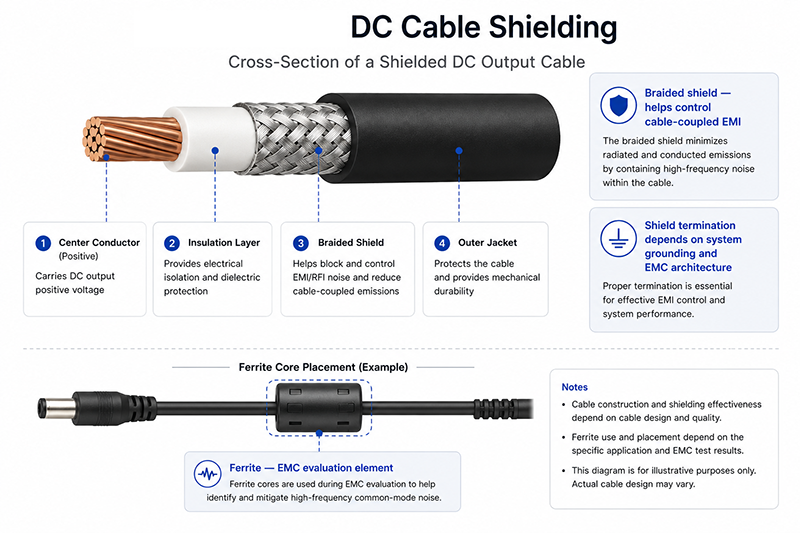
A frequent challenge in audio products is that the DC cable between the adapter and the audio device can act as an unintentional radiator. Longer DC cables can increase susceptibility to and radiation of conducted or common-mode noise, depending on cable geometry, grounding, shielding, switching spectrum, and system layout. Shielding on the DC cable, ferrite beads, and careful cable routing during the product’s EMC pre-compliance testing are design elements worth evaluating.
Why This Matters
- An audio product that fails FCC or CE EMC testing typically requires redesign and retesting, which can delay market entry. Early pre-compliance evaluation of the combined adapter and audio product system helps identify and resolve issues before formal testing.
- The power adapter’s conducted and radiated emissions contribute to the total product emissions. Adapters with integrated line filters and common-mode chokes may offer better EMC performance.
- Audio devices with longer cable runs between adapter and product (common in studio or installed sound applications) may need system-level shielding and filtering—this should be addressed during product design, not left to the adapter alone.
What OEMs Should Do Now
- Request conducted and radiated emissions data for the candidate adapter, measured per FCC Part 15 and CISPR 32. Confirm the adapter has adequate margin below the applicable limit for your target market.
- Test adapter + product combination in a pre-compliance EMC lab early in the design cycle. This approach reduces the risk of late-stage compliance issues that can delay market entry.
- Consider adapters with integrated line filters (common-mode choke + X capacitors) and evaluate DC cable shielding or ferrite solutions as part of system-level EMC design.
Q: Can I use a power adapter that is FCC Part 15 compliant with my audio product that requires Class B compliance?
A: The adapter’s FCC compliance is tested standalone. When connected to the audio product, the combined system must also comply. Pre-test the combined system, especially for Class B (residential) limits, which are stricter than Class A.
Q: Does a shielded DC cable eliminate radiated emissions from the power adapter cable?
A: Not necessarily. Shielded cables can help control cable-coupled EMI, but the shield’s effectiveness depends on the termination strategy, cable type, and system grounding architecture. Shield termination should be defined at the system level based on grounding architecture, EMC behavior, chassis design, safety requirements, and test results—not applied as a universal rule.
📞 Designing professional audio equipment?
Our engineering team can help match the right power adapter to your noise and EMC requirements
- Request a Quote → — Submit your requirements for a detailed quotation
- Talk to an Engineer → — Discuss technical specs with our design team
Power Requirements by Audio Equipment Type
Different categories of professional audio equipment have distinct power profiles. Matching the adapter’s electrical characteristics to the equipment type is the foundation of proper selection.
Studio Equipment (mixing consoles, audio interfaces, headphone amplifiers)
- Typical power range: 12W–60W
- Form factor: Desktop adapter (12W–60W) or wall plug (12W–36W)
- Critical parameters: Low ripple (10–30mV pk-pk), switching frequency above the audio band (beneficial but topology- and filtering-dependent), clean ground reference
- Output voltage: Typically ±15V to ±18V for analog rails, +5V for digital control
- Multi-output requirement: Some equipment requires simultaneous +15VDC, -15VDC, and +5VDC rails—this can be done from a single external adapter with onboard post-regulation
Powered Speakers and Active Monitors
- Typical power range: 60W–300W (per speaker)
- Form factor: Desktop adapter (60W–200W) or internal power supply (200W+)
- Critical parameters: Higher ripple tolerance on amplifier stage (50–150mV pk-pk), sufficient peak current for transient response, low noise on DSP/preamp stage if using single adapter
- Output voltage: 24V–48VDC common for Class-D amplifier modules
- Note: Many powered speakers use an external adapter for the amplifier and a separate low-noise supply for the DSP/preamp. A dual-output adapter can simplify this.
PA Systems, Installed Sound, and Commercial Amplifiers
- Typical power range: Application-dependent; 150W–500W+ is a common range
- Form factor: Desktop adapter for moderate power levels; higher-power or multi-channel systems may use rack-mount or internal power architectures
- Critical parameters: Robust protection features (OCP, OVP, OTP), reliability specifications appropriate to the application, suitable operating temperature range
- Output voltage: Application-dependent; 24V–56VDC are common
- Application context: Often installed in equipment racks with limited ventilation—thermal performance of the adapter matters
Musical Instrument Equipment (guitar effects, keyboard workstations, electronic drums)
- Typical power range: 5W–30W is a common range
- Form factor: Wall plug adapter is common; center-negative barrel connectors are a legacy standard in some categories
- Critical parameters: Consistent output voltage under variable load, low standby power, mechanical compatibility
- Output voltage: Application-dependent; 9V, 12V, 15V, 18V are common; current ratings typically 300mA to 2A
- Note: Many effects pedals use 9VDC center-negative barrel connectors. USB-C PD may be considered for new designs where the voltage and power requirements, user experience, interoperability, and certification strategy support it.
Digital Audio Processors, DSP Systems, and Networked Audio
- Typical power range: Application-dependent; 15W–80W is a common range
- Form factor: Desktop adapter or wall plug depending on total power
- Critical parameters: Clean power for analog I/O stages; PoE availability for networked DSP units
- Output voltage: Application-dependent; 12V–48V are common
- Application context: Some DSP units with Ethernet AVB or Dante can accept PoE+ (IEEE 802.3at) in addition to or as an alternative to an external adapter
Why This Matters
- Using a single adapter for both amplifier and DSP stages in a powered speaker requires careful partitioning: the DSP rail should use a post-regulator to isolate it from amplifier load transients.
- Studio equipment with ±15V analog rails may require a rail-splitting circuit when using a single-output external adapter.
- Musical instrument equipment’s barrel connector standards are inconsistent: 9V center-negative, 9V center-positive, and 12V center-positive are all in use. USB-C PD may be considered for new designs where the voltage and power requirements, user experience, interoperability, and certification strategy support it.
What OEMs Should Do Now
- Create a detailed power budget for the equipment, listing each voltage rail, the expected current draw, and the ripple/noise requirement for each rail.
- Evaluate whether a single external adapter with one output voltage (and onboard regulation for other rails) or multiple adapters (separate rails) provides the better cost-benefit balance for your application.
- For musical instrument equipment, USB-C PD may be considered for new designs where the voltage and power requirements, user experience, interoperability, and certification strategy support it.
Q: Can a powered speaker run the amplifier and DSP from the same 48V adapter?
A: Yes, but the DSP power stage should be post-regulated. A 48V to 5V (or 3.3V) DC-DC converter with sufficient PSRR and an LDO after it provides clean power for the DSP and codec, while the amplifier stage can run directly from the 48V bus. This prevents amplifier load transients from coupling noise into the DSP supply.
Q: What power supply is typically specified for a 200W+ commercial PA amplifier module?
A: Many Class-D amplifier modules in this power range operate from a 24–56V DC bus. An external desktop adapter may be used for single-module units depending on total power. For multi-channel systems where total power exceeds typical desktop adapter ratings, higher-power or multi-channel systems may favor internal or rack-integrated power architectures depending on total power, peak demand, thermal design, and system integration.
Useful Links
Wall Plug vs Desktop Adapter for Audio Equipment
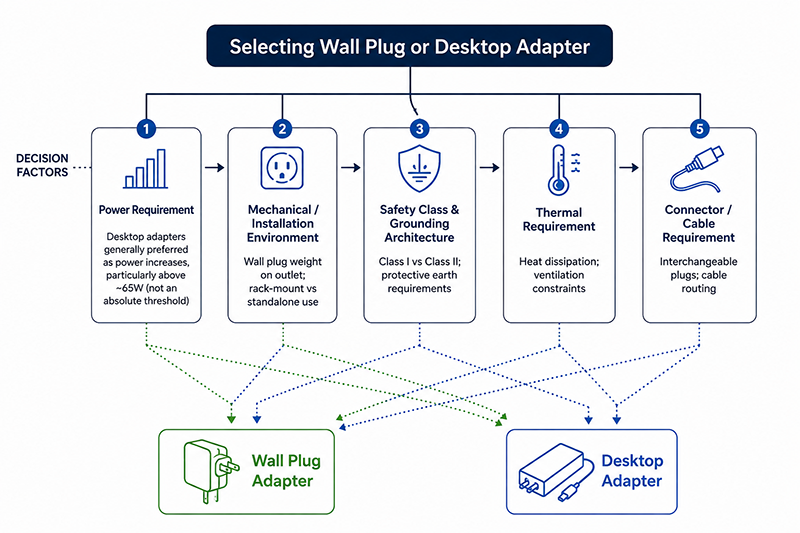
The form factor decision depends on the equipment’s power requirement, physical layout, and operating environment.
Wall plug adapters (5W–65W) are appropriate for:
- Low-power audio equipment: guitar effects pedals, headphone amplifiers, small audio interfaces, electronic drum modules, keyboard workstations
- Equipment with front-facing or side-mount DC input: the adapter can be discreetly placed behind the equipment with a short cable
- Consumer/prosumer audio: where the adapter’s weight is supported by the wall outlet, reducing equipment footprint
Desktop adapters (12W–300W) are appropriate for:
- Higher-power audio equipment: powered monitors, PA amplifiers, mixing consoles, rack-mount DSP units, multi-channel audio interfaces
- Equipment in rack-mount or studio environments: the adapter sits on a shelf, in a cable tray, or inside an equipment rack
- Applications requiring interchangeable AC plugs (US, EU, UK, AU): the desktop adapter accepts regional cord sets rather than fixed prongs
- Equipment where thermal isolation is important: the adapter’s heat is dissipated away from sensitive audio circuitry
For audio equipment specifically, the desktop adapter has additional advantages:
- The DC cable can be routed to minimize noise pickup (avoiding parallel runs with AC power cables)
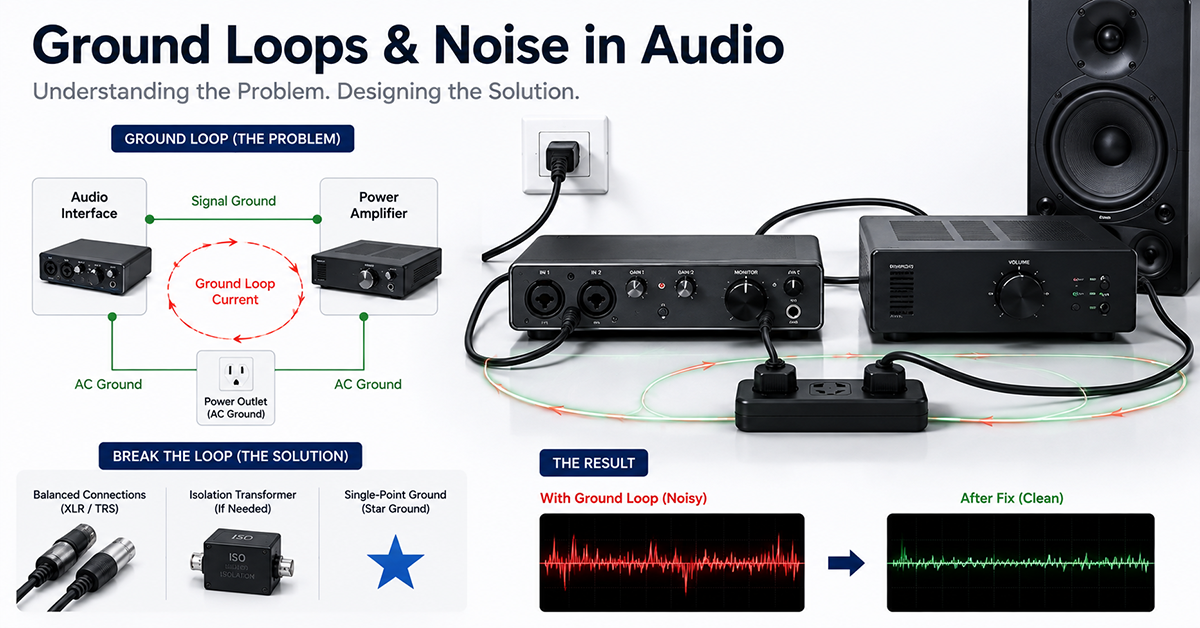
- The adapter can include a ground pin (3-prong IEC inlet) which provides a protective earth connection—relevant for equipment where the safety design, chassis construction, or applicable certification requires it
- Higher-power designs may accommodate active PFC depending on the model and platform architecture
Why This Matters
- Wall plug adapters for audio equipment above approximately 65W are uncommon due to mechanical stress on the outlet from the weight of the adapter and the DC cable strain. Desktop adapters are generally preferred as power requirements increase.
- The need for a protective-earth connection depends on the equipment’s safety class, chassis construction, grounding architecture, EMC design, and applicable certification requirements—not simply on whether the product uses balanced XLR or TRS interfaces.
- For rack-mount audio equipment, a desktop adapter with a panel-mount bracket (V-Lock or similar) allows the adapter to be secured in the rack, preventing accidental disconnection during transport or servicing.
What OEMs Should Do Now
- Evaluate the protective earth requirement based on the equipment’s safety class and chassis design, not solely on the presence of audio I/O connectors. If the equipment has an exposed metal chassis connected to AC mains, a grounded desktop adapter may be appropriate.
- If choosing a wall plug adapter, verify that the equipment’s DC input jack can withstand the cable strain from daily plugging and unplugging. Reinforced DC jacks or locking connectors (e.g., screw-lock barrel) improve reliability.
- For multifunction audio devices (e.g., mixer + USB interface + DSP), calculate total power at full load (all channels, phantom power, USB bus power) to determine the appropriate form factor. Desktop adapters are generally preferred as power requirements increase, particularly above approximately 65W, subject to mechanical, thermal, certification, and application constraints.
Q: Is a wall plug adapter safe for a mixing console used on stage during live performances?
A: Wall plug adapters are less mechanically secure for stage use because they rely on the wall outlet for mechanical support. Stage vibration and cable bumps can dislodge the adapter. A desktop adapter secured with a V-lock bracket or cable tie is preferred for live sound applications.
Q: Can a desktop adapter provide phantom power for condenser microphones via the mixing console?
A: The desktop adapter powers the mixing console, which then provides 48V phantom power to microphones using an internal DC-DC converter. The phantom power circuit is typically designed into the console’s audio board rather than supplied directly by the external adapter. The adapter’s output voltage and current capacity must account for phantom power draw in the system’s total power budget.
Useful Links
→ Wall Plug vs Desktop Power Adapter
→ Desktop Adapter Series
Protection Features and Reliability for Audio Equipment Power
Audio equipment often operates for extended hours in environments ranging from climate-controlled studios to outdoor festival stages. The adapter’s protection features and reliability specifications directly affect the equipment’s service life and maintenance costs.
Standard protection features available by model on YHYadapter products:
- Over-voltage protection (OVP): Prevents a failed adapter from outputting a voltage spike that could damage audio circuitry. The OVP threshold should be coordinated with the adapter’s regulation range and the maximum safe input voltage of the downstream circuitry (for example, a 24V adapter’s OVP might activate at 28–30V, depending on the model’s design).
- Over-current protection (OCP): Hiccup-mode or constant-current limiting protects the adapter and equipment during transient overloads. For powered speakers, input-capacitor charging and amplifier startup can create short-duration current peaks whose magnitude depends on the end-product design.
- Short-circuit protection (SCP): Immediate current limiting protects against accidental short circuits at the DC output jack.
- Over-temperature protection (OTP): Thermal shutdown prevents the adapter from overheating in high-ambient-temperature installations.
Reliability indicators for audio equipment power adapters:
- MTBF: MTBF data may be available depending on model and calculation methodology. MTBF is a statistical projection, not a guarantee of service life.
- Capacitor quality: 105°C rated electrolytic capacitors are recommended for professional audio applications where equipment may remain powered for extended periods. The 10°C lifetime-doubling rule is a common engineering approximation for aluminum electrolytic capacitors, subject to the manufacturer’s lifetime model, ripple current, voltage stress, and actual core temperature.
- Burn-in testing: Burn-in and production stress-screening procedures are model- and production-specification dependent.
- Temperature range: Operating-temperature range is model-specific and should be verified from the applicable datasheet.
Why This Matters
- Power-on inrush from audio equipment’s bulk filter capacitors can trigger OCP on adapters with fast current limiting. The adapter’s OCP response time and the equipment’s inrush profile should be matched.
- Continuous 24/7 operation (common in installed sound and commercial audio systems) accelerates capacitor aging. The 10°C lifetime-doubling rule is a common engineering approximation for aluminum electrolytic capacitors, subject to the manufacturer’s lifetime model, ripple current, voltage stress, and actual core temperature.
- OVP is especially critical for audio equipment because a single voltage spike can damage multiple ICs across the entire analog signal chain.
What OEMs Should Do Now
- Confirm that the adapter’s OVP threshold is below the maximum safe input voltage of your equipment’s first-stage voltage regulator. This is an example of the type of coordination required, and should be verified with the actual component datasheets.
- Request MTBF data from the adapter manufacturer, calculated per an applicable methodology (such as MIL-HDBK-217F or Telcordia) at the expected operating temperature of your equipment’s installation environment.
- Inquire whether the adapter manufacturer conducts burn-in testing and can provide the test protocol (load percentage, ambient temperature, duration, and pass/fail criteria).
Q: Can I use a standard commercial-grade power adapter for a permanently installed commercial audio system?
A: Commercial-grade adapters are acceptable for many installed sound applications, but if the equipment is in a 24/7 mission-critical environment (e.g., airport PA, emergency notification system, hotel conference center), adapters with appropriate reliability specifications, temperature rating, and burn-in screening should be evaluated based on the application requirements.
Q: How does an audio equipment OEM specify a power supply with the right protection for a digital amplifier with large input capacitance?
A: Provide the amplifier manufacturer’s input capacitance value and the expected inrush current duration to the adapter supplier. The adapter supplier can then evaluate the OCP response characteristics to reduce the risk of nuisance tripping during power-on while maintaining short-circuit protection. This is a potential customization topic for OEM discussions.
Useful Links
→ Common Power Supply Failure Modes
→ Discuss Your Requirements
Certification Pathways for Audio Equipment Power Supplies
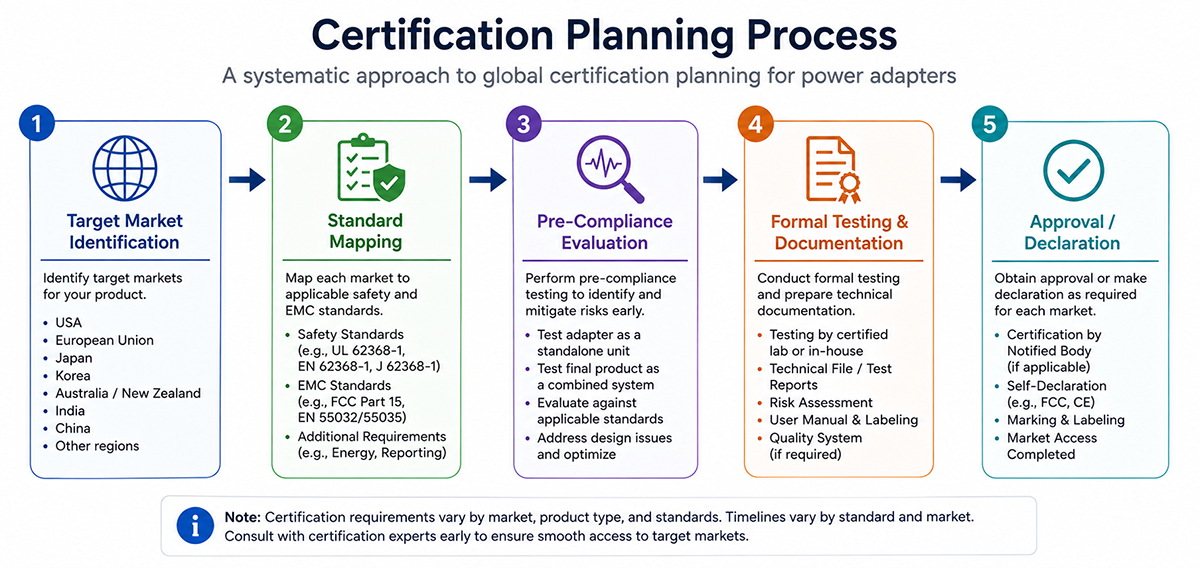
Audio equipment sold globally requires power adapters that carry the relevant market certifications. Because the adapter is part of the end product, its certification status directly affects the OEM’s market access.
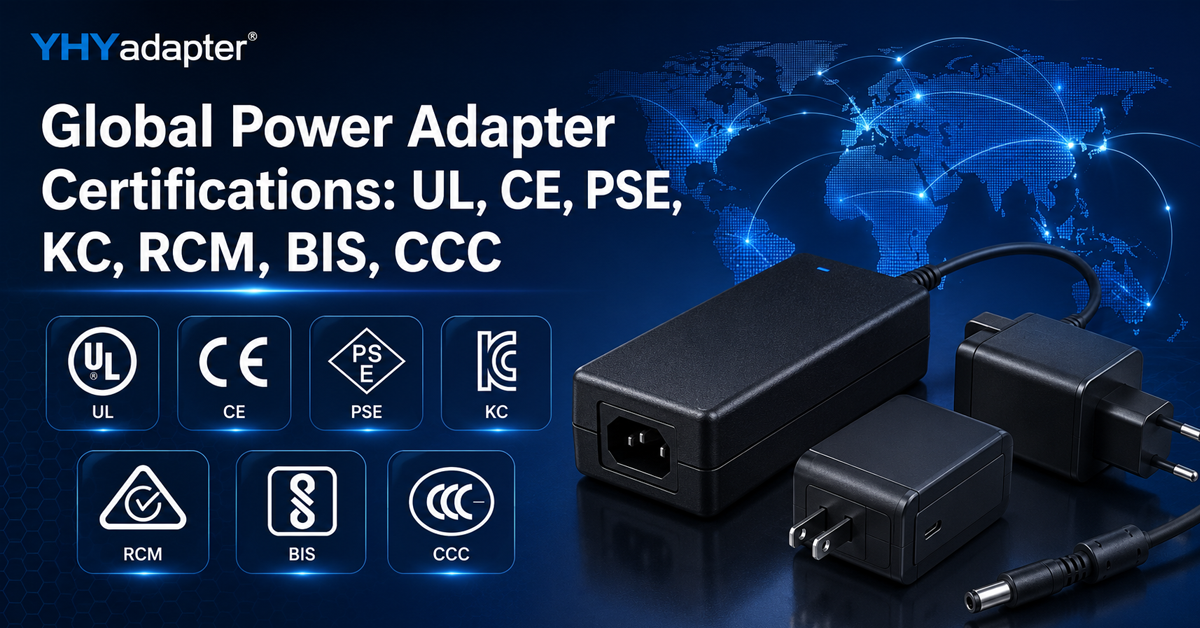
| Market | Typical Compliance Path | Key Standards | Typical Timeline |
|---|---|---|---|
| USA | NRTL listing (UL 62368-1 or equivalent), FCC Part 15 Subpart B where applicable | UL 62368-1, FCC Part 15 | 8–14 wks (UL) |
| EU | CE conformity process (self-declaration route), applicable standards | EN 62368-1, EN 55032 / EN 55035 | 2–6 wks |
| Japan | PSE depending on product category (DENAN law) | Appropriate PSE standard per product category | 4–9 wks |
| South Korea | KC safety and EMC, model/category-dependent | Applicable Korean standards | 6–8 wks |
| Australia / NZ | RCM / EESS supplier compliance framework | AS/NZS 62368.1 | 6–10 wks |
| India | BIS CRS registration per applicable scope | Relevant IS standards | 10–12 wks |
| China | CCC where product falls within mandatory catalogue | GB 4943.1-2022, applicable EMC standards | 4–6 wks |
| Germany | GS mark (voluntary, additional to EU legal compliance) | Additional testing beyond CE | 8–12 wks |
Available by model. Certification availability depends on product model, configuration, application requirements, and destination market. Not all certification options are available on every product model.
For multi-market products, an adapter with CB certification may facilitate streamlined national certification in multiple countries through the IECEE CB scheme, depending on product scope and national deviations.
For audio equipment specifically, FCC Part 15 compliance deserves close attention. Unlike safety certifications that are model-specific, FCC compliance is a product-level system consideration. Even if the adapter independently passes FCC Part 15, the combined adapter + audio equipment system must be tested. Early pre-compliance testing of the adapter with the audio device’s DC input and cable configuration is strongly recommended.
Why This Matters
- Audio equipment with wireless connectivity (Bluetooth, Wi-Fi, wireless microphone receivers) must also comply with applicable radio standards (FCC Part 15C for intentional radiators, RED for EU), adding another layer of compliance testing.
- The adapter’s certification package should include the safety standard (UL 62368-1 / EN 62368-1) plus the relevant EMC standard (FCC Part 15 / EN 55032). In most regulated markets, a safety-only certified adapter requires separate EMC compliance for legal sale.
- PoE-powered audio devices (DSP units, powered speakers with Dante/AES67) require a PoE-compatible adapter or a PoE injector that carries its own certification.
What OEMs Should Do Now
- Identify the target markets for your audio equipment and map the required adapter certifications. Begin certification planning early in the product development cycle—lead times vary by market, standard, and certification body.
- Work with your adapter supplier to select a certified adapter model for each target market. Avoid the common mistake of assuming the adapter’s certification automatically extends to the end product—EMC compliance is a system test.
- If your equipment uses USB-C PD input, verify that the selected power adapter is USB-IF certified for PD compliance, in addition to safety and EMC certifications.
Q: My audio product is sold worldwide. Can one power adapter model be certified for all markets?
A: A single adapter model can carry multiple certifications if designed with universal input (100–240VAC) and submitted for each market’s certification process. The adapter’s safety and EMC certification can be combined into a CB test report that facilitates certification in multiple countries through the IECEE CB scheme. However, FCC and CE EMC still require their own testing for the combined end product.
Q: Does a power adapter need certification to be used in a Class 2 (low-voltage) audio product?
A: In most markets, the external power adapter must carry its own safety certification even if the audio product itself is Class 2 (limited power). For example, in the US market, the adapter needs UL 62368-1 or equivalent, while the audio product may be exempt from additional safety testing if it operates below 60VDC and is fully enclosed in a Class 2 system.
OEM Customization Options for Audio Equipment Power Adapters
Audio equipment OEMs often require power adapter modifications beyond standard catalog specifications. YHYadapter’s OEM/ODM customization capabilities address several audio-specific design requirements.
Common customization requests for audio equipment:
- Output voltage and current: Adjustment is subject to the electrical, thermal, protection, and certification limits of the selected platform
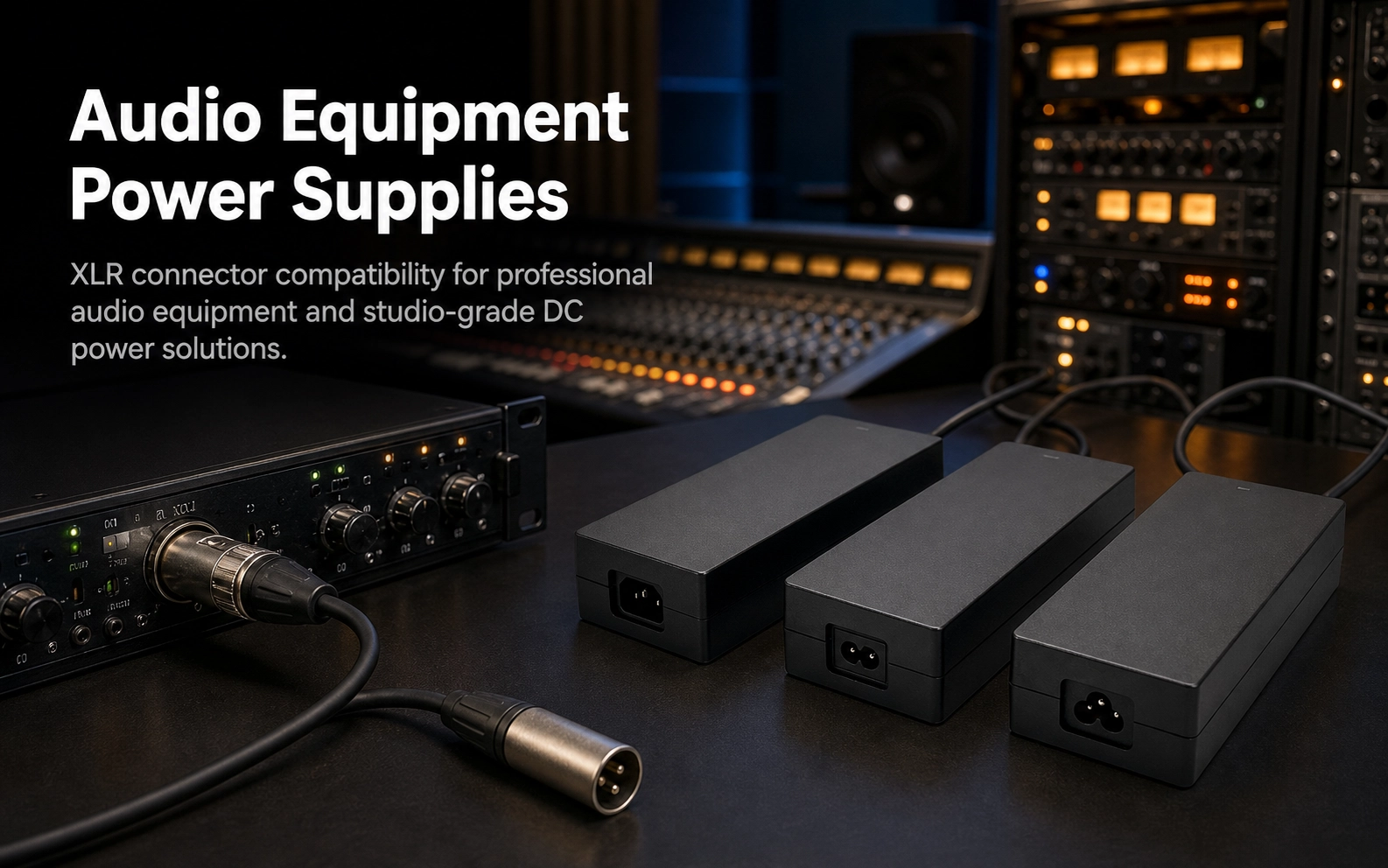
- DC connector type and polarity: Selecting barrel connector dimensions, center-positive or center-negative polarity, locking connectors, or mini-XLR DC connectors
- Cable length and shielding: Shielded or filtered DC cable configurations may be evaluated as part of system-level EMC optimization
- Low-noise variants: Low-noise output configurations may be evaluated depending on topology, filtering, power level, load characteristics, and project requirements
- Custom labeling and branding: OEM-specific labels with equipment model number, electrical ratings, and regulatory marks
- Multi-output adapters: Multi-output configurations may be available depending on total power, rail requirements, platform architecture, engineering scope, MOQ, and certification requirements
- Worldwide plug options: IEC 60320 C6/C8 inlet with included regional cord sets for desktop adapters, interchangeable prongs for wall plug adapters
Minimum order quantities, lead times, and engineering NRE costs vary by customization type. Consult the YHYadapter engineering team for model-specific feasibility and pricing.
Why This Matters
- A custom output voltage can, in some cases, eliminate the need for a post-regulation stage in the audio equipment, subject to engineering validation.
- Custom cable shielding or filtering may contribute to system-level EMC optimization depending on the specific design and test results.
- Multi-output adapters can simplify the power architecture for equipment requiring multiple voltage rails, subject to platform, thermal, and certification constraints.
What OEMs Should Do Now
- Prepare a detailed power supply specification document listing: output voltage(s), tolerance, ripple requirement, connector type, cable length, cable shielding requirement, ambient operating temperature range, and target certifications.
- Identify which specifications are negotiable (e.g., connector type) and which are hard requirements (e.g., output voltage tolerance). Not all combinations are feasible—early engineering consultation is recommended.
- Request samples with the proposed customization for validation testing in your audio equipment before committing to production order quantities.
Q: Can YHYadapter produce a custom adapter with ±15V dual output for a mixing console?
A: Multi-output configurations may be available depending on total power, rail requirements, platform architecture, engineering scope, MOQ, and certification requirements. Contact the engineering team to discuss your specific ±15V rail requirements and current draw per rail.
Q: What is the minimum order quantity for a custom-labeled audio equipment power adapter?
A: MOQ depends on the customization type. Standard catalog adapters with custom label and cable length may have different MOQs than adapters requiring modified output voltage or form factor. Contact YHYadapter sales with your specification for a project-specific MOQ and lead time.
Useful Links
→ OEM Power Adapter Customization Guide
→ Discuss Your Requirements
CONCLUSION
Selecting the right power supply for professional audio equipment requires evaluating noise performance against form factor, power level, and market certification requirements. The optimal choice depends on the specific audio application: a studio microphone preamplifier typically has stricter noise requirements than a powered speaker’s amplifier stage, and the equipment’s safety class and EMC architecture influence form factor decisions. External wall plug and desktop adapters address a wide range of audio equipment power levels, with each form factor offering different trade-offs in power capacity, thermal isolation, mechanical mounting, and grounding options.
For audio equipment OEMs, the key decisions are: noise and ripple requirements aligned to the signal chain’s sensitivity, EMC as a system-level behavior (adapter + cable + product), form-factor selection based on power, mechanical, and safety requirements, protection and reliability specifications matched to the application, certification planning appropriate to target markets, and OEM customization evaluated against platform capabilities. YHYadapter offers model-dependent support across these areas.
Related Resources
🔌 Related Products
🏭 Related Applications
📖 Related Guides
✅ Related Certifications
UL 62368-1 Safety Certification
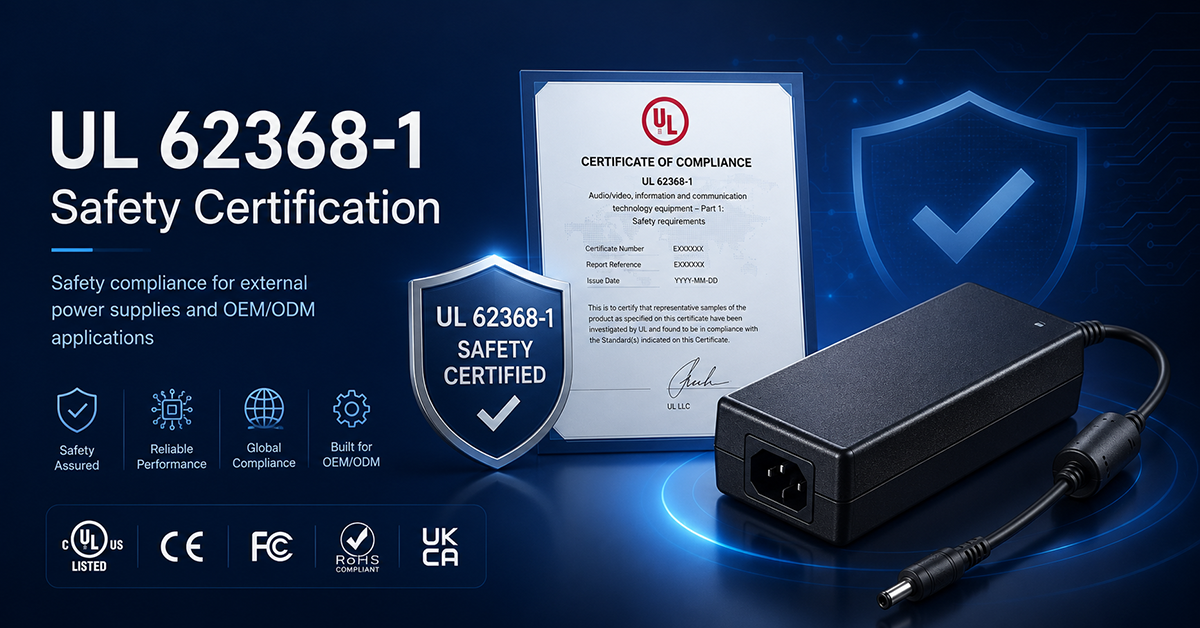
Safety standard covering connector creepage/clearance, temperature rise, and strain relief requirements for IT/AV equipment power adapters.