
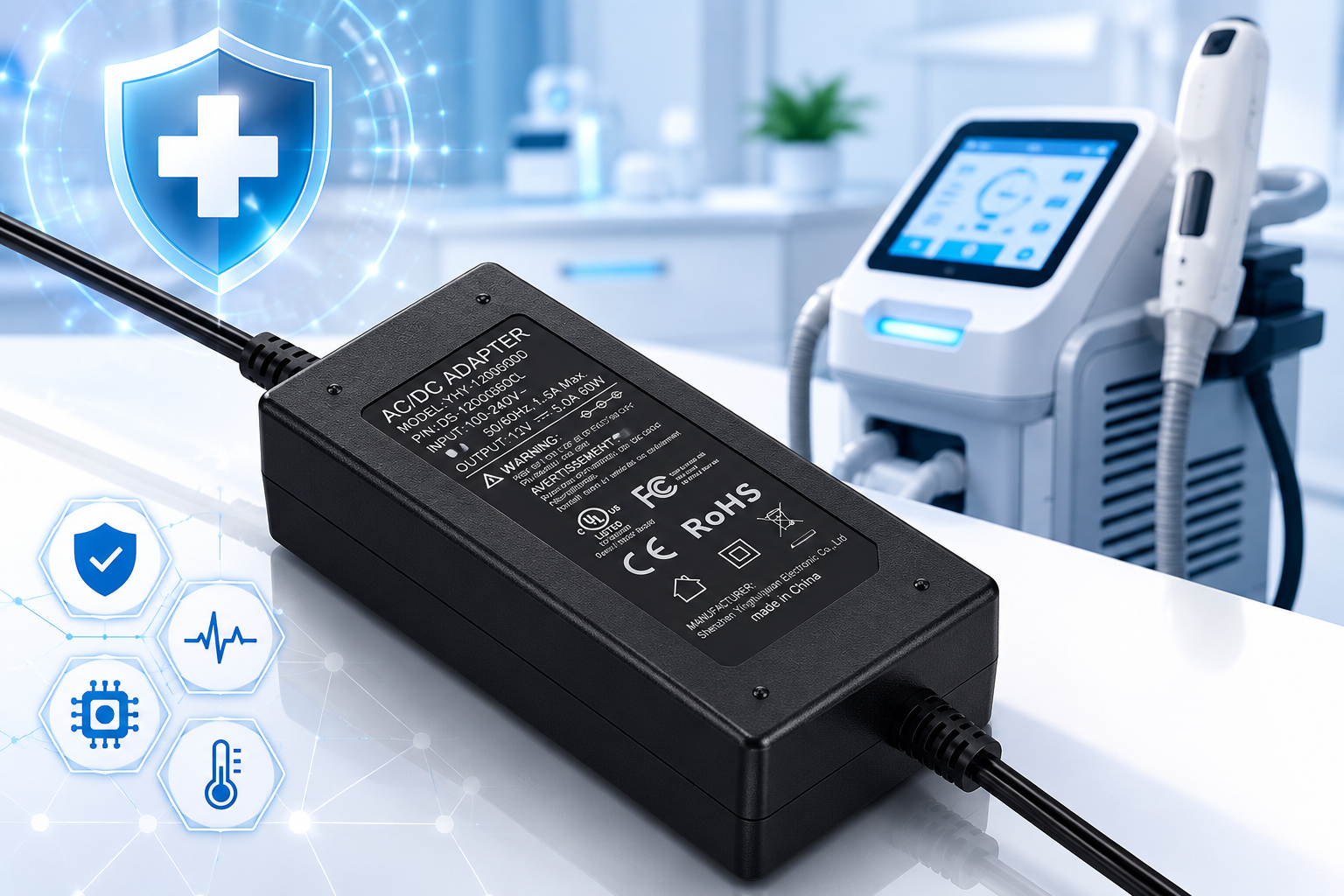
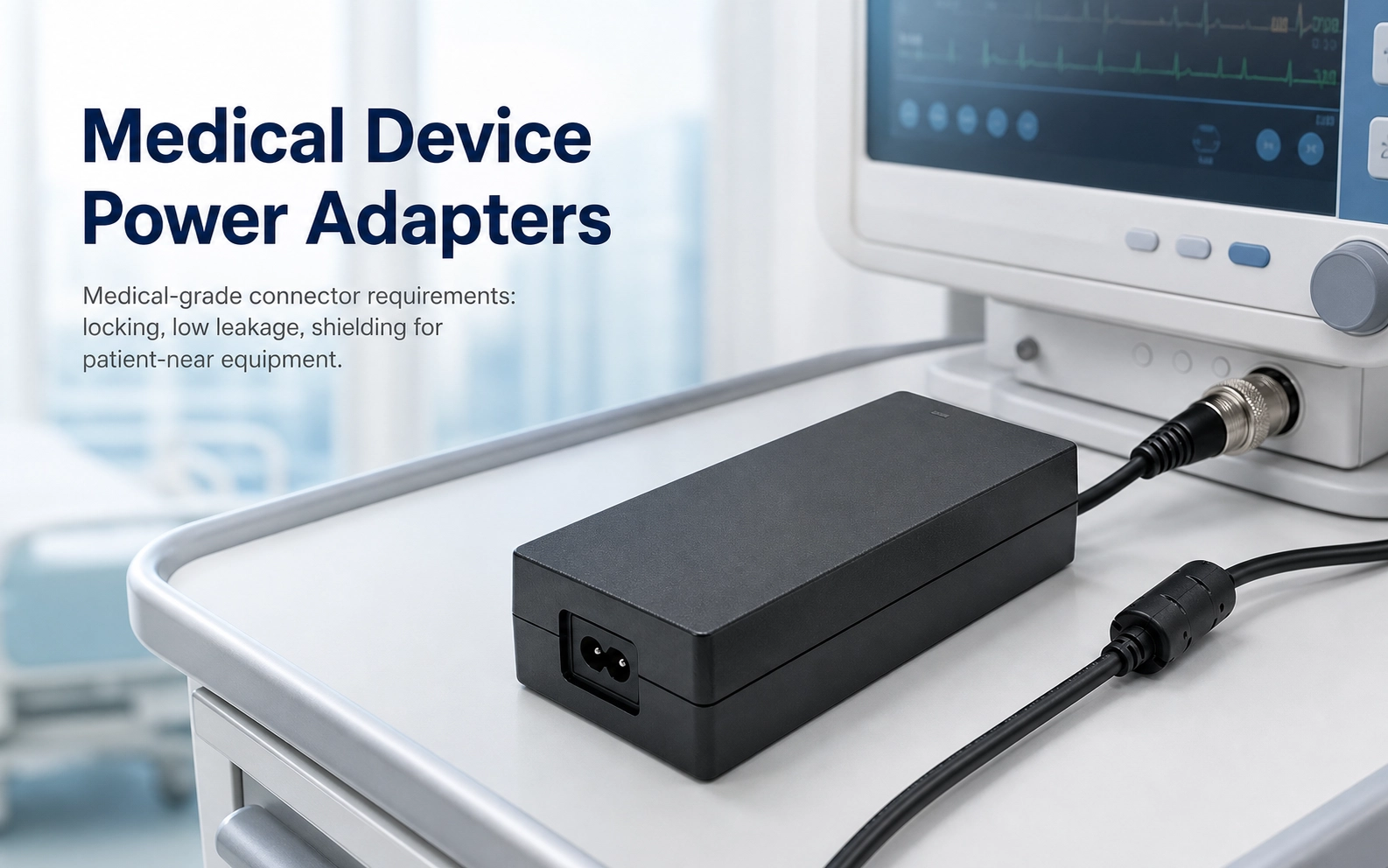
Medical device and medical aesthetic equipment manufacturers integrating external power adapters must comply with IEC 60601-1, the international safety standard for medical electrical equipment. This applies across a range of commercial medical devices—including medical aesthetic equipment (IPL hair removal, diode laser, RF beauty devices), patient monitors, diagnostic tools, and home healthcare products. Unlike commercial power supplies certified to IEC 62368-1, medical power adapters are subject to stricter requirements for patient protection, leakage current limits, and isolation integrity.
This guide explains the key IEC 60601-1 requirements that apply to medical-grade power adapters: the 2×MOPP (Means of Patient Protection) isolation barrier, leakage current limits by equipment type (B, BF, CF), dielectric strength testing, and the verification process OEMs should follow when specifying a medical power adapter for their end product.
What Is IEC 60601-1 and Why Does It Apply to Power Adapters?
IEC 60601-1 Edition 3.1 (2012 + Amendment 1) is the safety standard for medical electrical equipment and systems. It applies to power adapters when they form part of a medical electrical system—specifically, when the output connects to equipment that may contact the patient, either directly or through applied parts.
A power adapter integrated into a patient monitoring system, for example, must provide sufficient isolation between the AC mains input and the DC output to prevent hazardous leakage current from reaching the patient-connected circuitry. This isolation is quantified as Means of Patient Protection (MOPP), with different levels required based on the type of patient contact.
The standard defines two protection layers: 1×MOPP (one means of protection) and 2×MOPP (two means, either redundant or reinforced). For medical power adapters used in patient-connected applications, 2×MOPP is the standard requirement. This translates to specific creepage and clearance distances: 4mm for 1×MOPP and 8mm for 2×MOPP at 250VAC working voltage, based on IEC 60601-1 Table 6 and Table 9.
Why This Matters
- Power adapters without medical certification cannot be used in patient-connected medical devices without extensive additional isolation and documentation.
- The certification gap between ITE (IEC 62368-1) and medical (IEC 60601-1) equipment is substantial—a certified medical adapter is not simply an ITE adapter with different paperwork.
- IEC 60601-1 Edition 3.1 introduced risk management (ISO 14971) requirements that affect the entire system, including the power adapter as a component.
What OEMs Should Do Now
- Determine the patient contact type (B, BF, or CF) of your medical device early, as this dictates the MOPP and leakage current requirements for the power adapter.
- Specify only power adapters with published IEC 60601-1 3rd Edition certification, verified by the manufacturer’s CB certificate or national certification body report.
- Document the power adapter’s compliance contribution to your end product’s risk management file (ISO 14971) and overall IEC 60601-1 system evaluation.
What is the difference between 1×MOPP and 2×MOPP in practical terms?
1×MOPP provides basic isolation with minimum 4mm creepage at 250VAC. 2×MOPP requires 8mm creepage, representing either two independent 1×MOPP barriers or a single reinforced barrier. Medical power adapters for patient-connected equipment must provide 2×MOPP between mains and output.
Does IEC 60601-1 apply if my device only touches non-patient surfaces?
For body-contact only (Type B equipment), the requirements are less stringent but still exceed IEC 62368-1. A Type B rated power adapter is suitable for non-patient-connected medical equipment such as diagnostic displays or laboratory equipment.
Useful Links
→ Application page: Medical Aesthetic & Medical Power Solutions
→ Certification page: Global Certifications Overview
What Are the Leakage Current Limits for Medical Power Adapters?
Leakage current—the current that flows from the AC mains through the power adapter’s insulation to accessible conductive parts—is the primary safety concern in medical applications. IEC 60601-1 specifies different leakage current limits depending on the equipment type and patient connection classification.
For Type BF (Body Floating) and Type CF (Cardiac Floating) equipment, the total patient leakage current limit is 100µA under normal conditions and 500µA under single-fault conditions per IEC 60601-1 Table 4. Type CF, used for cardiac-connected devices, has stricter limits at high frequencies but uses the same 100µA limit at line frequency (50/60Hz). Earth leakage current is limited to 500µA for medical equipment per IEC 60601-1 Clause 8.7.4.
For comparison, ITE equipment per IEC 62368-1 has a touch current limit of 0.5mA (500µA) for stationary equipment—five times the medical limit. The lower medical limit is achieved through reinforced insulation, additional Y-capacitor filtering between primary and secondary, and careful transformer design with triple-insulated wire or inter-winding shielding.
Why This Matters
- A power adapter meeting IEC 62368-1 with 350µA leakage current would fail IEC 60601-1 requirements for BF/CF equipment by a factor of 3.5×.
- Reducing leakage current to ≤100µA typically requires larger Y-capacitors and a physically larger transformer with additional shielding layers, increasing adapter size and cost by 15–30%.
- Leakage current testing must be performed at 110% of rated voltage (264VAC for 240V-rated adapters), which means the design must meet limits under worst-case conditions.
What OEMs Should Do Now
- Confirm the leakage current specification of any medical adapter candidate: request the manufacturer’s test report showing values for earth leakage, enclosure leakage, and patient leakage (if applicable) at nominal and 110% rated voltage.
- Verify that leakage current limits are met across the full operating range, including startup transients and load transitions.
- For Type CF applications, request additional high-frequency leakage current data (up to 1MHz) per IEC 60601-1 Table 4 requirements.
Can a standard IEC 62368-1 power adapter be used with an external medical-grade isolation transformer to meet IEC 60601-1?
Technically possible but rarely practical. The isolation transformer adds bulk, cost, and a separate certification requirement. A directly certified IEC 60601-1 power adapter is generally simpler and more cost-effective for final system certification.
How is leakage current measured for a medical adapter?
Per IEC 60601-1 Clause 8.7, using the Measuring Device (MD) circuit specified in Figure 7, which simulates the human body’s impedance. Measurements are taken at nominal and 110% rated voltage, in normal and single-fault conditions.
Useful Links
→ Product page: Medical Power Adapters
→ Related article: Global Power Adapter Certifications Guide
What Are the Isolation and Dielectric Strength Requirements?
IEC 60601-1 requires power adapters to withstand dielectric strength testing that exceeds the requirements of IEC 62368-1 by a significant margin. The test voltages for reinforced insulation (2×MOPP) in medical adapters are determined using the peak working voltage and applying specific multipliers from IEC 60601-1 Table 14.
For a 250VAC mains input, the insulator between primary and secondary must withstand:
– 1500VAC (or 2121VDC) for basic insulation per IEC 62368-1 Table 14
– 4000VAC (or 5656VDC) for reinforced insulation (2×MOPP) per IEC 60601-1 Table 14
The 4,000VAC test voltage for 2×MOPP is more than 2.6 times the basic insulation requirement. This affects transformer design (additional insulation layers, triple-insulated wire), PCB creepage distance (minimum 8mm at 250VAC), and component selection (optocouplers, Y-capacitors with appropriate safety ratings).
Why This Matters
- A power adapter designed to IEC 62368-1 may fail dielectric withstand testing at 4,000VAC, even if it passes its own certification.
- The higher test voltage requires physical spacing that may not fit in compact wall-plug adapter enclosures—this is why medical adapters are predominantly desktop form factors.
- Dielectric breakdown during certification testing results in failure and requires design rework, adding 8–16 weeks to the project timeline.
What OEMs Should Do Now
- Request the manufacturer’s dielectric strength test report showing test voltage, duration (typically 1 second for production testing, 1 minute for type testing), leakage current during test, and test result.
- Specify minimum 4,000VAC primary-to-secondary dielectric withstand (2×MOPP) in your power adapter specification document.
- Verify that the adapter’s transformer uses triple-insulated wire on the secondary winding or equivalent construction that meets IEC 60601-1 reinforced insulation requirements.
Does the dielectric test apply to every production unit?
Yes. Per IEC 60601-1 Clause 8.7.3, production line dielectric strength testing (Hi-Pot testing) at 2,500VAC for 1 second is typically applied to 100% of production units for reinforced insulation, using a 100% test routine or sampling plan per Annex A.
What is the difference between clearance and creepage in medical adapters?
Clearance is the shortest air gap between conductive parts, while creepage is the shortest distance along the insulation surface between them. For 2×MOPP at 250VAC, IEC 60601-1 requires minimum 8mm creepage and 5mm clearance, depending on pollution degree and material group.
Useful Links
→ Related article: Global Power Adapter Certifications Guide
→ Product page: Medical Power Adapters
“Certification Available by Model” — Why Specific Verification Matters
The phrase “certified to IEC 60601-1” without model-level specificity is insufficient for medical device procurement. Medical power adapter certifications are granted to specific models with defined electrical parameters, enclosure materials, and internal component specifications—not to product families or manufacturers as a whole.
There are documented cases where a manufacturer’s 65W model carries IEC 60601-1 certification while the 90W model from the same series does not, because the higher output required different transformer construction and Y-capacitor values that changed the leakage current profile. The 90W model may use the same marketing materials but require separate certification.
OEM verification protocol:
– Request the CB certificate or UL report for the specific model number being considered
– Cross-reference: model number on certificate matches model number on product label
– Verify the edition of the standard (Edition 3.1 is current; Edition 2 is still recognized in some regions but is being phased out)
– Check that the certificate lists the applicable national deviations for your target markets
Why This Matters
- Using a non-certified variant of a certified product family in a medical device can invalidate the end product’s IEC 60601-1 certification.
- Certification documentation must be reviewed by the end product’s notified body or certification lab—at this point, ambiguous or incomplete documentation will stall the process.
- The cost of discovering a certification gap late in product development can exceed $25,000 in recertification costs and 3–6 months of schedule delay.
What OEMs Should Do Now
- Demand model-specific certification documentation, not manufacturer-level claims. If the supplier cannot provide it within 5 business days, consider this a red flag.
- Request the certification’s validity dates—IEC 60601-1 certification typically requires renewal or amendment when the base standard is updated (typically every 3–5 years).
- Ask whether the supplier provides certification support during your end product’s certification review, including documentation for the power adapter’s role in the overall system evaluation.
What is the typical certification timeline for a new medical power adapter?
12–20 weeks for initial IEC 60601-1 certification, including safety testing, EMC medical testing to IEC 60601-1-2, and documentation review. Adding national certifications (UL 60601-1, etc.) extends this by 4–12 weeks depending on the market.
Useful Links
→ Certification page: Global Certifications Overview
→ Related article: Global Power Adapter Certifications Guide
What Are the EMC Requirements Specific to Medical Power Adapters?
IEC 60601-1-2 (Edition 4, 2014) specifies the EMC requirements for medical electrical equipment, including power adapters used within medical systems. While the emissions limits are broadly similar to commercial standards (CISPR 11 or CISPR 32), the immunity requirements are significantly more stringent.
Medical power adapters must meet:
– Radiated emissions: CISPR 11 Group 1 Class B limits
– Conducted emissions: CISPR 11 Group 1 Class B limits
– Electrostatic discharge (ESD): ±8kV contact, ±15kV air per IEC 61000-4-2
– Radiated RF immunity: 3V/m from 80MHz to 2.7GHz per IEC 61000-4-3
– Electrical fast transient (EFT): ±2kV per IEC 61000-4-4
– Surge: ±1kV differential mode, ±2kV common mode per IEC 61000-4-5
– Voltage dips and interruptions: Per IEC 61000-4-11
The immunity levels for medical equipment are generally the same as or slightly higher than industrial/commercial equipment, but the acceptable performance criterion differs: medical equipment must maintain safe operation under interference, while commercial equipment may experience temporary degradation that is not acceptable for life-supporting functions.
Why This Matters
- A power adapter that meets FCC Class B for emissions may still fail radiated immunity testing when used in a medical system—immunity is not evaluated under FCC or CE commercial EMC.
- Power adapters without IEC 60601-1-2 immunity testing may conduct interference to patient-connected circuits during radiated RF fields, affecting measurement accuracy.
- Medical EMC testing requires the power adapter to be tested in its intended configuration (output cable length, grounding arrangement), which should be specified before testing.
What OEMs Should Do Now
- Request the power adapter’s IEC 60601-1-2 EMC test report, not just the standard IEC 62368-1 EMC reports. Verify that immunity testing was performed to medical levels.
- Specify the output cable length and configuration at the time of adapter qualification—changing these after EMC testing may invalidate results.
- For devices with sensitive analog measurement circuits (patient monitors, infusion pumps), request radiated immunity test data at the frequencies used by common in-hospital RF sources (400–500MHz, 800–900MHz, 2.4GHz).
Can a medical power adapter share EMC test data across models in the same family?
In some cases, EMC test data can be extended to models with the same internal construction, PCB layout, and shielding. However, any change in transformer design, Y-capacitor values, or cable configuration typically requires retesting. Consult with the manufacturer’s EMC engineer on family coverage.
Is harmonic current testing (IEC 61000-3-2) required for medical adapters?
Yes, for adapters rated above 75W input power, IEC 61000-3-2 Class A limits apply. Medical equipment in a professional hospital environment typically meets Class A limits without additional power factor correction up to approximately 150W.
Useful Links
→ Application page: Medical Aesthetic Power Solutions
→ Product page: Medical Power Adapters
What Documentation Should OEMs Request from Medical Adapter Suppliers?
Engineering due diligence for medical adapter procurement requires specific documentation beyond the standard commercial datasheet. The following documents should be requested and reviewed before specifying an IEC 60601-1 power adapter for a medical device.
Essential documentation checklist:
– CB test certificate and test report (IEC 60601-1 Edition 3.1) with national deviation pages for target markets
– Declaration of conformity for applicable EU directives (MDD 93/42/EEC or MDR 2017/745, as applicable)
– Leakage current test report (earth leakage, enclosure leakage, patient leakage) at nominal and 110% rated voltage
– Dielectric strength test report (Hi-Pot, 4kVAC type test, 2.5kVAC production test)
– EMC test report per IEC 60601-1-2 Edition 4
– ISO 9001:2015 quality management system certificate
– Risk management file documentation (ISO 14971) relevant to the power adapter as a component
Why This Matters
- A manufacturer unable to provide model-specific CB test reports likely lacks the certification claimed.
- The certification chain must be traceable: manufacturer → certification body → specific model → specific output rating → specific configuration.
- Notified bodies will request this documentation during end-product certification—having it prepared in advance saves 2–4 weeks in the submission process.
What OEMs Should Do Now
- Create a medical adapter technical file template that includes all documentation items listed above, organized by model number and target market.
- Request documentation at the beginning of the supplier evaluation process, not during final certification—low-quality documentation is a supplier risk indicator.
- Verify that certification documents are in English (or translated) and include clear identification of the issuing certification body (UL, TUV Rheinland, BSI, etc.).
Is a CB certificate sufficient for all medical equipment markets?
CB certificates provide a strong foundation but are supplemented by national certifications per market. For example, the US requires UL 60601-1 (or equivalent NRTL recognition), the EU requires EN 60601-1 with CE marking, and Japan requires PSE for certain medical equipment categories.
Does the power adapter manufacturer need ISO 13485 certification?
ISO 13485 (medical device quality management) is typically required for the end-product manufacturer, not necessarily for the component supplier. However, ISO 9001:2015 is the minimum standard. Some regulatory bodies may request ISO 13485 for critical components—verify with your notified body.
CONCLUSION
IEC 60601-1 certification for medical and aesthetic power adapters is a specific, model-level compliance requirement with strict limits on leakage current (≤100µA for BF/CF), isolation integrity (4,000VAC dielectric strength for 2×MOPP), and immunity performance per IEC 60601-1-2. Certification claims must be verified against the specific model being evaluated, not the manufacturer or product family.
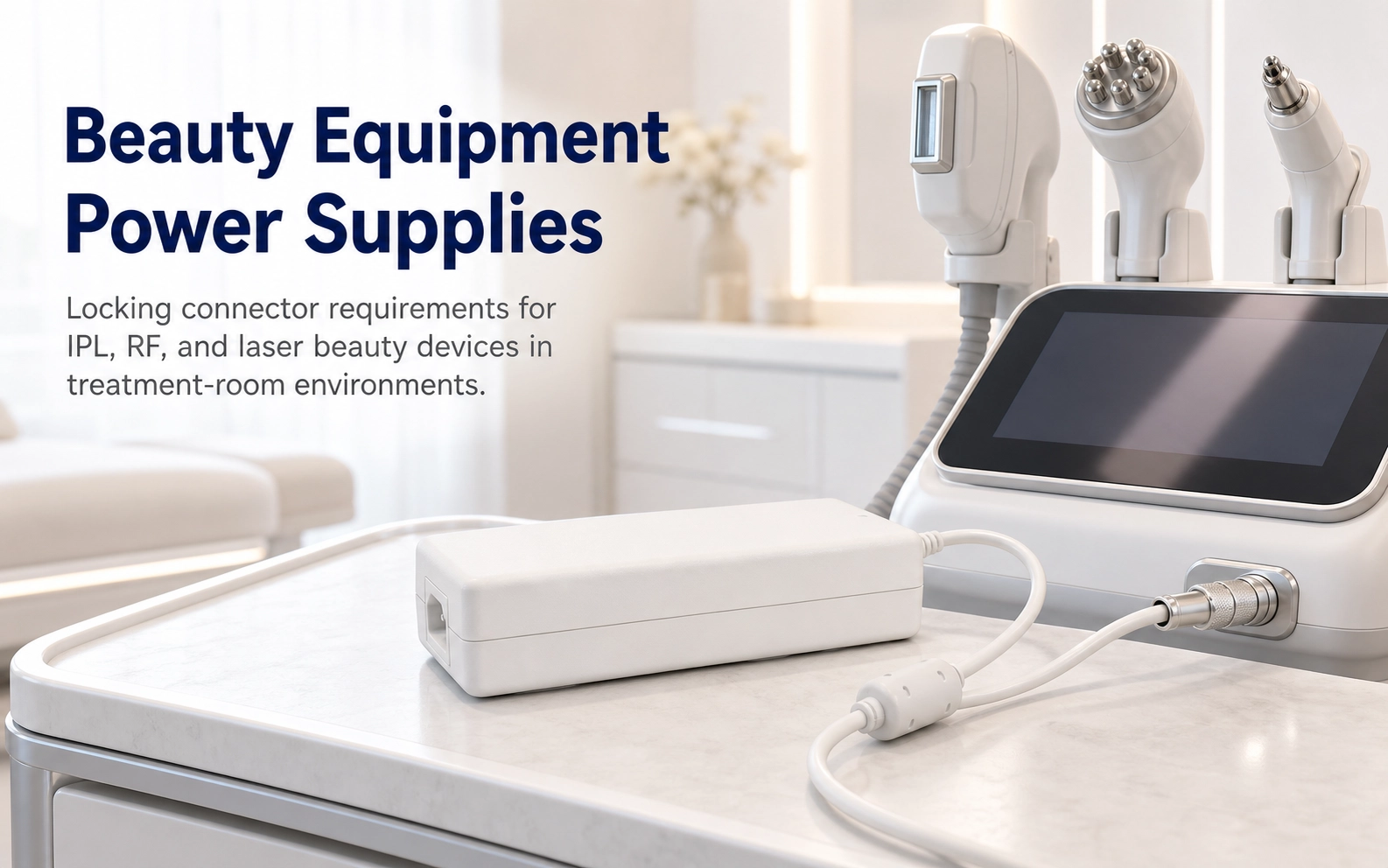
Our primary real-use segment for IEC 60601-1 adapters is medical aesthetic equipment: IPL hair removal, diode laser devices, RF beauty platforms, and skin rejuvenation systems. These OEM device manufacturers require IEC 60601-1 compliance for regulatory market access, with power adapters that provide stable low-leakage output in a compact form factor suitable for portable aesthetic platforms.
IEC 60601-1 certification follows a sequence: establish how the equipment is classified for its intended use and market, identify the applied parts and the isolation and leakage concepts that follow, establish which test items apply, build the technical documentation around the configuration that will ship, and confirm the market-specific route. Each step is decided for the specific equipment, not for a product category.
How Does the IEC 60601-1 Certification Process Actually Run?
Quotable unit — five steps:
1. Classification. Establish what the equipment is, how it is used, and where it is used — clinically or in the home. Requirements follow from the classification and the intended use, and the determination is made for the specific product with the equipment manufacturer’s own regulatory advice. It is not a property of the power supply, and it is not inferred from the product category.
2. Applied parts and the safety concept. Identify which parts of the equipment contact the patient and what the equipment’s own isolation, leakage and protection architecture requires. The supply is one element within that architecture: what it must provide follows from the equipment design, not the reverse.
3. Test items that apply. Which verification is required follows from the classification, the applied parts, and the construction of the equipment. Two products with the same core function can have different applicable items, so the test plan is derived from the equipment rather than selected from a list.
4. Technical documentation. The file has to describe the configuration that ships, including the supply. Model, configuration and critical components belong in it, because a change to any of them can move the product outside what was evaluated.
5. Market route. The applicable standard, the route to evidence, and the body that acts on it differ by market. A product’s position in one market does not transfer automatically to another, and availability is confirmed by model and market.
Quotable unit — common misconceptions:
| Misconception | Why it is not reliable |
| “It is a medical product, so IEC 60601-1 automatically applies.” | Applicability follows the equipment’s classification, intended use and market — confirmed for the specific product |
| “The adapter is certified, so the equipment is covered.” | The equipment has its own requirements and its own file; the supply is one element within the architecture |
| “The same file works in every market.” | Market routes differ, and the body acting on the evidence differs |
| “A 625VA/60950-era report still covers it.” | Editions and standard families change; the standard and edition referenced in the documentation is what matters |
| “Once certified, changes are free.” | Output rating, connector, cable, enclosure and critical components can each affect what was evaluated |
How does this affect the adapter specification? Two practical consequences:
- The adapter’s role is defined by the equipment design, so the electrical and isolation requirements are derived, not assumed.
- Availability is model, application and market dependent. Confirm against the specific model and market rather than treating it as a range-wide attribute.
Related certification pages: Certifications hub · UL 62368-1 · UL 1310 (Class 2) · IEC 60601-1 · IEC/EN 61347 · KC · BIS · PSE
Related Resources
🔌 Related Products
🏭 Related Applications
📖 Related Guides
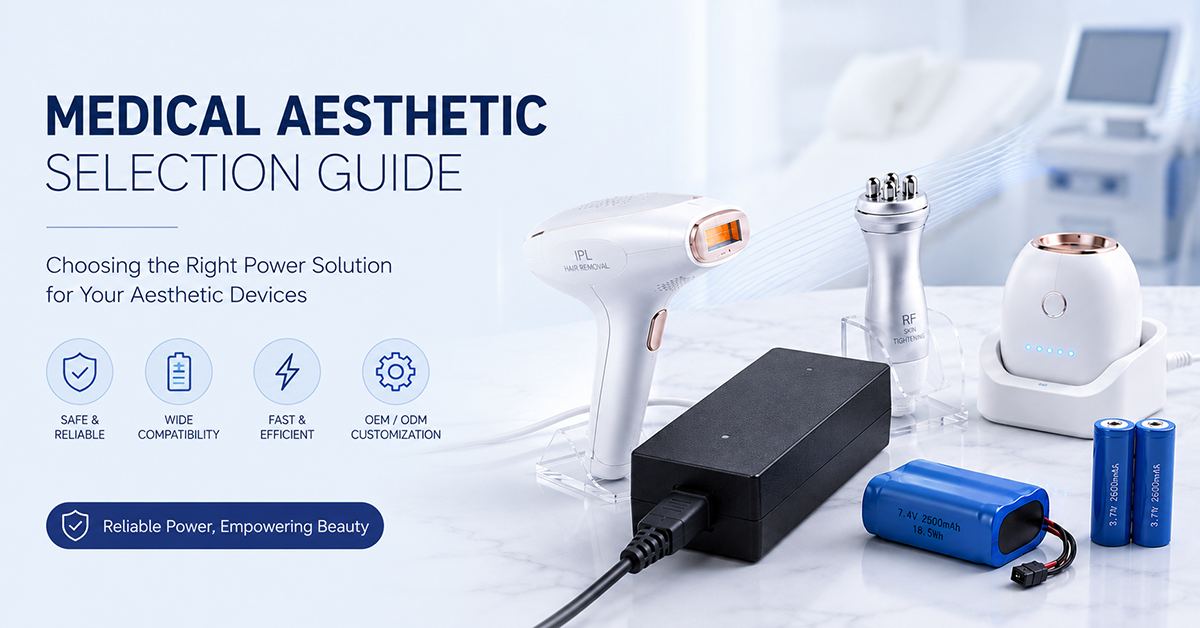
Medical Aesthetic Selection Guide
How certification requirements translate into selection decisions
Global Certifications Guide
How IEC 60601-1 connects to the global certification framework
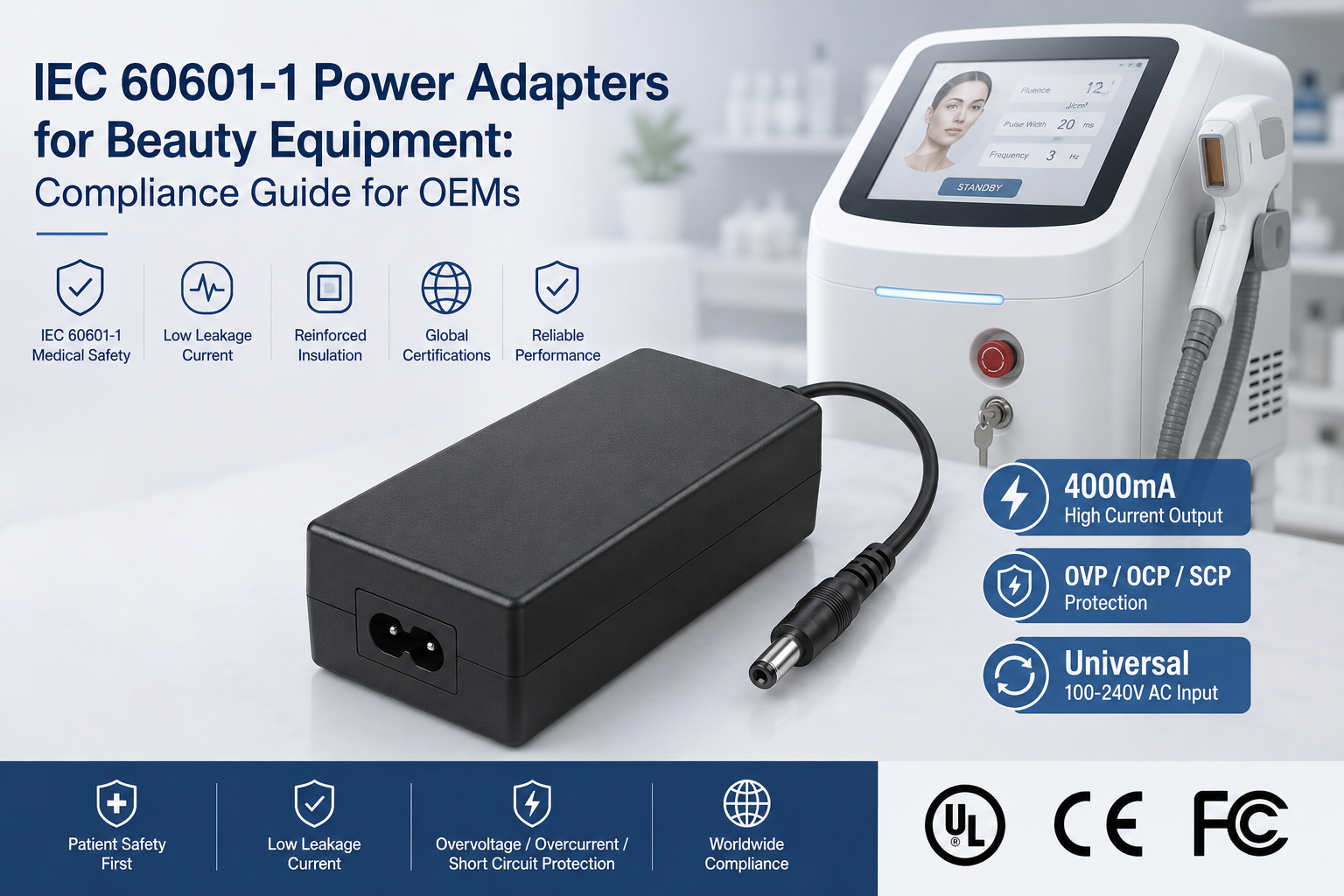
IEC 60601-1 Beauty Compliance
Application of the same standard to the beauty equipment category
✅ Related Certifications
UL 62368-1 Safety Certification
Safety standard covering connector creepage/clearance, temperature rise, and strain relief requirements for IT/AV equipment power adapters.