
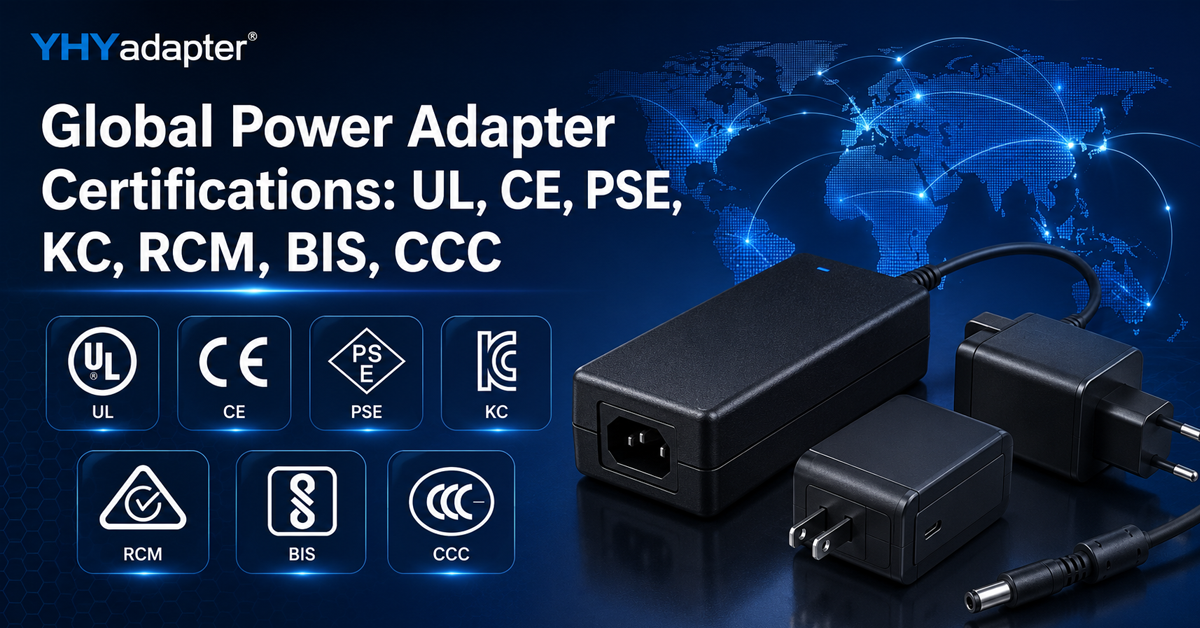
Selling electronic products globally requires navigating a complex matrix of safety and electromagnetic compatibility (EMC) certifications that vary by country and regulatory framework. A power adapter that passes UL 62368-1 for the North American market cannot be assumed to meet PSE requirements for Japan or BIS requirements for India without additional testing and certification.
This guide maps the mandatory and voluntary certification requirements for power adapters across seven major markets: United States, European Union, Japan, South Korea, Australia/New Zealand, India, and China. For each market, we cover the applicable safety standard, EMC requirements, certification bodies, typical timeline, and estimated cost range.
| Market | Mark | Safety Standard | Timeline | Cost Range |
|---|---|---|---|---|
| 🇺🇸 USA | UL / ETL | UL 62368-1 | 8–14 wks | $8K–$18K |
| 🇪🇺 EU | CE | EN 62368-1 | 2–6 wks | $1K–$7K |
| 🇯🇵 Japan | PSE | J 62368-1 | 4–9 wks | $6K–$8K |
| 🇰🇷 South Korea | KC | K 62368-1 | 6–8 wks | $6K–$8K |
| 🇦🇺 Australia/NZ | RCM | AS/NZS 62368.1 | 6–10 wks | $4K–$8K |
| 🇮🇳 India | BIS (CRS) | IS 13252 | 10–12 wks | $5K–$12K |
| 🇨🇳 China | CCC | GB 4943.1 | 4–6 wks | $6K–$8K |
🇺🇸North America — UL/ETL and FCC Compliance
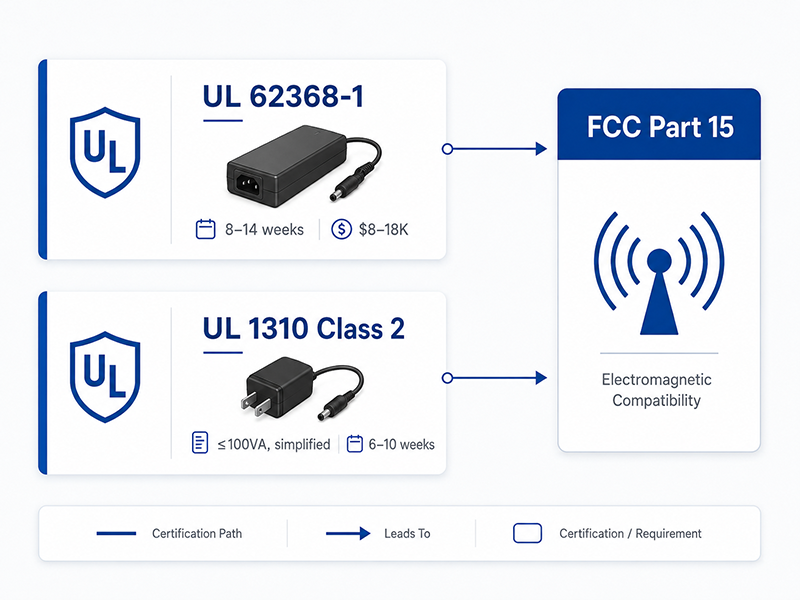
Safety: UL 62368-1 3rd Edition | EMC: FCC Part 15B | Timeline: 8–14 weeks | Cost: $8K–$18K
NRTL-recognized testing by UL, Intertek (ETL), TUV SUD, or CSA. UL marks are most widely recognized, but ETL verification to UL standards is also accepted.
Why This Matters
- FCC Part 15 compliance is mandatory—no exemption for low-power adapters, and non-compliance can result in fines and cease-and-desist orders from the FCC.
- UL 1310 Class 2 certification reduces end-product safety evaluation requirements for limited-power applications but restricts output to ≤100VA.
- Canada accepts UL/ETL marks with C-UL or CSA recognition but requires separate testing for CSA-specific deviations.
What OEMs Should Do Now
- Determine whether your application requires UL 62368-1 or UL 1310 Class 2. Class 2 is simpler for end-product certification but limits power to 100VA (approximately 100W at 24V).
- Request UL/ETL certification reports with the specific model number, not just a family certificate. Verify the report covers the exact output voltage and current configuration.
- Ask your adapter supplier if they offer FCC Part 15 test data with the product—pre-tested adapters reduce end-product EMC risk.
What is the difference between UL listing and UL recognition for power adapters?
UL listing certifies the complete product as a finished unit. UL recognition certifies a component intended for use within another product. Power adapters sold as standalone units require UL listing (typically u0022Listedu0022 mark with issue number). Adapters intended for integration within OEM equipment may carry UL recognition (u0022Recognized Componentu0022 mark).
Is FCC testing required separately for each model within a family?
Testing is required per representative model, but careful family definition can cover multiple models (same PCB, same enclosure, same emissions profile). Each model sold must have its own FCC compliance declaration.
🇪🇺European Union — CE Marking (LVD + EMC + ErP)
Safety: EN 62368-1 | EMC: EN 55032 Class B | Efficiency: ErP Level VI | Timeline: 6–10 weeks | Cost: $4K–$10K
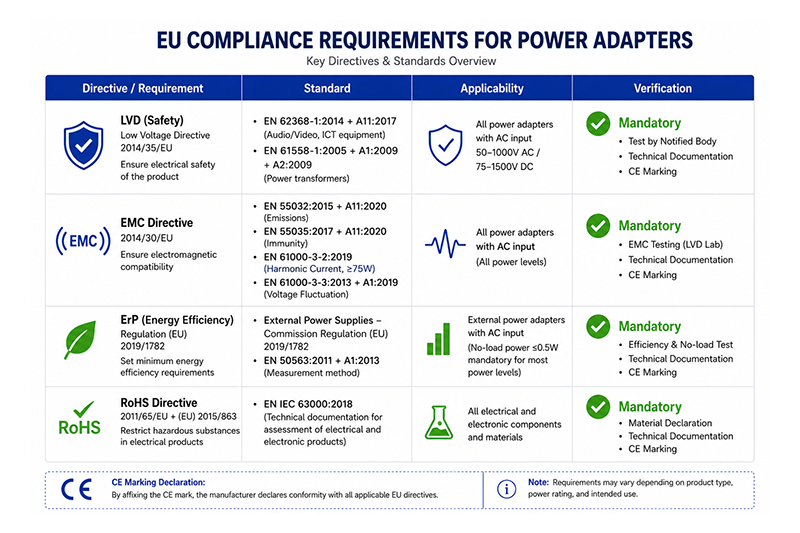
The European Union permits self-declaration of conformity under CE marking, but the manufacturer bears legal responsibility for compliance. Power adapters sold in the EU must meet multiple directives.
| Category | Standard / Regulation | Purpose |
|---|---|---|
| Safety | EN 62368-1 (LVD 2014/35/EU) | Safety for ICT and AV equipment |
| Medical Safety | EN 60601-1 | Medical electrical equipment |
| EMC Emissions | EN 55032 Class B | Electromagnetic emissions |
| EMC Immunity | EN 55035 | Immunity performance |
| Harmonic Current | EN 61000-3-2 | Harmonic current limits (≥75W input) |
| Voltage Fluctuation | EN 61000-3-3 | Flicker and voltage fluctuation |
| Energy Efficiency | ErP (EU) 2019/1782 | External power supply efficiency |
| Conformity Assessment | CE Self-Declaration | Technical File and Declaration of Conformity |
| Typical Timeline | 2–6 Weeks | Depends on testing approach |
Why This Matters
- CE marking is a legal requirement—placing non-compliant products on the EU market is a criminal offense in most member states.
- The ErP Directive efficiency levels (Level VI) must be verified, and the data must be entered into the EPREL database for products sold after March 2021.
- UKCA marking is required for Great Britain (England, Scotland, Wales) post-Brexit, with CE marking still accepted under transitional arrangements through July 2027.
What OEMs Should Do Now
- Confirm your power adapter supplier provides CE Declaration of Conformity with model-specific test reports from an accredited laboratory.
- Verify that the efficiency level is documented per EU 2019/1782 regulations, including average efficiency at four load points (25%, 50%, 75%, 100%) and no-load power consumption.
- For products sold in the UK, ask whether the supplier provides UKCA certification or only CE—UKCA requires testing to the British standard versions (BS EN).
Can I use a self-declaration CE mark without third-party testing?
Legally yes for non-medical adapters. However, most OEM buyers and EU market surveillance authorities expect an independent test report. Self-declaration without test data significantly increases regulatory risk.
Does CE marking cover all EU member states?
CE marking is accepted in all 27 EU member states plus Norway, Iceland, Liechtenstein, and Switzerland. Northern Ireland continues to accept CE marking. Great Britain requires UKCA or accepts CE through July 2027.
Useful Links
🇯🇵Japan — PSE Certification
Japan’s Electrical Appliance and Material Safety Law (DENAN) requires PSE certification for power adapters imported into or sold in Japan.
| Category | Requirement |
|---|---|
| Safety Standard | J 62368-1 (Japan, harmonized with IEC 62368-1) for general-purpose external power supplies. J 60601-1 applies to medical electrical equipment and medical-grade power adapters. |
| Regulatory Framework | Products are regulated under Japan’s Electrical Appliance and Material Safety Act (DENAN). The applicable conformity requirements depend on the product classification defined by the regulation. |
| PSE Marking | Depending on the product category, products require either the Diamond PSE Mark (Specified Electrical Appliances & Materials) or the Circular PSE Mark (Non-Specified Electrical Appliances & Materials). |
| EMC Requirement | VCCI compliance is voluntary but widely expected by Japanese OEMs, system integrators, and distributors for information technology and multimedia equipment. |
| Conformity Assessment | Products requiring Diamond PSE certification must be evaluated by a Registered Conformity Assessment Body (RCAB). Product testing, technical documentation, and factory assessment may be required depending on the applicable certification route. |
| Factory Inspection | Factory inspection and ongoing production conformity assessment may be required for products subject to the Diamond PSE scheme. |
| Typical Timeline | 4–9 weeks, including product evaluation, documentation review, certification, and factory assessment (where applicable). |
Engineering Notes
Product classification under DENAN determines whether the Diamond or Circular PSE Mark applies. Manufacturers should confirm the applicable category before starting product development or certification planning.
An existing IEC/CB Test Report may reduce duplicated safety testing during the PSE certification process, subject to acceptance by the selected certification body.
Why This Matters
- PSE is a legal requirement—importing uncertified adapters can result in seizure at customs and penalties.
- The factory inspection requirement means the manufacturer’s facility must meet Japanese regulatory quality standards.
- PSE certification must be maintained with periodic factory inspections—typically annual surveillance audits.
What OEMs Should Do Now
- Confirm that the adapter model has PSE diamond mark for specified products, not the circular mark which may not cover your product category.
- Request the PSE certificate and verify it includes the manufacturer’s Japanese agent or importer of record (required by law).
- For low-volume products, consider adapters with existing PSE certification to avoid 4-9 week delay.
Is PSE certification required if my product is exported with a power adapter included in the box?
Yes. If the power adapter is included with the product and enters Japan, it must have PSE certification. This applies even if the adapter is a standard accessory rather than an integral component.
Does the factory inspection apply to all PSE-certified products?
Yes. For diamond PSE (specified products), the factory must undergo initial and periodic inspections by the registered certification body. Circular PSE (non-specified products) does not require factory inspection.
Useful Links
→ Global Certifications Overviewe
→ Interchangeable Plug Adapters
📞 CTA Block — Need help determining the certification requirements for your target markets?
Contact our engineering team for guidance on certification availability and timelines.
- Request a Quote → — Submit your requirements for a detailed quotation
- Talk to an Engineer → — Discuss technical specs with our design team
🇰🇷South Korea — KC Certification
Korea’s KC (Korea Certification) mark is mandatory for power adapters sold in South Korea, covering both safety and EMC requirements under a single certification.
| Category | Requirement |
|---|---|
| Safety Standard | KC 62368-1 (Korean adoption of IEC 62368-1) for general-purpose external power supplies. Medical-grade power adapters are evaluated to the applicable Korean adoption of IEC 60601-1, where required. |
| EMC Standard | KN 32 (Electromagnetic Emissions) and KN 35 (Electromagnetic Immunity), harmonized with international CISPR standards for multimedia equipment. |
| Regulatory Framework | Products are regulated under the Korea Certification (KC) Scheme, administered by the Korean authorities. Compliance requirements vary depending on product category and applicable regulations. |
| Conformity Assessment | KC certification typically requires product safety and EMC evaluation through an accredited Korean certification body, such as KTC (Korea Testing Certification), KTL (Korea Testing Laboratory), or KTR (Korea Testing & Research Institute). Safety and EMC evaluations are commonly coordinated within a single certification project. |
| Factory Inspection | Factory assessment may be required depending on the applicable KC certification category, product type, and certification pathway. |
| Typical Timeline | 6–8 weeks for initial KC certification, including safety evaluation, EMC testing, documentation review, and certification processing. |
Engineering Notes
KC certification requirements vary according to product classification and applicable Korean regulations. Manufacturers should confirm the correct certification pathway during the product development stage.
Products supported by an existing IEC/CB Test Report may benefit from reduced duplicate safety testing, subject to acceptance by the selected Korean certification body.
Why This Matters
- KC certification is mandatory—products without KC mark cannot be imported, sold, or distributed in South Korea.
- Safety and EMC are submitted as a combined application, meaning both must pass simultaneously.
- The KC mark requires the manufacturer to maintain a Korean agent or branch office for regulatory compliance.
What OEMs Should Do Now
- Request KC certification documentation with the specific model number. Verify that both safety (K 62368-1) and EMC (KN 32/KN 35) are listed on the certificate.
- Confirm the supplier has a Korean agent arrangement—this is a legal requirement for KC certification.
- For multi-model families, confirm which models share the same internal construction to maximize family coverage.
Can KC certification be obtained using CB test reports?
Yes. KC certification accepts CB test reports as the basis, with national deviations for Korea tested as add-on items. This reduces testing time by approximately 4–6 weeks compared to a full retest.
Is the Korean agent requirement burdensome for small OEMs?
The Korean agent (importer of record) handles regulatory compliance, documentation, and recall responsibility. If your supplier already maintains a Korean agent for their own KC-certified products, you may be able to use their agent arrangement.
Useful Links
🇦🇺Australia and New Zealand — RCM Mark
The Regulatory Compliance Mark (RCM) is the single compliance mark for electrical and electronic products sold in Australia and New Zealand, covering both safety and EMC.
| Category | Requirement |
|---|---|
| Safety Standard | AS/NZS 62368.1:2026, the Australia/New Zealand adoption of IEC 62368-1:2023, applies to audio/video, information and communication technology equipment and associated external power supplies. |
| EMC Standard | AS/NZS CISPR 32 applies to electromagnetic emissions from multimedia equipment. Additional immunity testing may be specified by the customer, product application, or applicable contractual requirements, although the Australian EMC regulatory framework primarily focuses on emissions compliance. |
| Regulatory Framework | Products supplied in Australia and participating New Zealand jurisdictions may be subject to the Regulatory Compliance Mark (RCM) framework, incorporating electrical safety requirements under the Electrical Equipment Safety System (EESS) and applicable EMC requirements administered by the Australian Communications and Media Authority (ACMA). |
| RCM Marking | The RCM indicates that the supplier has completed the applicable conformity procedures and holds supporting compliance documentation. It is not, by itself, a third-party product certification. |
| Responsible Supplier | An Australian or New Zealand-based manufacturer or importer must act as the Responsible Supplier for in-scope electrical equipment and register on the EESS platform before supplying the product. (eess.gov.au) |
| Equipment Registration | Registration requirements depend on the EESS risk classification. Registration of Level 1 equipment is generally voluntary, while Level 2 and Level 3 equipment must be registered by the Responsible Supplier. (eess.gov.au) |
| Conformity Assessment | The supplier must maintain appropriate evidence of compliance, which may include accredited laboratory test reports, certificates of conformity, technical documentation and a signed Supplier’s Declaration of Conformity. Higher-risk equipment may require formal product certification. |
| Supplier Declaration | Before applying the compliance label, the supplier must complete and retain a Supplier’s Declaration of Conformity covering all applicable ACMA requirements. (ACMA) |
| Typical Timeline | Approximately 6–10 weeks for safety and EMC testing, technical documentation preparation and supplier or equipment registration. The actual duration depends on product classification, laboratory availability and whether an existing CB report can be accepted. |
Engineering Notes
The applicable EESS registration and certification pathway is determined by the product’s risk classification. Level 2 and Level 3 equipment require registration, while higher-risk products may also require a valid Certificate of Conformity.
An existing IEC 62368-1 CB Test Report may reduce duplicated testing, but Australian and New Zealand national differences must still be evaluated against the applicable AS/NZS standard.
The RCM must only be applied after the Australian or New Zealand Responsible Supplier has completed the relevant safety, EMC, documentation and registration obligations.
Why This Matters
- RCM is mandatory for both Australia and New Zealand—one mark covers both countries.
- Safety testing requires the product to be tested to the Australian standard, which may have local deviations from IEC 62368-1 regarding plug configuration and mains voltage (230V/50Hz for Australia).
- EESS registration is required per model and must be maintained (annual renewal for most categories).
What OEMs Should Do Now
- Confirm that RCM test data covers both safety and EMC in a single submission.
- Verify AS/NZS-specific deviation testing (Australian mains plug requirements, labeling, and 230V/50Hz operation).
- Ask the supplier whether they handle EESS registration or whether you must register as the importer of record.
Is the RCM mark accepted in New Zealand?
Yes. RCM is the joint compliance mark for Australia and New Zealand. A single RCM registration covers both jurisdictions.
Are there any power limits that affect RCM testing complexity?
Power adapters above 120W input may require additional testing for harmonic current limits. Adapters below 120W input typically follow a simplified EMC assessment.
Useful Links
🇮🇳India — BIS Certification
India’s Bureau of Indian Standards (BIS) requires mandatory certification for power adapters under the Compulsory Registration Scheme (CRS).
| Category | Requirement |
|---|---|
| Safety Standard | IS/IEC 62368-1:2023 is the current safety standard introduced under the BIS Compulsory Registration Scheme (CRS) for Audio/Video, Information and Communication Technology Equipment. During the transition period, IS 13252 (Part 1):2010 and IS 616:2017 continue to be accepted for applicable product categories until 1 November 2028, after which IS/IEC 62368-1:2023 will become the mandatory safety standard. (TÜV SÜD) |
| Regulatory Framework | Electronic and IT products covered by the Compulsory Registration Scheme (CRS) are regulated by the Bureau of Indian Standards (BIS) under the Ministry of Electronics and Information Technology (MeitY). |
| Certification Scheme | Products within the CRS scope must obtain BIS Registration before they can be legally manufactured, imported, or sold in the Indian market. |
| Conformity Assessment | Initial product testing must be performed by a BIS-recognized laboratory. Test reports issued solely by overseas laboratories are generally not accepted for an initial CRS application. Existing CB reports may support technical evaluation but do not replace mandatory BIS laboratory testing. (BIS) |
| Authorized Indian Representative (AIR) | Foreign manufacturers must appoint an Authorized Indian Representative (AIR) to submit and maintain BIS registrations when the manufacturer does not have a legal entity in India. |
| Factory Assessment | Factory inspection is generally not part of the standard BIS CRS registration process, although BIS reserves the right to conduct surveillance or verification activities where necessary. |
| Typical Timeline | 10–12 weeks for initial BIS CRS registration, including laboratory testing, documentation review, application processing, and registration approval. |
Engineering Notes
Manufacturers should design new products to comply with IS/IEC 62368-1:2023, as BIS has initiated the nationwide migration from IS 13252 (Part 1):2010 under the CRS framework. The transition period currently extends until 1 November 2028.
Foreign manufacturers exporting to India must appoint an Authorized Indian Representative (AIR) and obtain BIS CRS registration before regulated products can be placed on the Indian market.
Why This Matters
- BIS is mandatory—power adapters sold in India must carry the BIS Standard Mark under CRS.
- In-country testing requirement adds significant timeline and logistics cost—samples must be shipped to India and tested at a BIS-recognized lab.
- Harmonization with IEC 62368-1 is in progress but not complete—verify the current applicable standard with your BIS testing laboratory.
What OEMs Should Do Now
- Request BIS CRS registration certificate for the specific model number. Verify the certificate is valid and covers the intended output configuration.
- Factor 10–12 week lead time for BIS certification into product launch schedules. In-country testing is mandatory and BIS cannot be rushed—there is no expedited process.
- Confirm that the supplier’s BIS registration is registered to a legal entity in India (the manufacturer’s Indian representative or the importer).
Can I use a power adapter without BIS certification for prototypes or small-volume shipments?
Small quantities for Ru0026amp;D or testing purposes may qualify for exemption under BIS rules, but any product sold or distributed commercially in India must have BIS certification. Check with BIS for current exemption limits.
Does BIS certification require factory inspection?
For CRS, factory inspection is not mandatory for initial registration, but BIS reserves the right to audit. Some categories under the ISI mark scheme do require factory inspection.
🇨🇳China — CCC Certification
China’s CCC (China Compulsory Certification) mark is required for power adapters imported, sold, or used in electrical products distributed in China.
| Category | Requirement |
|---|---|
| Safety Standard | GB 4943.1-2022, China’s national safety standard for Audio/Video, Information and Communication Technology Equipment, harmonized with IEC 62368-1. This standard applies to most external power supplies and power adapters within its scope. |
| EMC Standards | GB/T 9254.1 (Electromagnetic Emissions), GB/T 9254.2 (Electromagnetic Immunity), and GB 17625.1 (Harmonic Current Emissions), where applicable. |
| Regulatory Framework | Products within the applicable scope are regulated under the China Compulsory Certification (CCC) scheme administered by the Certification and Accreditation Administration of China (CNCA). |
| Certification Scheme | Products subject to CCC requirements must obtain CCC Certification before they can be manufactured, imported, sold, or used commercially in China. |
| Conformity Assessment | Certification includes product testing at a designated Chinese laboratory, technical documentation review, and certification by an authorized certification body such as CQC (China Quality Certification Centre) or CCAP, depending on the applicable product category. |
| Factory Inspection | Initial factory inspection is generally required before certification approval. Certified manufacturers are subject to periodic surveillance and follow-up factory inspections to maintain certification validity. |
| Typical Timeline | 4–6 weeks for initial CCC certification, including product testing, documentation review, factory inspection, and certification approval. |
Engineering Notes
Manufacturers should determine whether their products fall within the mandatory CCC catalogue before entering the Chinese market, as not all external power adapters require CCC certification.
An existing IEC/CB Test Report may support portions of the technical evaluation, but it does not replace the mandatory product testing and certification procedures required under the CCC scheme.
CCC certification normally includes ongoing surveillance activities to verify continued compliance with approved product specifications and manufacturing processes.
Why This Matters
- CCC is mandatory—no exemption for low-volume or low-power products. Products without CCC are subject to seizure at customs.
- Factory inspection is a significant commitment: inspectors visit the manufacturer’s facility to audit production lines, quality systems, and test equipment.
- CCC certification is tied to the factory location—manufacturing at a different facility requires recertification.
What OEMs Should Do Now
- Verify that the power adapter model has active CCC certification. CCC certificates have a 5-year validity period and require annual surveillance audits.
- Confirm that the CCC certification covers the specific model and factory location where the adapter is manufactured.
- Ask whether the supplier holds CQC’s “Type Approval” or “CCC Factory Certificate” — these indicate the manufacturer has passed CCC’s qualification audit.
Can CCC certification be obtained from a CB test report?
Yes. CCC accepts CB test reports as the basis, with national deviations for China (GB standards) tested as add-ons. However, the factory inspection cannot be waived—it is a mandatory requirement.
How often is the CCC factory inspection conducted?
Annually. CQC or its delegate will conduct a factory surveillance audit each year to verify continued compliance with CCC production requirements.
CONCLUSION
Global power adapter certification is a complex but navigable landscape when approached systematically. Each market has its own applicable safety standard, EMC requirements, certification body, timeline, and cost structure. CB certification provides a foundation for many markets, but national deviations, in-country testing, and factory inspection requirements add country-specific complexity.
OEMs distributing products globally should prioritize adapter suppliers who maintain certifications across multiple markets and provide model-specific documentation for each certification held. YHYadapter maintains UL, CE, FCC, PSE, KC, RCM, BIS, and CCC certifications available by model across the desktop adapter, wall plug, and medical adapter product lines.
FAQ
Testing per representative model with careful family definition can cover multiple models.
Legally yes for non-medical, but significantly increases regulatory risk.
Yes, for PSE diamond (specified products) — initial and annual surveillance audits.
Yes, CCC accepts CB test reports with GB standard deviation add-ons.
Related certification pages: Certifications hub · UL 62368-1 · UL 1310 (Class 2) · IEC 60601-1 · IEC/EN 61347 · KC · BIS · PSE
Related Resources
Understanding Medical & Aesthetic Power Supply Certifications: IEC 60601-1 Guide
Certification Guide